Get Full Government Meeting Transcripts, Videos, & Alerts Forever!
Get email alerts on the Student Surveys topic
No spam. Unsubscribe anytime.
Senate panel weighs bill requiring parental opt‑in for K‑12 student surveys
Summary
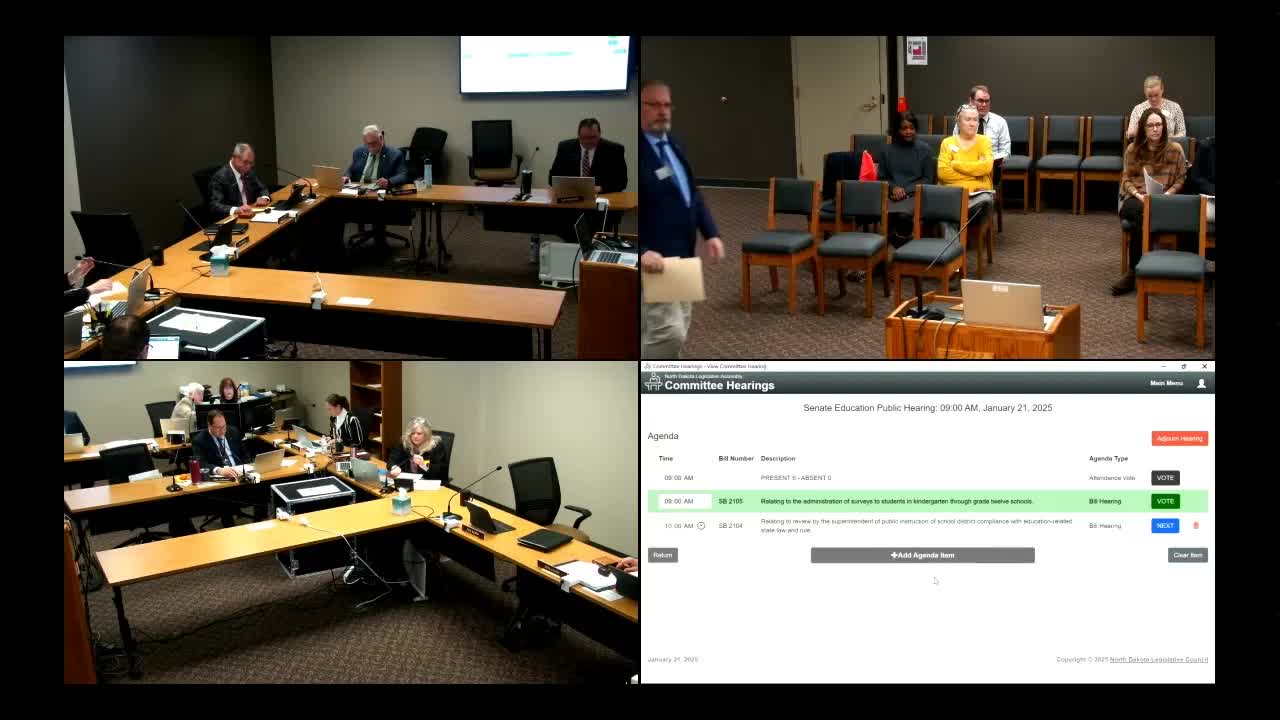
Senate Bill 2105, introduced by Senator Todd Beard, would require written parental authorization before a K‑12 student may complete most third‑party surveys; the Senate Education Committee heard testimony and took no vote.
Senate Bill 2105, introduced by Senator Todd Beard, would require written parental authorization before a student in kindergarten through 12th grade may complete a survey about themselves that is administered by anyone other than a school or the Department of Public Instruction. The Senate Education Committee heard public testimony and closed the hearing without taking a committee vote.
The measure defines “survey” as a written document that obtains information about a student from the student and excludes surveys given for educational or extracurricular purposes and those administered by a licensed teacher or administrator. Beard, a senator from District 23, told the committee the bill is “meant to ensure parents have the opportunity to review a survey their child is asked to fill out” and cited the federal Protection of Pupil Rights Amendment as a guiding example. “Parents are the ones who should decide if their children should participate in a survey. No third party has a right to their information,” Beard said.
Proponents described current third‑party data collection as intrusive and hard for parents to track. Kimberly Hurst, who said she is a resident of District 1 and a mother of four, told the committee she was “absolutely unaware” her children had received certain state and third‑party surveys and read sample Youth Risk Behavior Survey questions she found objectionable. Testimony from Williston educator and parent Karen Krenz raised concerns about data‑mining, named the Panorama survey platform, and described a prior incident in which Panorama emailed district students directly.
Opponents and neutral witnesses warned the bill would interfere with long‑standing public‑health and educational data collection and create large administrative burdens for districts. Dr. Amy Kopas, executive director of the North Dakota Council of Educational Leaders, said districts rely on vendor‑provided surveys (for example, Cognia tools) that are used to meet ESSA and other accountability needs and that an opt‑in requirement would be “untenable at the local level” and likely reduce data quality. Dr. Tracy Miller, state epidemiologist at the Department of Health and Human Services, said the bill as written would prevent HHS from collecting the Youth Risk Behavior Survey and Youth Tobacco Survey and would “result in a loss of data used by a variety of agencies” for program planning, grants, outbreak follow‑up and policy decisions.
Committee members questioned how the bill would interact with existing opt‑out practices, whether school districts purchasing survey tools from vendors would be covered, and who would determine whether a given instrument is educational or asks “personal” information. Beard said the bill leaves initial determinations to the school and that parents could raise issues with the district if they believed the law had been bypassed. Several members urged clearer language addressing required public‑health and ESSA‑linked instruments and administrative feasibility.
The committee recessed at the conclusion of testimony and did not vote on SB 2105 at the hearing.
What’s next: Committee staff and members may pursue clarifying amendments to distinguish federally required or district‑procured instruments from third‑party research and to address implementation mechanics for large districts.