Get Full Government Meeting Transcripts, Videos, & Alerts Forever!
Get email alerts on the Criminal Justice Sentencing topic
No spam. Unsubscribe anytime.
Attorney general’s office backs 'truth in sentencing' bill; researcher warns mandatory minimums have costs and limited crime effect
Summary
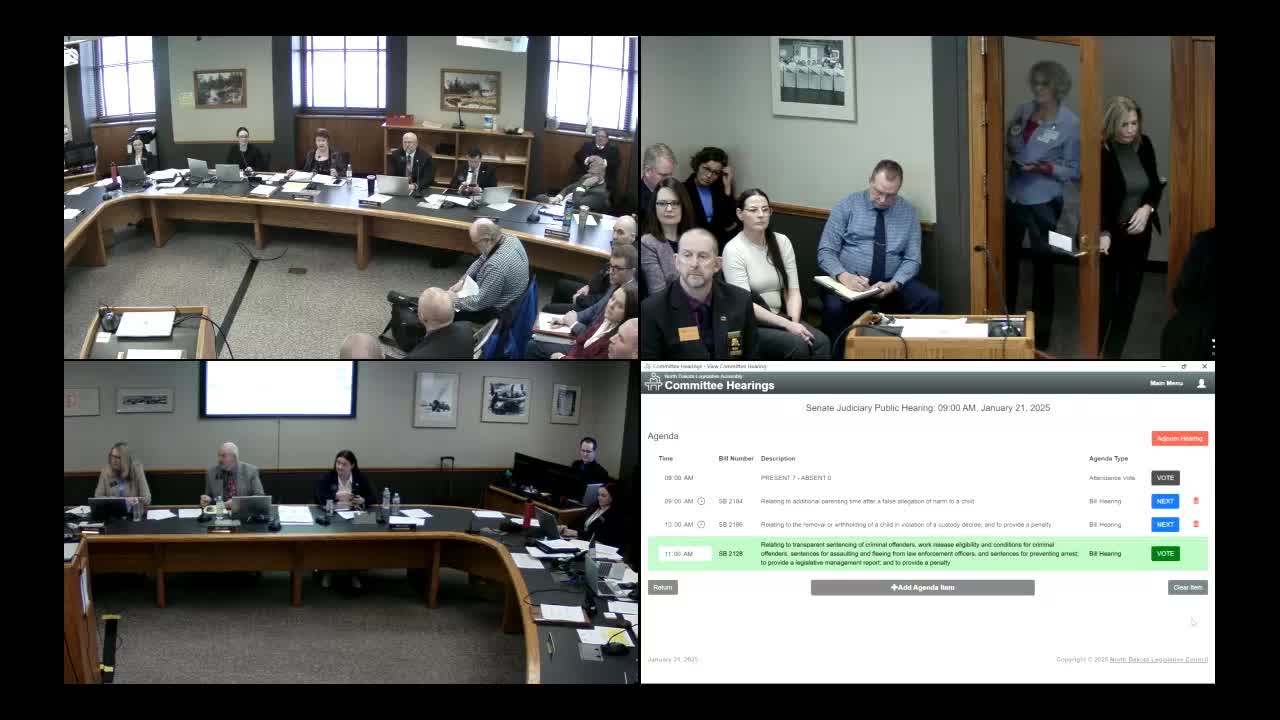
The attorney general’s office told the Senate Judiciary Committee that Senate Bill 2128 would increase transparency and set minimum percentages of sentences to be served in secure custody; a criminal-justice researcher said studies show mandatory minimums do not reliably reduce crime and can raise costs and prison safety risks.
The Senate Judiciary Committee heard detailed testimony on Senate Bill 2128, a comprehensive proposal the attorney general’s office described as a “truth in sentencing” package covering work‑release eligibility, definitions for transitional facilities, good‑time and meritorious‑conduct reforms, and new mandatory minimum elements for some crimes.
Claire Ness, chief deputy attorney general, presented the bill’s sections and an amendment prepared by the attorney general’s office. She told the committee the bill would (1) define transitional facilities and require objective assessments before transferring prisoners to dorm‑style, community‑facing programs; (2) require quarterly reporting to the attorney general and legislative counsel about eligible offenders in release programs; (3) require that “good time” be earned by satisfactory monthly performance (capped at 15% of a sentence) rather than routinely awarded up front; (4) reduce meritorious‑conduct reductions from two days per month to one day per month; and (5) add penalties and consecutive sentences for assaults on officers and felony fleeing cases, among other provisions.
Ness said the bill aims to restore public understanding of what “time served” means by excluding unsecured transitional‑facility days from time‑served calculations and by making parole and release decisions more transparent. Her office cited examples in which DOCR (the Department of Corrections and Rehabilitation) practice appeared to credit significant portions of sentences to non‑secure transitional programs, which the attorney general said can inflate reported “time served.” The bill would also require objective assessments that an offender is not a high security risk before participation in work‑release or transitional programs and would bar stacking multiple short leaves to create extended community absence.
Dennis Ingold, a senior assistant state's attorney, supported the bill and told the committee about individual cases in which defendants spent only a few weeks in secure custody before being transferred to transitional programs and credited with substantial amounts of time served. He said those practices can create situations in which out‑of‑state traffickers or repeat dealers spend a small fraction of their sentences behind bars.
Law‑enforcement voices and prosecutors urged stronger deterrence for assaults on officers and for felony fleeing. Deputy Chief Jason Stugelmeyer said assaults and vehicle fleeing have risen and argued for increased penalties to provide deterrence and protect officers.
By contrast, Dr. Andrew Meyer, a criminal‑justice researcher testifying neutrally, summarized published empirical research showing that mandatory‑minimum laws and truth‑in‑sentencing reforms do not consistently reduce crime, impose large additional fiscal costs, and can increase safety problems in prisons. Meyer told senators that increasing severity alone is a poor substitute for the certainty and swiftness needed for deterrence; he cautioned that longer sentences and reduced parole discretion can raise institutional violence and increase costs without commensurate crime reductions.
Committee members asked for data about how much time offenders currently spend in transitional facilities, how DOCR calculates time served and good time, and for an analysis of fiscal impacts. Ness said DOCR had reported that existing meritorious‑conduct changes could carry a cost estimate to the state. The committee recessed the hearing with plans for additional testimony and follow‑up on data, fiscal estimates and draft language clarifications.