Get Full Government Meeting Transcripts, Videos, & Alerts Forever!
Get email alerts on the Family Law Parenting topic
No spam. Unsubscribe anytime.
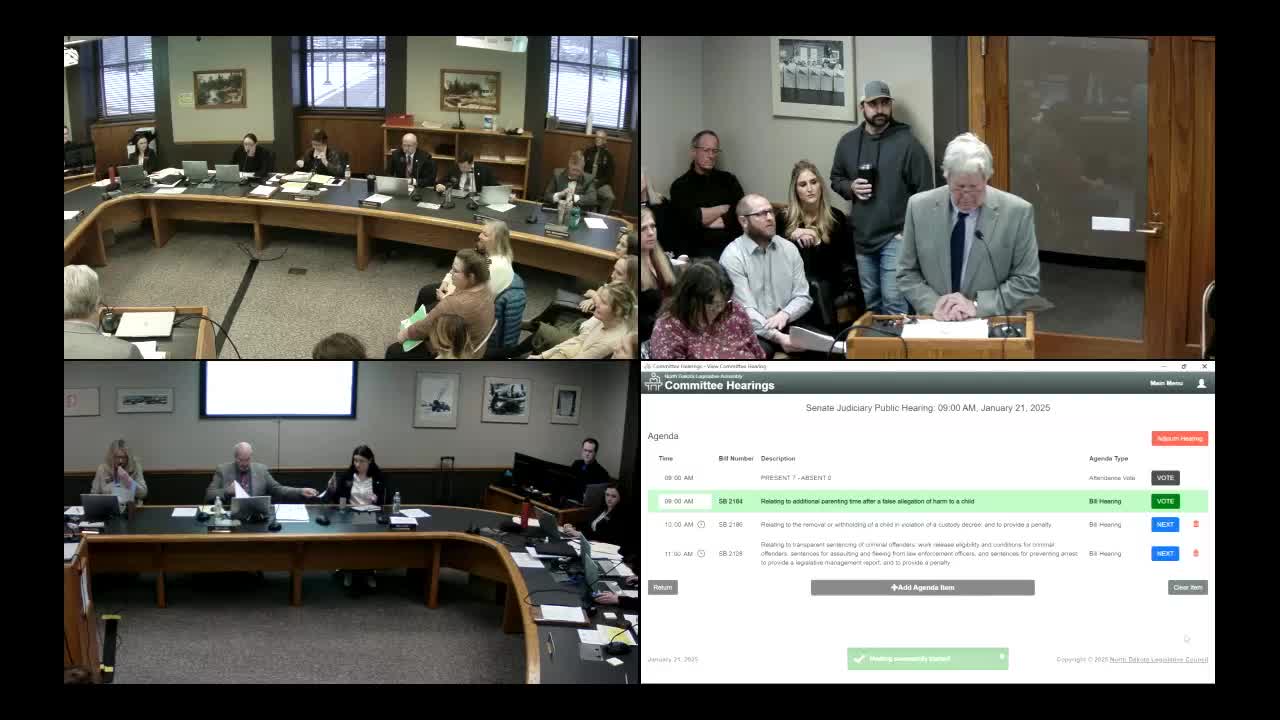
Senate Judiciary hears bill to restore parenting time when abuse allegations prove false
Summary
Supporters told the Senate Judiciary Committee that Senate Bill 2184 would restore parenting time lost during investigations they say are often unfounded; opponents and child-welfare officials warned the proposal could punish victims and be weaponized without clearer definitions and safeguards.
At a Senate Judiciary Committee hearing, members heard testimony on Senate Bill 2184, which would require a court to award additional parenting time to a parent when an allegation of harm, abuse or neglect against them is later found false.
Supporters said the bill—described by witnesses as a remedy for “parental alienation”—would restore time they say is lost to long investigations and would reduce incentives to make false reports. Todd Peterson of West Fargo testified that the bill would “restore” parenting time taken during investigations and said the change would not penalize people who report concerns; rather, he said, it would remove incentives to misuse complaints. Kelly Craft, Crystal Magnuson and other parents and advocates described long, painful separations from children after allegations they said were later found unfounded.
Those testifying in support framed the proposal as a child-welfare measure. Cora Doctor of the North Dakota Suicide Prevention Coalition said researchers find that children fare better when both parents remain meaningfully involved and that parental alienation increases risks to children’s mental health. Robert Garza, who testified later on related bills, said the approach has been adopted in Texas and called it a tool to prevent long-term family disruption.
Opponents and child-welfare officials urged caution. Hallie Peterson, who described herself as surviving abuse, told senators she feared the bill would force children to spend more time with a parent they ran to escape. Lindsay Peterson said victims often lack the evidence courts require, and that the bill’s language—particularly its reference to findings from “an investigation by any person”—could be misapplied. Kim Jacobson, director for a local human services zone and president of the North Dakota Human Service Zone Directors Association, said existing North Dakota law already permits reporting by any person and includes penalties for willfully false reports; she told the committee that 5%–7% of child-protection assessments in the state result in a confirmed finding and that an unconfirmed assessment is not the same as a false report.
Committee members repeatedly asked witnesses what “good cause” would mean in practice and whether the bill should narrowly point to CPS (child protective services) investigations rather than “any person.” Peterson, a supporter, said he expected the finding of falsity to rest on a preponderance of evidence and a judge’s discretion; witnesses advising caution said that burden and the investigative processes need clearer statutory language.
No formal action was taken; the committee closed the hearing on SB 2184 and moved on to other bills.
Questions raised before the committee included who would make or review determinations of falsity, how “good cause” should be defined, whether the bill would discourage victims from reporting, and how the bill would interact with existing criminal penalties for knowingly making false reports. Several witnesses urged changes to clarify that the bill applies only when a court or authorized child-welfare investigation finds an allegation false and cautioned against letting unqualified or informal investigations determine parenting-time adjustments.
Committee members did not vote on SB 2184 during the hearing. The record includes detailed testimony both for and against the bill and multiple requests from senators for narrower statutory definitions and assurance about how the bill would work with existing child-welfare law.