Get Full Government Meeting Transcripts, Videos, & Alerts Forever!
Health response section warns rising complaints, stagnant federal funding strain licensing and surveys
Summary
Department of Health and Human Services staff told the Appropriations committee that federal grant stagnation, rising complaint volumes and pandemic-era temporary staff funding winding down are stretching licensure, survey and emergency-response work across EMS, life-safety construction, food and lodging and health facilities.
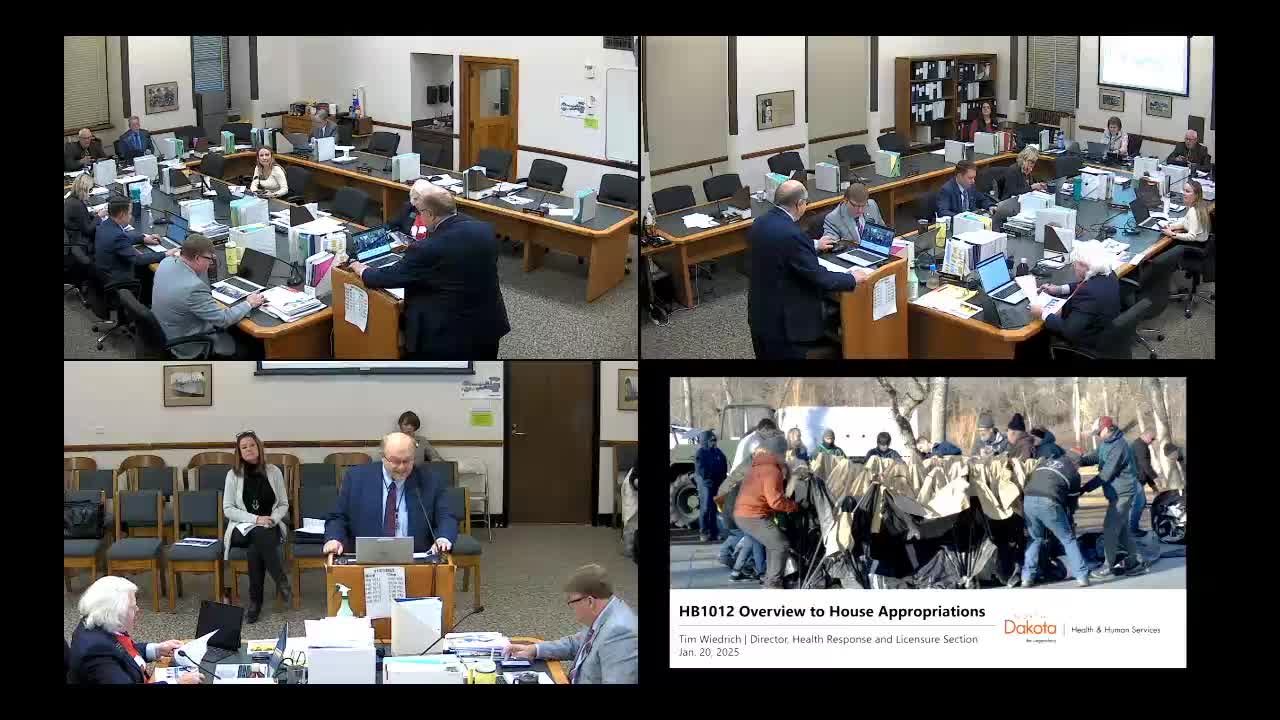
Tim Widdick, director of the Health Response and Licensure section of the North Dakota Department of Health and Human Services, told the House Appropriations subcommittee that the section’s five units — emergency medical services (EMS), emergency preparedness response, food and lodging, life safety and construction, and health facilities — are under growing strain as federal funding has not kept pace with rising demand.
Widdick said the section has 73 full‑time employees, six full‑time temporaries and about 30 part‑time temporaries; many of the part‑time positions are remnants of COVID crisis workforce grants that will expire June 30. He told lawmakers the department will not ask the Legislature to convert the remaining temporary positions to state FTEs.
The department emphasized two interlocking problems: rising operational demand and constrained funding. Widdick said federal funding that supports much of the section has been stagnant — CMS survey funding was last increased in 2015 and CDC emergency‑preparedness funding last changed in 2019 — and inflation has reduced purchasing power. Meanwhile, workload has climbed: the section projects nearly 8,000 inspections for the biennium, roughly 820 plan reviews, more than 27,000 licensed people and about 7,960 inspections (projected). Health facilities survey work has been particularly affected, he said, because federal survey duties must be performed within CMS timeframes and these urgent surveys are crowding out routine state inspections.
Why it matters
Widdick told the committee that complaint volumes and required federal reporting have surged and that staffing levels cannot keep pace. He said basic‑care facility routine oversight has become complaint‑driven; with current resources, routine cycles could not be…
Already have an account? Log in
Subscribe to keep reading
Unlock the rest of this article — and every article on Citizen Portal.
- Unlimited articles
- AI-powered breakdowns of topics, speakers, decisions, and budgets
- Instant alerts when your location has a new meeting
- Follow topics and more locations
- 1,000 AI Insights / month, plus AI Chat