Get Full Government Meeting Transcripts, Videos, & Alerts Forever!
Get email alerts on the Health Response Licensure topic
No spam. Unsubscribe anytime.
Health response section warns rising complaints, stagnant federal funding strain licensing and surveys
Summary
Department of Health and Human Services staff told the Appropriations committee that federal grant stagnation, rising complaint volumes and pandemic-era temporary staff funding winding down are stretching licensure, survey and emergency-response work across EMS, life-safety construction, food and lodging and health facilities.
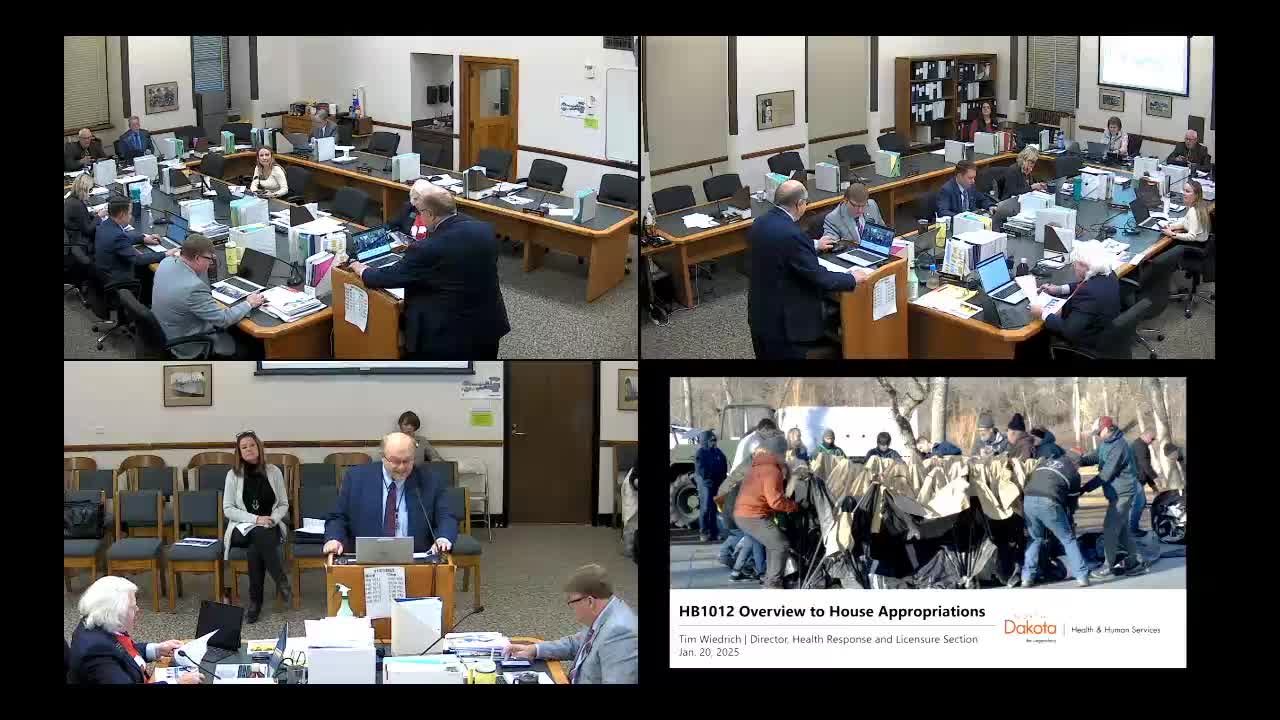
Tim Widdick, director of the Health Response and Licensure section of the North Dakota Department of Health and Human Services, told the House Appropriations subcommittee that the section’s five units — emergency medical services (EMS), emergency preparedness response, food and lodging, life safety and construction, and health facilities — are under growing strain as federal funding has not kept pace with rising demand.
Widdick said the section has 73 full‑time employees, six full‑time temporaries and about 30 part‑time temporaries; many of the part‑time positions are remnants of COVID crisis workforce grants that will expire June 30. He told lawmakers the department will not ask the Legislature to convert the remaining temporary positions to state FTEs.
The department emphasized two interlocking problems: rising operational demand and constrained funding. Widdick said federal funding that supports much of the section has been stagnant — CMS survey funding was last increased in 2015 and CDC emergency‑preparedness funding last changed in 2019 — and inflation has reduced purchasing power. Meanwhile, workload has climbed: the section projects nearly 8,000 inspections for the biennium, roughly 820 plan reviews, more than 27,000 licensed people and about 7,960 inspections (projected). Health facilities survey work has been particularly affected, he said, because federal survey duties must be performed within CMS timeframes and these urgent surveys are crowding out routine state inspections.
Why it matters
Widdick told the committee that complaint volumes and required federal reporting have surged and that staffing levels cannot keep pace. He said basic‑care facility routine oversight has become complaint‑driven; with current resources, routine cycles could not be completed for decades. He warned that inability to perform routine, unannounced inspections leaves gaps in oversight of facilities that serve frail or medically fragile residents.
Key facts and figures
- Section staffing: 73 FTEs, 6 full‑time temporaries, 30 part‑time temporaries (many funded by expiring COVID grants). - Medical responses in current biennium: 378 incidents (examples include gap staffing and facility hardening such as temporary heating). - Medical Reserve Corps: roughly 1,600 volunteers available for emergency missions. - State medical cache: inventory of durable medical equipment, pharmaceuticals and supplies valued at about $29 million (replacement cost); Widdick said North Dakota held about 1.9 million N95 masks during COVID and is targeting ~3.4 million going forward. - Licensing and enforcement: roughly 27,000 licensees; 771 complaints handled so far this biennium; projected 7,960 inspections and 820 plan reviews. - Health facilities: 523 complaints and 522 onsite surveys through Dec. 31 (biennium to date); 28 survey staff (excluding administrative staff) responsible for these visits.
Food and lodging fees and enforcement
Julie Wagendorf, director of Food and Lodging, told the committee the last statewide fee increase was 2012 and state license fees do not cover the program’s full costs; the general fund subsidizes the work. She gave examples: annual restaurant license fees start at $110 plus 50¢ per seat (with an overall cap referenced in administrative rule), grocery fees are square‑footage based and lodging is room‑based. Wagendorf said larger local public health units (for example, Fargo, Grand Forks) routinely charge substantially higher local fees; local boards and commissions may increase fees locally.
Wagendorf and Widdick said the department receives regular resistance from industry when fees are proposed and that a regional comparison of license schedules (Montana, South Dakota, Minnesota) would be prepared for the committee.
IT systems and licensure management
The department described two decision packages to replace aging information systems. Wagendorf said the current food and lodging inspection software is an off‑the‑shelf product more than a decade old and will be sunsetting; replacement would improve electronic inspection workflows and scheduling. The licensure management system used by EMS and health facilities is also aged and increasingly expensive to maintain; staff said repeated hard‑coding and vendor limits make it costly and inefficient. The department identified the Community Health Trust Fund as the intended funding source for both replacements.
Medical cache, preparedness and partnerships
Widdick emphasized the public‑private planning that built the state’s preparedness capacity after 2001, noting partnerships with hospitals, long‑term‑care providers and private sector partners. He described the state medical cache and logistics for federal allocations such as monoclonal antibodies and vaccines, and said the system aims to equitably allocate federal supplies statewide. Widdick described recent missions that prevented evacuations by hardening facilities and providing heating or other emergency measures.
Workforce and temporary staff
Committee members asked about the 29 PRN nurses funded by expiring COVID monies. Widdick and Julie Sickler (Emergency Preparedness Response director) said the PRN nurses are used intermittently — roughly eight missions per month, often for a day at a time — to fill gap staffing needs at facilities. The department said it encourages those PRN staff to take permanent facility employment if offered and does not intend to compete with long‑term employers for staff. Lawmakers expressed concern that crisis‑funded positions can draw from the local labor pool; department leaders said the PRN roles existed before COVID and serve a continuing emergency response purpose.
Health facilities complaints and triage
Widdick told the committee the combination of rising complaint volumes and CMS timeframes for “immediate jeopardy” responses means staff must prioritize high‑risk events. He said that triggers rapid on‑site responses that can suspend routine inspection cycles; as a result, routine oversight of some basic‑care facilities has been deferred. Committee members pressed for more detail about the geographic distribution of complaints and which facilities repeatedly produced high‑severity complaints; Widdick said about 121 facilities had been involved in complaints and that some programs within CMS have special focus processes that can require intensified oversight.
What the department asked for and next steps
The testimony focused on informational needs and decision packages for information systems, management of expiring temporary staff, and budget adjustments (including a correction moving $1.5 million between salary and IT lines). The department committed to provide additional information requested by the committee, including regional complaint counts, fee comparisons with neighboring states, utilization counts for PRN nurses, and more detailed reconciliation of federal and state funding lines.
Ending
Widdick told lawmakers the section’s work is a mixture of regulatory and consultative roles and said staff will return follow‑up answers to detailed questions. Committee members thanked the witnesses and recessed before the next agenda item.