Get Full Government Meeting Transcripts, Videos, & Alerts Forever!
Get email alerts on the Concurrent Jurisdiction Military topic
No spam. Unsubscribe anytime.
Committee backs bill enabling state to accept concurrent juvenile jurisdiction on military installations
Summary
House Bill 1033 would allow North Dakota and the federal government to agree that the state handle juvenile offenses occurring on military property. Defense and military officials urged the change as permissive, modeled on neighboring states; the committee voted to recommend the bill.
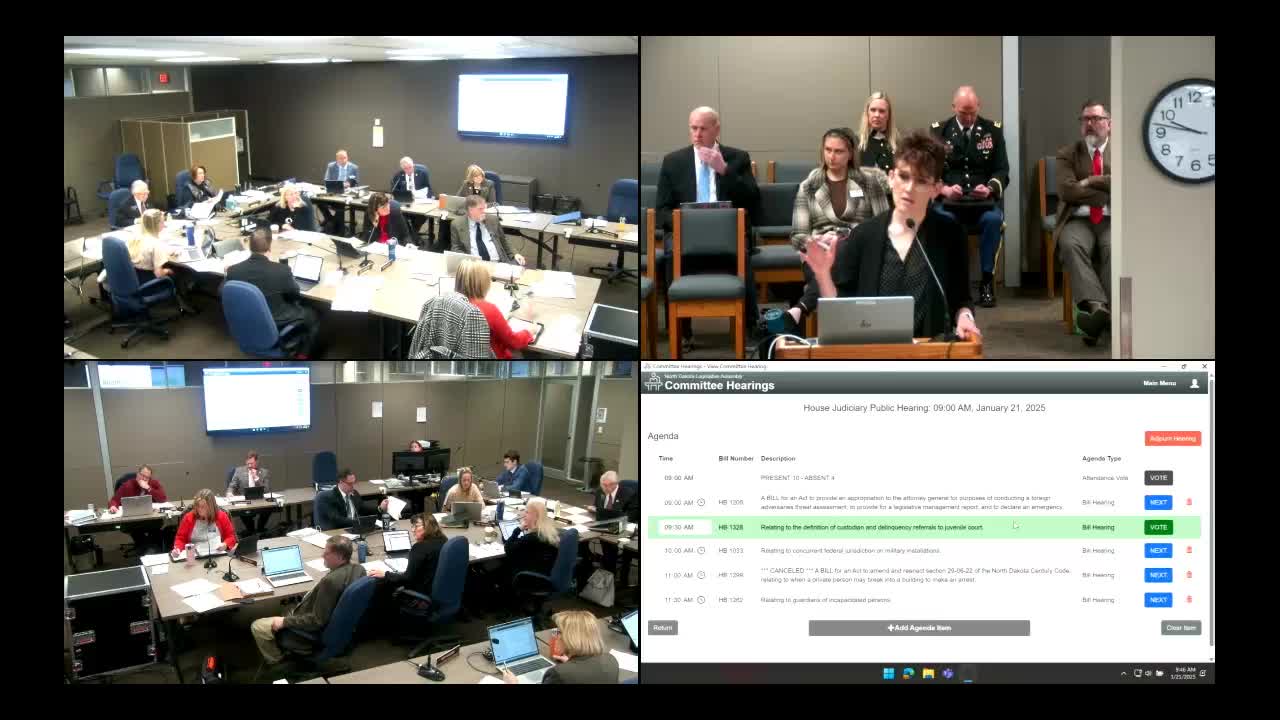
The House Judiciary Committee recommended a do-pass on House Bill 1033, an enabling measure that would allow the State of North Dakota and the federal government to enter a retrocession agreement so the state could handle juvenile offenses that occur on military installations.
Why it matters: Federal lands that are under exclusive federal jurisdiction can create gaps in juvenile-adjudication options. The bill would create a process by which a military installation and the state can agree — via a memorandum of understanding — that juvenile cases may be handled in state juvenile court when both parties concur.
Representative Lawrence Clamine presented the bill and said it was modeled on Colorado law. Michelle Richards, Midwest regional liaison for the Defense State Liaison Office, told the committee the measure is permissive and would not automatically change jurisdiction but would enable negotiations between installations and the state. Richards said, “This bill does not automatically confer concurrent jurisdiction, but rather, it makes it permissive.” She added the Department of Defense supports the change as a way to ensure juveniles on federal property are not left without an effective adjudicative path.
Lieutenant Colonel Jay Sheldon of the North Dakota Military Commission said the Military Commission supports the bill; he said several communities with major installations worked on the item and recommended the change. Richards noted neighboring states recently adopted similar laws and that most military lands in North Dakota already report proprietary jurisdiction; the bill addresses remaining pockets of exclusive federal jurisdiction, including some buildings at Minot Air Force Base and former federal property such as Fort Lincoln.
Outcome: Representative Schneider moved a do-pass recommendation, seconded by Representative Carls. A roll call recorded a committee recommendation to pass on a vote recorded as 10 yes, 0 no, with 4 members absent. Representative Twite was named as the bill carrier.
Ending: The committee closed the hearing and referred the bill with a do-pass recommendation to the next steps in the legislative process.