Get Full Government Meeting Transcripts, Videos, & Alerts Forever!
Get email alerts on the Juvenile Justice Chins topic
No spam. Unsubscribe anytime.
Schools seek ability to refer more ungovernable behavior to CHINS; advocates and human-service directors warn against changing “custodian” definition
Summary
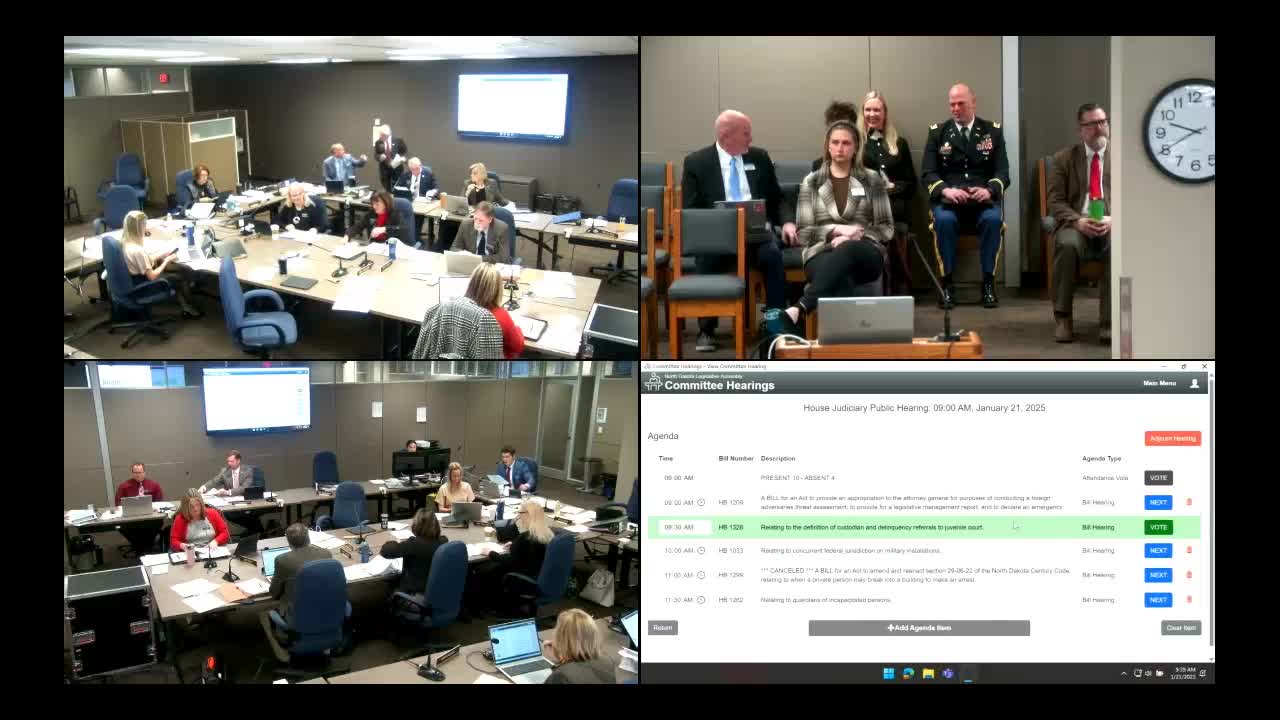
The House Judiciary Committee heard testimony on House Bill 1328, which would change who can refer certain ungovernable student behavior to CHINS and allow CHINS to refer some cases to juvenile court.
The House Judiciary Committee heard testimony on House Bill 1328, which would alter the juvenile statutes to expand which behaviors schools can refer to the Child in Need of Services (CHINS) process and would allow CHINS to refer certain matters directly to juvenile court.
Why it matters: School leaders described a gap for students who repeatedly refuse voluntary services and disrupt school; they said the bill would add “teeth” to compel family engagement. Human-service zone directors and disability advocates countered the proposed change to the legal definition of “custodian” could carry unintended legal powers and would increase CHINS caseloads without additional funding.
Dr. Carly Reederath, assistant superintendent for Mandan Public Schools, told the committee her district uses day-treatment programs, family liaisons, and other supports but still encounters students and families who “just refuse to engage.” She said those cases “lead to ongoing disruption in school and the community” and argued HB1328 would let schools refer some disrespectful or disruptive behavior earlier to CHINS and, in some cases, allow CHINS to refer matters to juvenile court to secure participation in interventions.
Supporters including the North Dakota Council of Educational Leaders said the bill is intended as a narrow tool after school-based interventions are exhausted. Amy Kopas, executive director of the Council, told the committee the sponsors and education groups had worked on language and viewed the proposal as a step to get help for students while preserving local effort and due process.
Opponents, including Brad Peterson, legal director at Protection & Advocacy, said they oppose the bill because of language on line 9 that would allow schools to assume the role described by the statutory term “custodian.” Peterson said the bill “is interfering with the ability to parent” and warned that the word custody carries significant legal consequences; he urged the committee to avoid a change that would give schools the legal powers associated with statutory custodianship, such as consent authorities used elsewhere in the juvenile code.
Lynn Fleeth, director of the RSR human-service zone that operates the statewide CHINS unit, said CHINS staffing is limited — the CHINS unit has eight specialists covering the state — and expected referrals would increase if schools could make broader CHINS referrals. Fleeth provided unit data showing 2,491 CHINS referrals in the first year of operation and 2,117 referrals in 2024 and said zones would need additional staff to absorb new volume.
Several lawmakers suggested narrower drafting changes — for example, allowing schools to refer to CHINS without changing every statutory use of “custodian,” or adjusting the CHINS petition definition — rather than making schools statutory custodians. Brad Peterson and other witnesses said they would submit written amendment suggestions to the committee.
Outcome: The hearing closed with no committee vote. Sponsors and stakeholders indicated willingness to negotiate drafting changes and possible amendments that would let schools refer specific behaviors to CHINS without creating broad custodial powers.
Ending: Lawmakers asked parties to provide written amendment language. Committee staff and witnesses noted that any expansion of referrals would likely require additional CHINS staffing and clarified the difference between CHINS referrals and juvenile-court filings.