Get Full Government Meeting Transcripts, Videos, & Alerts Forever!
Get email alerts on the Foreign Adversary Threats topic
No spam. Unsubscribe anytime.
House panel hears proposal to task state agencies with foreign-adversary threat assessment, not unanimous on funding or disclosure
Summary
A bill to authorize a state threat assessment of foreign adversary risks drew neutral support from the governor's office and state emergency officials, who said existing agencies can do the work but urged changes to funding and reporting language to protect sensitive information.
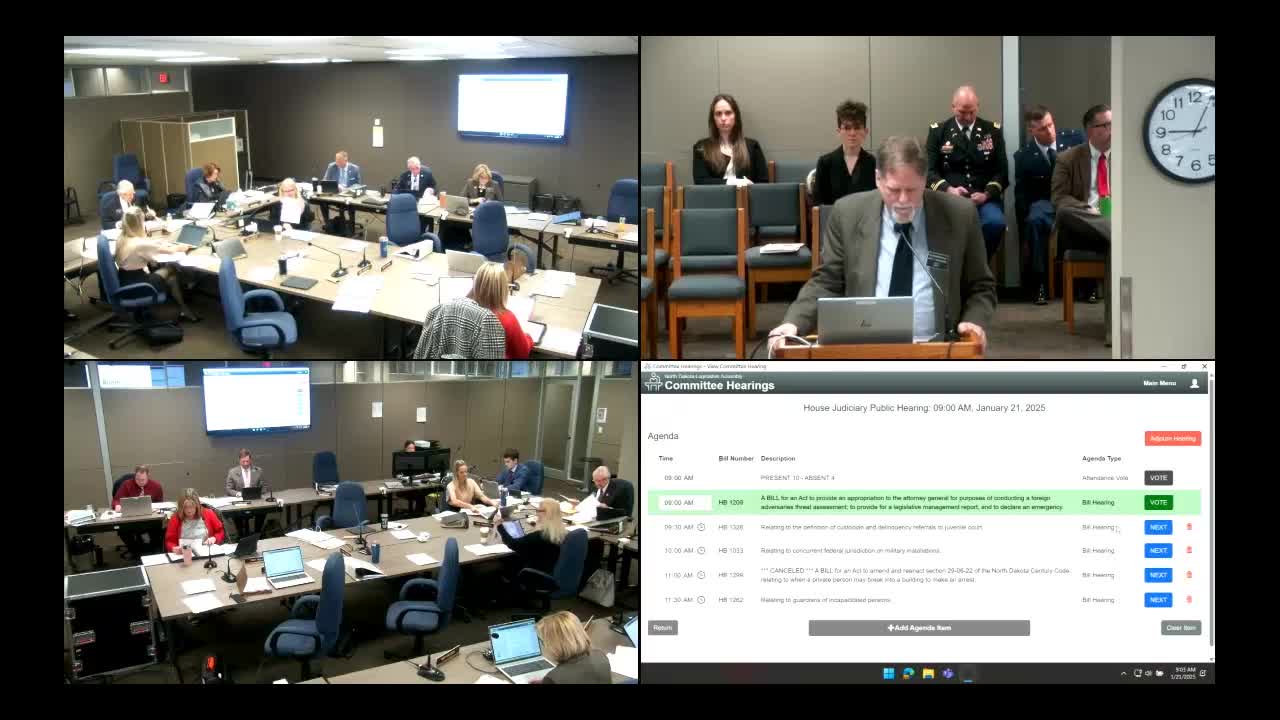
The House Judiciary Committee opened a hearing on House Bill 1209, which would authorize a threat assessment of “foreign adversary” risks and create a legislative reporting requirement. Representative Jeff Hoverson, filling in for Representative Olson, described the bill as an effort to determine how state government could identify and respond to risks from foreign adversaries and said the measure had been revised down from an earlier, larger appropriation.
Why it matters: Lawmakers said they want a state-level review to identify vulnerabilities and to determine whether legislative or operational changes are needed. Committee members pressed whether the work requires outside consultants or can be completed using state resources.
Representative Hoverson (legislator, filling in for Representative Olson) told the panel the bill’s appropriation had been reduced in the most recent amendment from “over $3,000,000” to $500,000 and described the measure as a way to bring expertise to bear on issues such as ownership and infiltration concerns he and colleagues had studied in interim work. He said the bill would require “a written report on July of 2026.”
Mister Dorman of the governor’s office (neutral testimony) told the committee the bill is “distinct” from a related proposal and recommended doing an assessment first before asking agencies to stand up a program. Dorman said, “I do not believe we need this bill to conduct this work,” and recommended that the state first use its existing intelligence and homeland-security capabilities to complete a threat assessment and then return with a proposed operational plan and any necessary legislation.
Darren Hanson, director of the Homeland Security Division at the Department of Emergency Services (DES), said his division has conducted quarterly threat assessments for about two years and has completed multiple sector assessments. Hanson testified DES and partner agencies already do much of the work and could expand that work if priorities are adjusted. He warned, however, that producing a public report that lists the state’s most vulnerable infrastructure “would provide a blueprint for adversaries” and raised concerns about the current draft’s requirement to submit findings to legislative management.
Committee members questioned whether the $500,000 appropriation is necessary. Dorman and Hanson said the state likely can perform an initial assessment with existing staff, though they acknowledged that doing so would require reprioritizing some work. Committee discussion produced three near-term directions requested of the bill sponsors: remove the appropriation, drop the emergency clause, and add language to preserve exempt treatment for sensitive material in the report. Dorman and Hanson offered to help draft amended language to protect sensitive intelligence while still allowing lawmakers to receive recommendations for policy changes.
Questions and next steps: Committee members asked whether the bill’s deadlines were achievable; Dorman said agencies could meet the July 1 and the legislative-management submission timelines if prioritized. Several members asked the sponsors to work with the governor’s office and state agencies on amendments removing the appropriation and emergency clause and on language to clarify when material should remain exempt from public disclosure.
Outcome: The hearing was closed with the committee asking sponsors to craft amendments in coordination with the governor’s office and DES. No vote on the bill was recorded during the hearing.
Ending: Staff from DES, the State and Local Intelligence Center and other agencies remained available to answer technical follow-up questions as the sponsors and the governor’s office work on amended language.