Get Full Government Meeting Transcripts, Videos, & Alerts Forever!
Get email alerts on the State Historical Society Budget topic
No spam. Unsubscribe anytime.
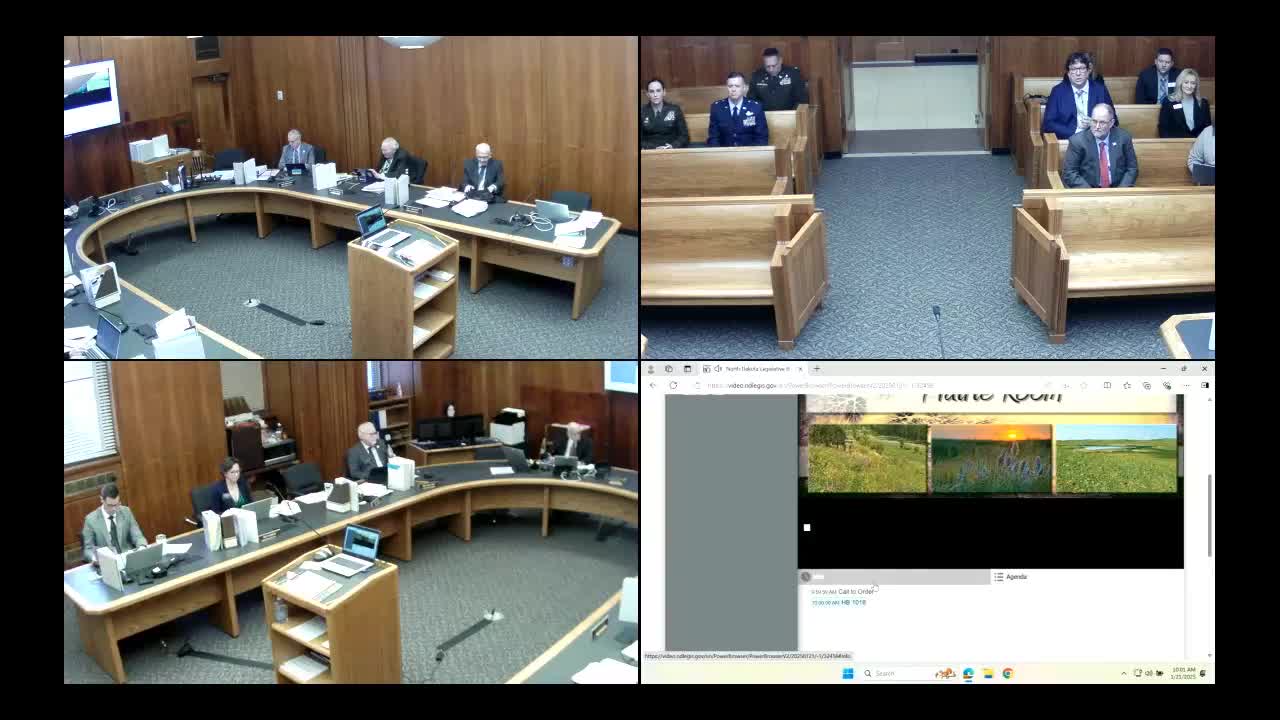
Historical society outlines military gallery, staffing and Medora plans during HB1018 hearing
Summary
At a House Appropriations Education & Environment Division hearing on House Bill 1018, the State Historical Society of North Dakota detailed priorities including a proposed military gallery, staffing requests for archives and archaeological work, Medora planning, and revisions in the governor's budget recommendation.
The State Historical Society of North Dakota presented its Biennial Budget request and answered committee questions at a hearing on House Bill 1018 before the Appropriations — Education and Environment Division. The most prominent item was the proposed military gallery at the North Dakota Heritage Center, for which agency and military representatives described a multi‑year fundraising and financing plan.
The military gallery — presented at the hearing by Mitch Johnson, Adjutant General for the North Dakota National Guard — is estimated at roughly $78 million to $80 million, with organizers planning a roughly 50/50 split of private and state support and a $40 million private match. “The goal of the project is to build a world class facility with exhibits and experiences to tell the North Dakota military history,” Johnson said. He told the committee the North Dakota National Guard Foundation has led fundraising and the project has received $7.5 million so far and pledges indicating further support.
Why this matters: the gallery would be co‑located with the State Heritage Center and is framed as an education and tourism investment. Committee members queried the scale of private fundraising and whether bonding or other state commitments would be needed to complete the project.
In addition to the military gallery, State Historical Society testimony summarized several agency priorities and proposed staffing changes. Agency representative Bill (first name not specified in testimony) described requests and tradeoffs reflected in Governor Armstrong’s revised executive budget (the “purple sheet”) compared with the prior administration’s recommendation. The agency asked for positions and one‑time funding for compliance, records processing, education programming and cultural resources work; several requests were reduced or converted to temporary positions in the Armstrong recommendation.
Key budget and project details discussed
- Military gallery: Estimated total cost presented as about $78,000,000 (the agency used $80,000,000 in planning figures). Plan: roughly half private fundraising and half public funding; the State Historical Society and the North Dakota National Guard Foundation are coordinating the campaign; the gallery concept and design have received planning approvals from the Capitol Grounds Planning Commission.
- Fund source shifts (Armstrong vs. Burgum): Committee staff (Levi) walked members through a “purple sheet” comparing the two governor recommendations. Notable changes included shifting the Pembina State Museum exhibit funding from general fund to SIF (State Infrastructure Fund) and reducing Medora area planning from the Burgum recommendation (about $24 million across items) to roughly $6,470,000 in the Armstrong recommendation. Governor Burgum had earlier proposed $5,000,000 for improvements to historical structures and buildings (split $2,000,000 general fund / $3,000,000 SIF); Governor Armstrong removed the $2,000,000 general fund portion and left $3,000,000 from SIF.
- America 250 / North Dakota 250 commemoration: The agency originally sought roughly $7,200,000; Armstrong recommended $2,000,000. The agency said its priority at the lower amount would be a large exhibit at the Heritage Center with remaining funds for local grants and a temporary coordinator position.
- Staffing and records backlog: The agency highlighted needs tied to NAGPRA consultation and an increasing volume of transfers to state archives. Requests included FTEs and temporary positions; examples cited during the hearing included: (a) authority and funding for one temporary position to process and rehouse legacy records (~$170,000); (b) a temporary education position (~$203,000) to support National History Day and education outreach; and (c) a proposal to convert two requested FTEs for in‑house cultural resource work to one FTE to reduce general fund and federal fund requests (agency estimated a $70,000 general fund reduction and $102,000 federal fund reduction if adjusted).
- Archaeology, remote sensing and drones: The society described in‑house archaeology capacity and growing demand for non‑invasive survey methods (ground‑penetrating radar, magnetometry, LiDAR and drone photography). The agency said it owns several drones (some retired), lacks LiDAR capability in‑house but accesses external LiDAR sources, and has received expensive equipment purchases through its foundation. Representative Richter asked about using LiDAR to map large cultural sites (for example Knife River and former towns such as Mondak); the agency said this work is expanding and that additional staff would free up senior archaeologists for field research.
- Medora planning: Committee members questioned a large planning figure that appeared in the executive budget (about $6,500,000 in Armstrong’s recommendation versus prior larger amounts). The agency said the governor’s office proposed the figure and that the society had retained the design firm that led the presidential library planning to help visualize “what done looks like” on society properties near Medora.
What the hearing produced
Committee members asked multiple clarifying questions; no formal vote or bonding decision was taken at this hearing. The committee received testimony from the Adjutant General and foundation and agency representatives, reviewed the purple sheet comparison, and closed the public hearing on HB1018.
Quotes from hearing participants
- “The goal of the project is to build a world class facility with exhibits and experiences to tell the North Dakota military history,” Mitch Johnson, Adjutant General, said in support of the military gallery.
- “We did receive a fair number of positive things in the Armstrong budget,” Bill, State Historical Society representative, said when asked about the revised executive recommendation.
- “The funding for the Pembina State Museum Exhibit Design Objects [was] switched from the General Fund to SIF,” committee staff Levi summarized when describing differences between the two executive budgets.
Ending
The committee recessed after closing the hearing and plans to continue appropriation work in subsequent sessions. Lawmakers signaled continued scrutiny of scale and funding sources for the military gallery, Medora planning and equipment/staffing requests; any state commitments for large capital projects would likely require separate bonding or appropriation actions in future committee deliberations.