Get Full Government Meeting Transcripts, Videos, & Alerts Forever!
Get email alerts on the Traffic Enforcement topic
No spam. Unsubscribe anytime.
Committee backs resolution asking MNPD to boost targeted traffic enforcement, requests NDOT traffic‑calming review
Summary
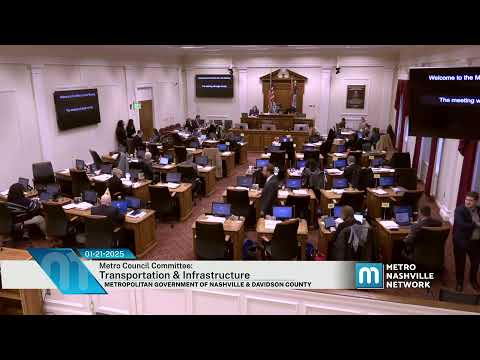
The Transportation & Infrastructure Committee recommended approval of resolution RS 2024-905, asking the Metropolitan Nashville Police Department (MNPD) to increase targeted enforcement for serious moving violations and asking the Nashville Department of Transportation and Multimodal Infrastructure (NDOT) to pursue infrastructure improvements and a study of traffic calming measures.
The Transportation & Infrastructure Committee recommended approval of resolution RS 2024-905, asking the Metropolitan Nashville Police Department (MNPD) to increase targeted enforcement for serious moving violations and asking the Nashville Department of Transportation and Multimodal Infrastructure (NDOT) to pursue infrastructure improvements and a study of traffic calming measures. The committee approved a substitute that narrowed enforcement priorities and an amendment asking MNPD to fill unstaffed positions in its traffic division; all motions passed by recorded committee recommendation votes.
The substitute, sponsored by Council Member Donna Toombs, directs MNPD to emphasize enforcement for reckless driving, DUI, speeding and distracted driving and to present a plan that includes consideration of non‑police traffic‑enforcement options. The amendment, offered by Council Member John Eslick, asks MNPD to fill unfilled traffic‑division officer positions. The substitute passed 11‑0, the amendment passed 11‑0 and the resolution as amended was recommended by the committee 11‑0.
Why it matters: committee members framed the measure as part of the city’s Vision Zero efforts to reduce pedestrian deaths and serious crashes. Sponsors said the resolution balances enforcement and infrastructure changes; several members emphasized the need to acknowledge Nashville’s history of racially disparate traffic stops and to avoid repeat harms while restoring enforcement where appropriate.
Discussion and key points - Sponsorship and intent: Council Member John Eslick introduced the original resolution as a nonbinding request to increase enforcement of traffic laws and to improve road engineering. He recounted meetings with MNPD traffic leadership and NDOT and said the goal is to reduce deaths and serious crashes. Council Member Toombs said she worked with MNPD, NDOT, the Community Review Board and the mayor’s office to craft the substitute language to address minority caucus concerns about mass traffic stops and bias.
- Scope of enforcement: The substitute focuses MNPD enforcement on four specific areas identified during committee discussion: reckless driving, driving under the influence, speeding and distracted driving (the last was added during discussion). Multiple council members including Cooper, Horton, Cash, Allen, Benedict, Ellis and Evan Siegel expressed support for a targeted approach and for pairing enforcement with infrastructure improvements.
- Staffing amendment: An amendment asks MNPD to fill unfilled traffic‑division positions. Committee members recorded inconsistent vacancy counts during explanation (committee remarks included both “6 or 7” as the likely number and other, unclear estimates). The transcript shows the vacancy count was disputed in the meeting; the committee did not adopt a new numeric figure beyond the amendment’s request that MNPD fill the unfilled positions.
- Automated enforcement and legality: Committee members asked how to analyze non‑police enforcement such as camera‑based systems. NDOT council liaison Matt Purvis said NDOT would seek legal guidance on what automated approaches are permitted under state law and would defer to MNPD on implementation if legally allowed. Council Member Bradford stated on the record that state law prohibits use of cameras to enforce moving violations; committee members said a legal analysis would be appropriate.
- Traffic‑calming review: NDOT told the committee it was taking an internal look at its traffic‑calming program and that committee members could expect a dedicated presentation on traffic calming at the committee’s first meeting in February; Purvis said NDOT intends to participate in that discussion.
Votes at a glance (committee recommendation) - RS 2024-905 (resolution urging MNPD increase traffic enforcement and NDOT improvements) — substitute adopted; amendment to request MNPD fill traffic‑division vacancies adopted; resolution as amended recommended, vote 11 in favor, 0 opposed. - Consent agenda (committee items read at the start, recommended) — includes RS 2025-982; RS 2025-985; RS 2024-986; RS 2025-988; RS 2025-991; RS 2025-993; RS 2025-994; RS 2025-995; RS 2025-996; BL 2024-678; BL 2024-679; PL 2024-680 (acceptance/encroachment and sanitary sewer items as listed on the consent agenda). Committee recommended approval of the consent agenda, vote 11 in favor, 0 opposed. - RS 2025-983 (amendment 1 to TDOT/NDOT intergovernmental agreement for pedestrian safety intersection improvements) — recommended approval, vote 11 in favor, 0 opposed. - RS 2025-984 (amendment 3 to TDOT/NDOT agreement for sidewalks on Dickerson Pike) — recommended approval, vote 9 in favor, 0 opposed. - RS 2025-987 (amendment 1 to contract with LAZ Parking Georgia LLC for on‑street parking program operations) — recommended approval, vote 9 in favor, 0 opposed. - RS 2025-992 (amendment 1 to location agreement between Water and T‑Mobile South LLC) — recommended approval, vote 9 in favor, 0 opposed. - RS 2025-997 (amend BL2024-265 for Madison Trinity Apartments revision 1 — water/sanitary sewer linear‑foot modifications) — recommended approval as amended, vote 9 in favor, 0 opposed.
What the committee directed or requested - MNPD: provide a plan for improved traffic enforcement that includes consideration of non‑police enforcement options and describes how enforcement will focus on the prioritized categories. - NDOT: prepare a dedicated traffic‑calming presentation for the first Transportation & Infrastructure Committee meeting in February and participate in discussions about program effectiveness and processes. - Legal analysis: the committee asked staff to obtain legal guidance on the feasibility and limits of automated enforcement under state law.
Quotes (selected) "This is a simple nonbinding resolution to try to enforce our traffic laws a little better," said Council Member John Eslick, the lead sponsor of the original resolution. "The language of the substitute ... emphasizes the four areas that the police look at when they're doing traffic stops," said Council Member Donna Toombs, sponsor of the substitute. "State law prohibits us from using cameras to enforce traffic moving violations," Council Member Bradford said on the record.
Ending The committee’s actions were framed as a step toward pairing enforcement with engineering under the city’s Vision Zero goals; committee members asked for follow‑up reports and a focused NDOT presentation on traffic calming at the committee’s next scheduled meeting. The resolution is a committee recommendation and will proceed through the council process according to the council’s rules.