
Richfield Beacons program highlights growth, warns 21st Century grant renewal is not guaranteed
Get AI-powered insights, summaries, and transcripts
Sign Up Free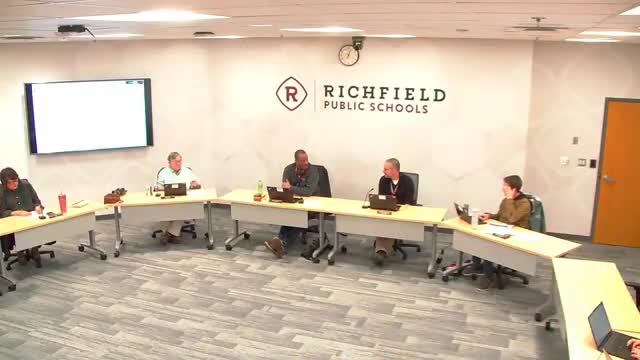
Summary
Richfield School District officials and student researchers described growth in after‑school Beacons programs, a youth participatory action research project, and possible consolidation of elementary after‑school services while cautioning that a key 21st Century grant must be competitively renewed.
Director Jonathan Hyer and partners told the Richfield School Board on Jan. 21 that the district’s Beacons extended‑learning programs have grown sharply this year but face uncertainty because the district must reapply for a competitive 21st Century grant.
In a presentation to the board, Director Jonathan Hyer said the district is in “the final year of a 6 of 6 year grant cycle,” and that the grant currently brings about $880,000 a year into the district through partner organizations. Hyer said roughly 10% of that funding flows directly through Richfield Public Schools to offset transportation, facility and leadership costs and that partners such as the YMCA and the Boys & Girls Club leverage additional funding to run programs at the elementary, middle and high school levels.
The presentation’s nut graf: the programs have measurable enrollment gains and expanded offerings but the next grant cycle requires a competitive application that emphasizes new and innovative programming; if the district does not win renewed funding, significant portions of the current programming would be at risk.
Board members heard enrollment and program metrics: elementary after‑school enrollment rose from 283 to 323 students; Centennial Beacon slots increased from about 60 to 82; and Richfield High School Beacon participation grew from 45 students last year to about 133 this year, Hyer said. Hyer and other presenters described after‑school schedules (high school Beacons meet Monday through Thursday, 3:30–5:30 p.m.), staff composition (two lead staff at the high school plus six paid student staff), and a range of club offerings including cooking, mural club, dance and karaoke.
Nikki Bai, program executive for the Beacons network, described a paid summer youth participatory action research (YPAR) project in which six student researchers mapped community assets, conducted focus groups and surveys, and met with local leaders to ask “what spaces do young people need to have a strong and involved Richfield community?” She said the group’s findings included transportation as the top barrier and that 20.5% of surveyed youth reported they did not feel involved in the community.
Student presenter Felicia, one of the YPAR researchers, described the youth work and its outcomes: “It was so much fun, meeting new people and learning their experiences,” she said, and related how youth recommendations led to small but concrete changes — for example, asking Parks & Rec to unlock soccer nets so teens could organize games.
Discussion with the board covered two planning items the district is weighing as it prepares the next grant application: 1) a centralized elementary after‑school “hub” at the RDLS and STEM campus to consolidate staff and expand access across the district, and 2) other innovations that would strengthen a competitive 21st Century grant proposal. Hyer and other staff cautioned the board that consolidation could raise bussing and logistics issues and said maintaining existing Beacon communities (for example at Centennial) would be a priority in planning.
Board members asked about tracking retention from school‑day activities into summer and community programs and about food access, seating and Wi‑Fi needs in community spaces. Presenters said the YPAR work has already informed program design and that the district’s improving data systems allow better monitoring of students who participate in extended learning and summer programming.
Why it matters: the Beacons network functions as Richfield’s principal vehicle for free after‑school enrichment, meal/snack supports and student leadership development. A failure to secure new grant funding or to develop a viable alternative could reduce those services and the district’s capacity to partner with community organizations.
The presentation concluded with board praise for student leadership and a reminder that the 21st Century grant application window is expected to open in the near future and will be competitive and time‑sensitive; district staff said they expect a short turnaround for the application period.