Get Full Government Meeting Transcripts, Videos, & Alerts Forever!
Get email alerts on the Alcohol Policy topic
No spam. Unsubscribe anytime.
Subcommittee tables bill to allow limited alcoholic ice cream sales after public‑safety concerns
Summary
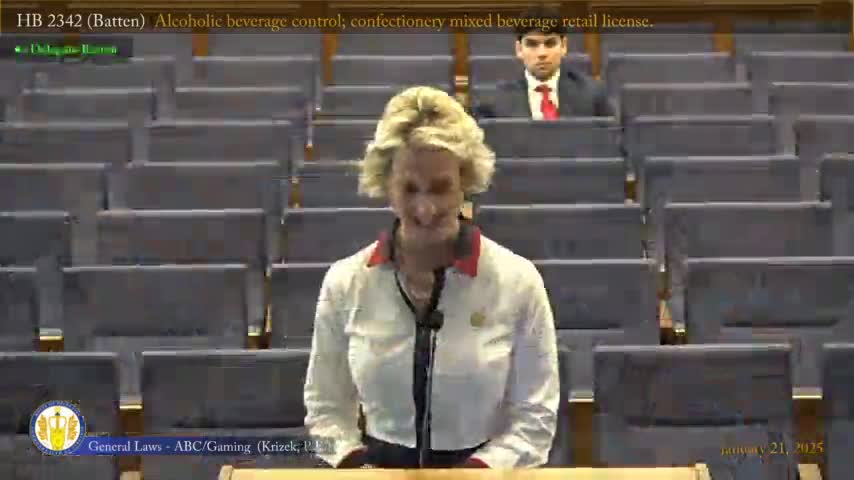
House Bill 2342, which would change the confectionery license to permit small quantities of alcohol in ice cream and sorbets, was laid on the table after members expressed concerns about underage access and enforcement; the subcommittee vote was 5‑2 to table.
A House Labor and Commerce subcommittee laid House Bill 2342 on the table after an extended discussion about enforcement and risks to minors. The bill would amend the confectionery license to allow low‑alcohol ice cream and similar frozen confections to be sold with alcohol content up to a stated cap (discussed in the hearing as 5 percent), and would require tamper‑evident packaging and labeling to indicate the presence of alcohol.
Patron Delegate Batten said the change responds to local entrepreneurs and distillery‑creamery collaborations and would permit small businesses to sell alcohol‑infused frozen confections without reclassifying as a restaurant license that some small shops cannot obtain. She said AB C guidance left some shop owners in limbo because ice cream is neither a liquid nor a baked good under the current confectionery definition.
Opponents and committee members raised concerns about underage access and workplace age limits at shops. Delegate Seibold said she could not support the bill, citing a duty to protect children and saying many teenagers work at ice cream shops: "I have teenagers at home and most of their friends work at the local ice cream store… I can't imagine that they can walk into that store and they wouldn't be able to access alcohol," she said.
John Daniel of the Virginia Alcoholic Beverage Control agency told the committee enforcement posed challenges because ice cream transitions from a semi‑solid to a liquid when taken off premise—particularly in hot weather—and that concession and seating arrangements could implicate on‑premises service rules that require 18‑and‑over servers. An owner of an independent Virginia ice cream shop (whose name did not appear in the transcript) urged the committee to allow small businesses to add adult flavors and brought samples to the hearing, arguing the alcohol portion is modest and existing ID and enforcement regimes could be applied.
After testimony and discussion, the committee voted to lay HB 2342 on the table; the clerk recorded the roll as 5 to 2 in favor of tabling the bill. The subcommittee chair said the vote reflected continuing public‑safety and enforcement concerns and acknowledged industry interest in a future solution.