Get Full Government Meeting Transcripts, Videos, & Alerts Forever!
Get email alerts on the Pharmacy Access Grants topic
No spam. Unsubscribe anytime.
Subcommittee lays on table independent pharmacy grant bill after split vote
Summary
House Bill 2023, a proposal to create a grant program to support independent pharmacies in rural and underserved areas, was laid on the table after a 5-3 vote; supporters said the grants would help convert pharmacies into health hubs and stem pharmacy closures.
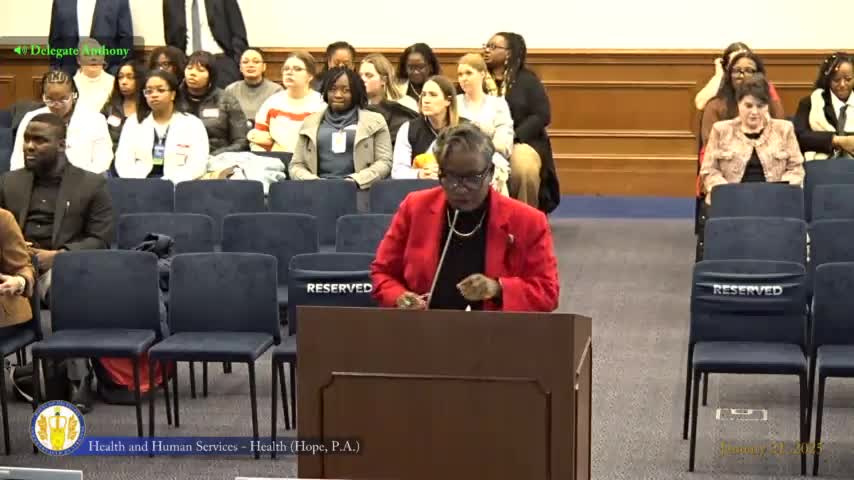
Delegate Anthony’s House Bill 2023, a proposal to establish a grant program to support independent pharmacies in rural and medically underserved areas, drew extensive testimony from pharmacists and pharmacy trade groups before the subcommittee voted 5-3 to lay the measure on the table.
The bill would authorize a phased grant program designed to fund at least 20 independent pharmacies annually, targeting existing independent pharmacies that serve rural and underserved urban neighborhoods. The legislation spells out eligible uses including salaries, inventory, rent, technology upgrades and staff training to help pharmacies expand into health-care‑hub functions such as point‑of‑care testing and telehealth. Delegate Anthony said the program is intended as a short‑term grant to sustain independent pharmacies while longer‑term reimbursement and structural issues are addressed.
Independent pharmacists and associations gave the bill broad support. Dr. Anna Peoples, owner of Peoples Pharmacy in Norfolk, described recent closures and “pharmacy deserts,” saying that in 2024 four independent Norfolk pharmacies closed and 50 closed statewide. “House Bill 2023 will provide financial assistance to help independent pharmacies remain open while we transition over to a health care hub,” Peoples said. Kim Wright, a pharmacist in Cumberland County, said her pharmacy is often the only local access point for care and that many independent pharmacies operate “month to month” because of low reimbursement.
The National Community Pharmacists Association and other groups emphasized the role of independent pharmacies in vaccine delivery and other community care. Committee discussion focused on immediate needs versus longer‑term study. Delegate Willett proposed a motion to lay the bill on the table and request the Joint Commission on Health Care study broader pharmacy access; the motion succeeded on a roll call vote of 5 to 3.
Roll call on the motion to lay on the table: Ayes — Delegate Price, Delegate Willett, Delegate Herring, Delegate Shinn, Chairman Hope (5). Nays — Delegate Hodges, Delegate Taylor, Delegate Waxman (3).
Supporters urged the panel to move quickly, saying independent pharmacies are closing at a rate that creates access gaps; opponents and some members argued for concurrent study through the Joint Commission on Health Care. The sponsor said the bill contains reporting infrastructure and a sunset and that a first-year appropriation of roughly $1.3 million had been anticipated to launch the program, though committee members said a formal fiscal impact had not been finalized in the hearing record.
Ending: After the 5-3 vote to lay the bill on the table, sponsors said they would continue to pursue funding and coordinate with the Joint Commission on Health Care; advocates urged quick action to stop further pharmacy closures.