Get Full Government Meeting Transcripts, Videos, & Alerts Forever!
Get email alerts on the Healthcare Innovation Sandbox topic
No spam. Unsubscribe anytime.
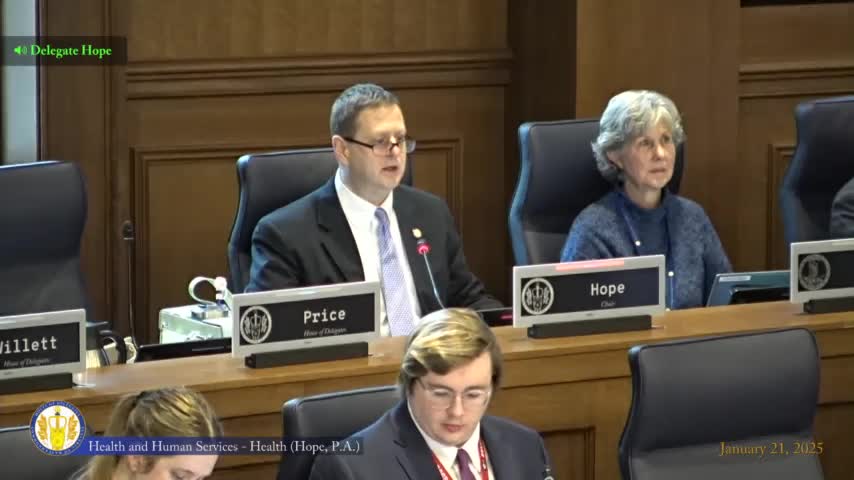
Subcommittee pauses healthcare regulatory sandbox after questions about scope and safety
Summary
House Bill 1555, which would create a two‑year healthcare regulatory sandbox administered by the Department of Health, was discussed at length over scope, FDA oversight and equity; the subcommittee allowed the bill to go by temporarily and later agreed to take it up again, effectively postponing final action.
Delegate Elliott Williams presented House Bill 1555, a measure to create a Healthcare Regulatory Sandbox Program that would let applicants request waivers of certain Commonwealth laws or regulations to test innovative health products or services for a two‑year pilot (with one 6‑month extension). The Department of Health would administer the program, set consumer protections, and report annually to legislative committee chairs on participant outcomes and recommendations.
Williams said the program is intended as a narrowly targeted pilot to let regulators and policymakers test innovations — especially digital health tools, remote monitoring and similar technologies — and see whether evidence from pilots supports broader regulatory or reimbursement changes. “Our goal is to allow us to play in a sandbox that is, sort of, a pilot program for two years,” Williams said.
Testimony and committee questions focused on the program’s scope and safety. Ben Knotts of Americans for Prosperity described sandboxes used in other states and said they typically approve only one or two programs a year. He emphasized they can accelerate reimbursement policy changes for validated technologies. Several members raised concerns about whether the sandbox could be used to introduce unapproved drugs or implantable devices without FDA approval. The substitute amendment added language making participants liable for expenses of participation and explicitly preserving Certificate of Public Need (COPN) requirements; a committee staff speaker, Mr. Brooks, described those two changes as the amendment’s principal additions.
Delegate Waxman and others pressed for limits on the bill’s scope to exclude ingestible or implantable products that would ordinarily require FDA review or clinical trials. Delegate Hodges and hospital association witnesses said the strongest gains in other states have come from telehealth, remote monitoring and blockchain applications used to share health information. Hodges urged the sponsor to consider equity provisions for selecting participants, and Delegate Price asked the patron to ensure fair access when the department solicits participants.
The subcommittee approved a substitution and then, without objection, agreed to hear additional work in a sidebar; the bill was first passed “by temporarily” and later the panel agreed to take the bill “for the day” to give the sponsor time to address concerns, effectively postponing final action so possible edits could be made before appropriations deadlines.
Supporters including Americans for Prosperity and the Virginia Hospital and Healthcare Association expressed willingness to accept narrower, technology‑focused amendments. Opponents did not speak on the record; several delegates asked the sponsor and witnesses to clarify safeguards and to ensure the program would not permit bypassing federal agency approvals where applicable.
Ending: The bill was not finally reported; committee members asked staff and the patron to refine the language to address device/drug exclusions, participant selection equity and COPN preservation before further consideration.