Get Full Government Meeting Transcripts, Videos, & Alerts Forever!
Get email alerts on the Energy And Utilities topic
No spam. Unsubscribe anytime.
Subcommittee advances multiple energy, utilities and EV bills; votes at a glance
Summary
The Virginia House Labor and Commerce Subcommittee 3 on Wednesday advanced a package of energy and utility bills, including measures to add battery storage to an accelerated renewable buyers program, authorize advanced transmission conductors, expand school solar priority, create a utility ombudsman, loosen multifamily shared solar rules, increase rooftop/previously developed solar targets and create an EV charger grant fund.
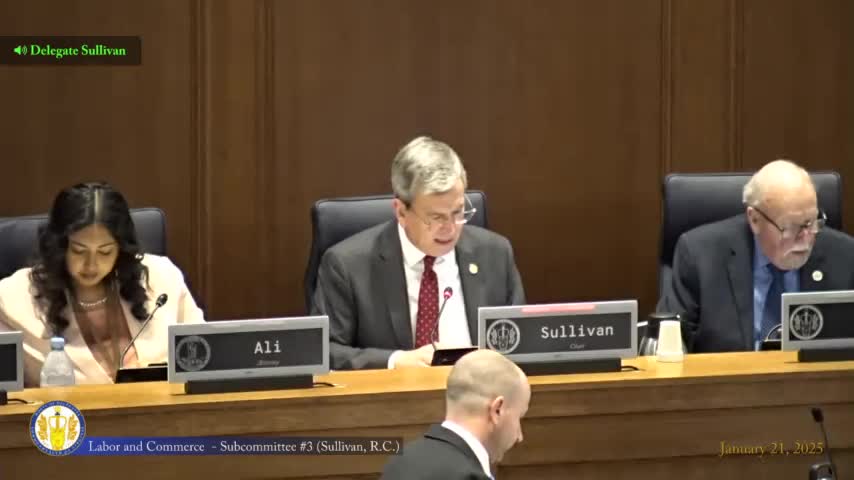
The Virginia House Labor and Commerce Subcommittee 3 on Wednesday advanced a package of energy, utilities and transportation-related measures after hours of testimony and several recorded votes.
The committee reported substitutes or referred bills on issues ranging from adding battery storage to an accelerated renewable buyers program, to allowing new transmission technologies, expanding school access to solar, creating an ombudsman for utility customers, easing rules for multifamily and shared solar projects, and creating a state fund to support electric vehicle (EV) charging in underserved rural and non‑interstate corridors.
Why it matters: The measures aim to broaden clean energy options for large commercial and community users, protect ratepayers on cost allocation, open markets for rooftop and previously developed-site solar development, provide a contact point for frustrated utility customers, and direct state support to EV charging in parts of Virginia unlikely to receive federal highway‑focused funds.
Key outcomes and votes
- HB 1821 (Del. Delia Reid) — Substitute reported 6–4. The substitute narrows the bill to implement Recommendation 3 from the Joint Legislative Audit and Review Commission (JLARC) data‑center study by allowing battery storage to be included in the accelerated renewable buyers program, which previously covered only solar and wind. The substitute directs the State Corporation Commission (SCC) to ensure distribution and transmission costs “are justly and reasonably allocated.” Delia Reid (patron) said the change is intended “so that we can smooth out the energy production and generation from solar and wind to the actual usage that occurs 24/7.” Dominion Energy and environmental groups testified in support of the narrowed substitute.
- HB 1822 (Del. Delia Reid) — Substitute reported 8–2. The bill addresses advanced conductor materials (ACM) for transmission lines. Reid told the committee ACMs could allow more electricity to travel on existing right‑of‑way and directs the SCC to consider prudency of ACM use rather than mandate it. Dominion Energy and Advanced Energy United supported the substitute; the bill includes a delayed enactment date to give the SCC time to evaluate the technology.
- HB 1934 (Del. LaVere Bolling) — Reported and referred to Appropriations 8–2. The bill amends the Virginia Clean Economy Act to prioritize K–12 public schools within the distributed generation carve‑out of the renewable portfolio standard (RPS). The patron said Virginia has about 1,800 K–12 school buildings and that roughly 8% now use solar; the bill would make schools next in line to meet the distributed‑generation carve‑out when low‑income projects are insufficient. Supporters (utilities, education and conservation groups) said the change would lower barriers for schools to sell renewable energy certificates and expand educational and resiliency benefits.
- HB 2136 (Delegate listed in transcript as “Delegate Keys Gamara”) — Reported 5–4. The bill would create an ombudsman mechanism to help utility customers navigate service and regulatory processes. The Virginia Poverty Law Center and Clean Virginia testified in favor. Dominion’s representative said the concept has precedents and expressed willingness to work with sponsors.
- HB 1883 (Del. Carlson) — Substitute reported 9–1. The bill raises the distributed‑generation carve‑out in the RPS (the substitute phases the carve‑out to 5% by 2028 rather than higher earlier targets), increases the megawatt size threshold for a distributed resource to 3 MW, triples the previously developed‑site carve‑out from 200 MW to 600 MW, delays an in‑state requirement from 2025 to 2027, and extends a strategic undergrounding program. Sponsors and environmental groups said the changes steer more utility‑scale solar to rooftops and previously developed sites, avoiding impacts to undeveloped land; industry witnesses, including Dominion, said they would continue technical discussions with the patron.
- HB 2090 (Del. Shin) — Motion to report the bill as introduced initially failed on a 5–5 tie. A motion to reconsider carried and the bill ultimately reported 6–4. The bill would revise the multifamily shared solar program created in 2020 to ease development constraints (for example, relaxing strict on‑site location and subscriber rules) so projects can be built within a defined radius of multifamily buildings to expand subscription options for renters. Utilities expressed concerns about administrative costs and cross‑subsidization if the service radius is expanded without corresponding cost allocation; the patron and supporters said the changes are intended to make the program financeable and accessible.
- HB 1791 (listed in the hearing as HB 17 91 / by Chair Sullivan) — Reported and referred to Appropriations 6–4. The bill establishes an EV infrastructure fund to provide grants (up to 70% of a private developer’s non‑utility costs in qualifying areas) to expand charging in rural, distressed or low‑population areas not otherwise likely to receive federal highway‑focused funding. Supporters from tourism and local business groups said adding chargers supports visitors and local commerce; committee members noted the bill will be routed to Appropriations for funding details.
Administrative and procedural notes
- An administrative motion to strike HB 1999 at the patron’s request passed 10–0.
Who testified and recurring voices
Speakers who took the floor for testimony or technical explanation across these items included: Delegate Delia Reid (patron, HB 1821/1822), Delegate LaVere Bolling (patron, HB 1934), Delegate Colson/Carlson (patron, HB 1883), Delegate Shin (patron, HB 2090), Chair of the subcommittee (Mr. Chair/Sullivan), Chrissy Noonan (7 Hills Strategy Group, representing Dominion Energy), Josie Casalman / Josepha Salman (Southern Environmental Law Center), Matt Mansell (Broad Street Group / Virginia LCV), Lillian Anderson (Virginia Conservation Network), Julianne Seifer (Department of Energy), Carmen Bingham (Virginia Poverty Law Center), Chris Unan / Chris Noonan (Dominion), Rob Bohannon (Smith Mountain Lake Chamber of Commerce), Abigail Thompson (Advanced Energy United / Gentry Lock), Tommy Herbert (Virginia Restaurant Lodging & Travel Association), and others. Quotations in this report are sourced to those speakers’ committee remarks.
What the record does not show
The committee frequently referenced fiscal impacts and administrative estimates; where the record did not include a dollar amount or fiscal estimate, that figure is recorded in committee documents as “not specified” in the transcript and will follow the appropriations process when or if the bill is advanced.
Next steps
Several measures were reported to the full House or referred to Appropriations for fiscal review. Sponsors and stakeholders signaled continued negotiations on technical language and cost allocation with Dominion Energy, the State Corporation Commission and other parties ahead of additional subcommittee and full‑committee consideration later in the week.
Ending note: The subcommittee recessed after the votes and adjourned with two additional meetings scheduled to consider incoming bills; the chair said the panel expects a heavy docket in the coming days.