Get Full Government Meeting Transcripts, Videos, & Alerts Forever!
Get email alerts on the Healthcare Rural Hospitals topic
No spam. Unsubscribe anytime.
Subcommittee advances bill letting critical-access hospitals average swing-bed limit
Summary
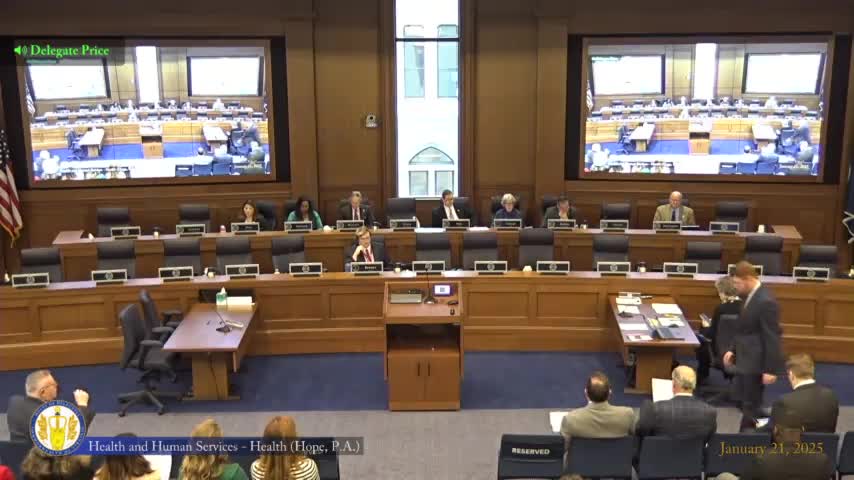
A House subcommittee voted 6-0 to report House Bill 1552 as a substitute, letting critical-access hospitals calculate the 10-bed swing-bed limit as a fiscal-year average and adding temporary guardrails for overages.
A House subcommittee on Thursday reported House Bill 1552 as a substitute, voting 6-0 to allow critical-access hospitals to calculate the state’s 10-bed limit for “swing beds” as an average over a hospital’s fiscal year rather than as a strict daily cap.
The substitute, introduced by Delegate Wiley, lets eligible hospitals average up to 10 swing beds across a fiscal year and includes guardrails for temporary increases. Under the substitute, a hospital may not operate more than 15 swing beds at any one time for five consecutive days; if a hospital’s fiscal-year average exceeds 10 swing beds, it will have one subsequent fiscal year to reduce its average to 10 or below. If the hospital does not meet the average over two years, it loses the privilege and must calculate swing-bed use daily until the average is restored.
The bill’s sponsor, Delegate Wiley, told the subcommittee that the state and federal rules differ: federal law allows a critical-access hospital to operate all 25 beds as swing beds, while Virginia’s statute has been interpreted to limit swing beds to 10. “Current limits on swing beds present challenges in placing patients effectively,” Wiley said, adding that the substitute is intended to give rural hospitals “additional flexibility to care for patients in their community.”
Brent Rollies of the Virginia Hospital and Healthcare Association testified in support, saying the substitute came from work with hospitals that had experienced capacity problems. “We came up with these guardrails — calculating the 10 beds as an average, not allowing more than 15 at any one time for five consecutive days, and a two‑year payback period — and a requirement to make a good‑faith effort to find placement in the community,” Rollies said. He described situations in which a patient needing post‑acute nursing home care could not be placed nearby and needed to remain at the hospital.
Delegate Hodges asked whether “swing bed” referred to acute or post‑acute care; Wiley and Rollies confirmed it refers to the level of care that enables a hospital to provide transitional or post‑acute services when appropriate. No members spoke in opposition during the hearing.
The substitute was approved and the bill was reported by a 6-0 vote.
About the issue: swing‑bed programs, commonly termed transitional care, allow small and rural hospitals to use beds flexibly for inpatient or post‑acute care to help patients remain near home when nursing‑facility placements are unavailable. Supporters told the panel the change would align state practice with federal flexibility while adding procedural safeguards to limit sustained increases in swing‑bed usage.
Votes at a glance: House Bill 1552 — reported as substitute, vote 6-0.
Ending: The subcommittee sent the substitute forward after unanimous approval; staff and stakeholders in attendance said they would be available to answer follow‑up questions as the bill moves through the process.