Get Full Government Meeting Transcripts, Videos, & Alerts Forever!
Get email alerts on the Breast Diagnostic Coverage topic
No spam. Unsubscribe anytime.
Subcommittee advances bill to eliminate out‑of‑pocket costs for medically necessary breast diagnostic imaging
Summary
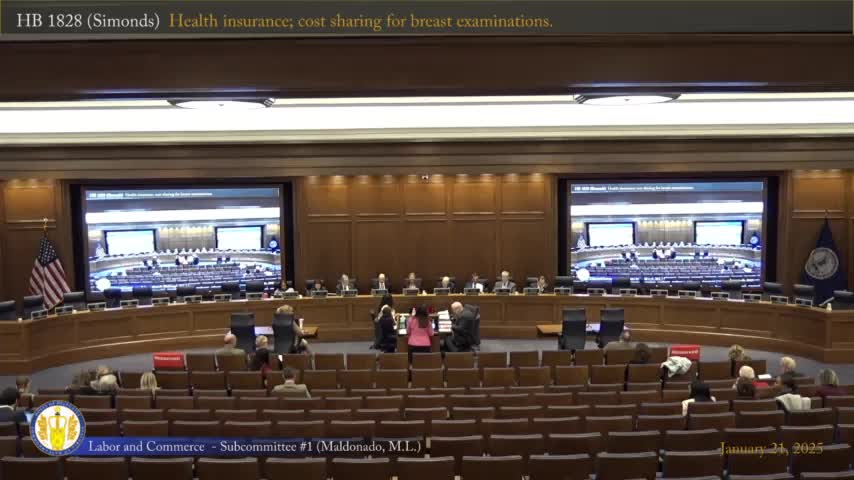
Delegate Simons asked the committee to report HB 18‑28; the subcommittee unanimously reported the substitute to Appropriations (7‑0).
Delegate Simons presented House Bill 18‑28 to the subcommittee and described the bill as removing patient out‑of‑pocket costs for medically necessary diagnostic and supplemental breast imaging. "This bill would eliminate out of pocket costs for these medically necessary diagnostic and supplemental breast images such as MRIs, ultrasounds and diagnostic mammograms," Simons said, adding that those costs can range from about $350 to $1,000 out of pocket and can deter patients from obtaining follow‑up imaging.
Nut graf: Advocates and clinicians said eliminating cost sharing for follow‑up diagnostic imaging will help ensure early diagnosis and better outcomes, and they cited national analyses showing cost‑related delays in follow‑up testing. Testimony came from Susan G. Komen, the Virginia Breast Cancer Foundation, the American Cancer Society Cancer Action Network, radiologists and outpatient imaging providers.
Multiple witnesses gave patient examples and studies: Kelly Fitzgerald of ACS CAN summarized recent analyses estimating large numbers of insured women faced out‑of‑pocket costs for follow‑up imaging and that cost sharing likely leads many to delay needed tests. Radiologist Priti Shah said studies show about 70.4% of insured patients had out‑of‑pocket costs for follow‑up breast imaging in 2023 and that 21% of women may skip additional imaging if they face cost sharing.
Opponents cautioned about waivering cost shares by disease. Doug Gray of the Virginia Association of Health Plans and other insurance witnesses warned that waiving cost sharing for specific conditions can create pressure for similar waivers across many diseases and noted House Bill 26‑11 (filed separately) would waive cost sharing for any cancer; they also warned higher premiums could result because waived cost shares shift costs to premiums.
The committee voted to report the substitute and refer HB 18‑28 to the Appropriations Committee by a vote of 7‑0. Supporters said the referral will let appropriations examine fiscal mechanics, and they urged the committee to move the proposal forward to reduce delayed diagnoses.
Ending: HB 18‑28 now proceeds to the Appropriations Committee; proponents signaled they will emphasize evidence that cost sharing deters necessary follow‑up imaging and that the bill aligns with recommendations from health policy review panels.