Get Full Government Meeting Transcripts, Videos, & Alerts Forever!
Get email alerts on the Ethics Gifts topic
No spam. Unsubscribe anytime.
Committee tables HB 1838 after debate over removing gift limits for legislative meals
Summary
HB 1838, pitched as a measure to restore bipartisan "cross‑pollination" by excluding certain meals from gift limits, was laid on the table 6–2 after committee members raised transparency concerns.
The committee voted to lay House Bill 1838 on the table by a roll-call announcement the chair described as 6–2 after members debated whether the bill would undermine public disclosure of gifts tied to legislative meals.
The bill’s patron, Delegate Elliot Bauxhall, told the committee HB 1838 was intended to “bring back some of what I consider to be the camaraderie of the House” and to restore informal bipartisan conversation that he said once occurred over meals. Bauxhall said the proposal was a response to recent events and described the measure as a way to increase “cross pollination” among members, not to facilitate lavish entertainment.
Committee members and an ethics adviser pressed on disclosure and reporting. Stuart Petto of the Conflict of Interest and Ethics Advisory Council explained the current lobbyist gift cap is $108 (indexed for inflation) and that $50 is the reporting threshold. Petto answered a committee question by saying, “If it's properly accounted for, that is correct,” when asked whether multiple lobbyists could apportion a check to keep individual shares under the cap.
Another member warned removing the gift definition would eliminate members’ reporting obligations for those events, saying in the hearing that without the gift classification “the public would have no way of knowing that we were at such a meal, how much it cost, or who paid for it.” The Ethics Council representative later said the council did not adopt an official position on the bill.
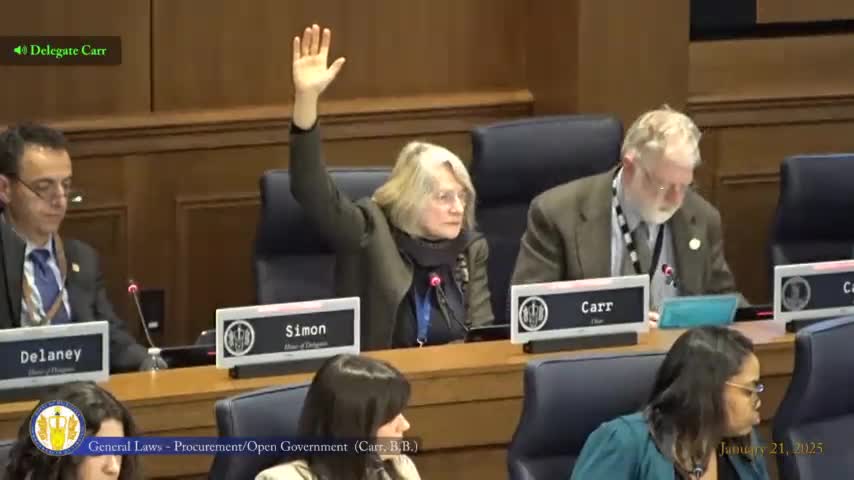
Delegate Salazar moved to lay the bill on the table; the chair announced the motion carried by a 6–2 vote. The transcript records that members raised concerns about transparency and reporting even as some supported the bill’s stated aim of encouraging interparty conversation.
Given the committee’s action, HB 1838 will not proceed out of the committee at this time.