Get Full Government Meeting Transcripts, Videos, & Alerts Forever!
Get email alerts on the Medicaid Pace topic
No spam. Unsubscribe anytime.
AHCA outlines expansion, contracting changes for Florida PACE program as slot reversions rise
Summary
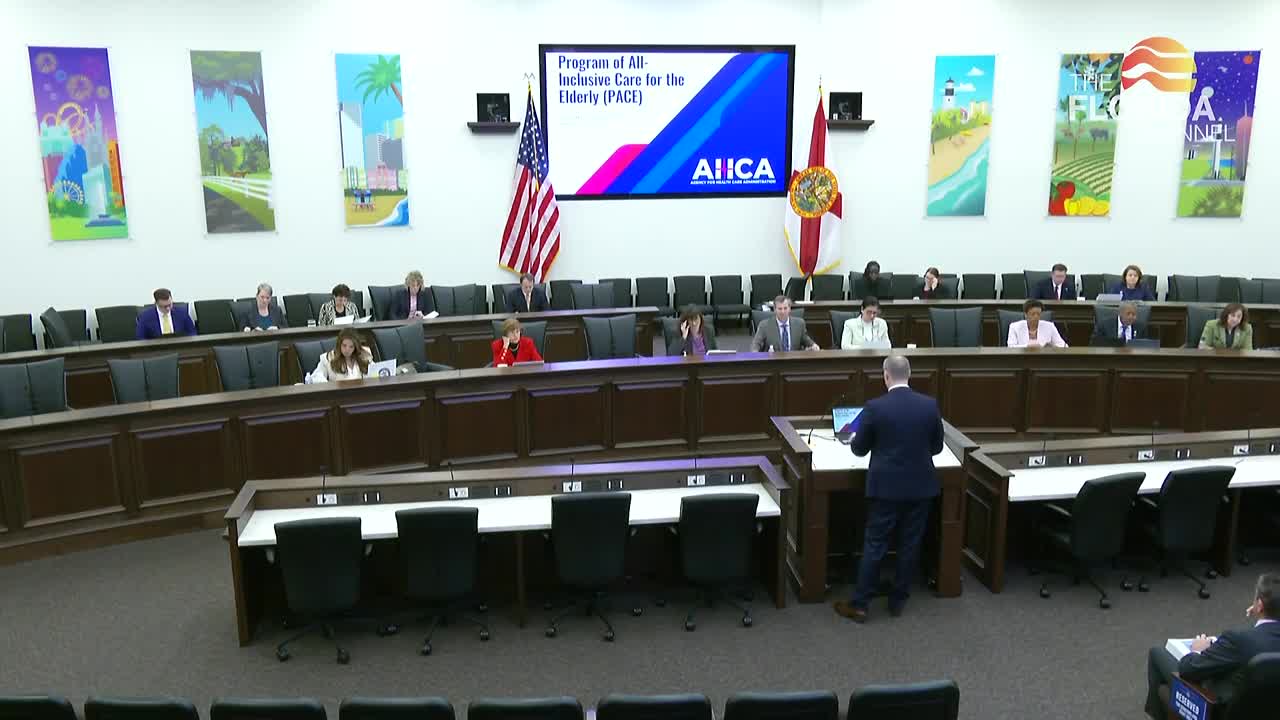
The Agency for Health Care Administration briefed the Appropriations Committee on the Program of All‑Inclusive Care for the Elderly (PACE), noting rapid application growth since 2020, unfilled appropriated slots, rising reversions, and plans to move from a federal three‑way agreement to a state two‑party contract to improve transparency and data.
The Agency for Health Care Administration told senators it has seen rapid growth in Florida’s Program of All‑Inclusive Care for the Elderly, or PACE, since 2020 and is pursuing a change in contracting to improve transparency and measure return on investment.
Bridal Meyer, deputy secretary for Medicaid and Florida’s Medicaid director, told the Appropriations Committee PACE organizations provide “primary care, social, restorative, and support services for Medicaid and Medicare eligible individuals 55 years of age or older” who live in designated PACE service areas. Meyer said PACE is separate from the statewide Medicaid managed care program and is an alternative enrollment option patients can choose.
Meyer reviewed eligibility and services: enrollees must be 55 or older, at risk of institutionalization, able to live safely in the community and reside in a PACE service area. Services can include acute care, adult day health care, home‑delivered meals, hospital care and community‑based supports. Meyer summarized the program’s federal framework, noting Centers for Medicare & Medicaid Services (CMS) authorization of PACE and Florida’s implementing legislation (chapter 98‑327, Laws of Florida) and described a capitated payment model with an actuarially set upper payment limit used to calculate PACE capitation rates.
The agency said Florida’s PACE program initially began serving members in 2003 and saw slow growth until 2020. Meyer said the agency received five PACE applications between 2015 and 2019; from 2020 through 2024 the agency has received 20 applications. As a result, appropriations for slots have sometimes outpaced the time it takes applicants to complete the CMS readiness and enrollment process, producing a larger share of unfilled slots and increased reversions in recent years. “For some PACE organizations it can take up to 2 years … it takes time for a PACE organization to get operational,” Meyer said.
Meyer described the agency’s current contracting approach — a federal three‑way agreement among CMS, the agency and the PACE organization — as the minimum federal requirement. The agency said it is developing a two‑party contract between the Agency for Health Care Administration and each PACE organization to add state contract requirements including clearer quality and performance metrics, utilization and financial reporting, and a dedicated agency contract manager for each organization. Meyer said the two‑party contract will borrow appropriate elements from the statewide Medicaid managed care contract but be “right sized” for the PACE model.
Senators pressed the agency on the large reversions, whether appropriations have been shifted to other programs, and what concrete dollar savings the two‑party contract could produce. Meyer said the agency cannot yet quantify expected cost savings from enhanced reporting and accountability and offered to follow up on whether funds appropriated for PACE had been realigned to other program areas. On coverage geography, Meyer said slot allocations are typically made by the Legislature for specific counties and expressed willingness to follow up with members on the process for reallocating or applying for slots in particular locales.
Meyer said the agency plans to complete the contract work during the year, “with the goal of getting this contract in place by the end of the year,” and emphasized continued collaboration with PACE organizations, the Department of Elder Affairs for screening, and Department of Children and Families for eligibility functions.
No formal legislative action or vote occurred during the presentation; members asked follow‑up questions and requested additional detail on reversions, slot allocation rules and audited financial reporting.