Get Full Government Meeting Transcripts, Videos, & Alerts Forever!
Get email alerts on the Career Technical Education topic
No spam. Unsubscribe anytime.
Subcommittee advances bills to widen CTE teaching pathways and recognize industry experience in pay
Summary
The subcommittee reported HB 2018 (substituted with SB 879) and HB 2103 after debate about standards, district fiscal impacts and teacher shortages; both measures move forward for further consideration.
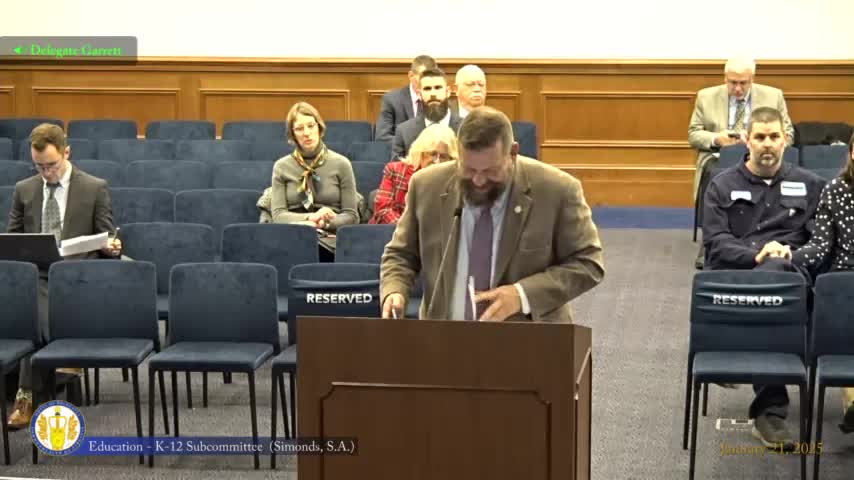
Delegate Delia Anthony presented House Bill 2018 to create additional pathways for career and technical education (CTE) teachers to obtain renewable licenses by recognizing industry experience and establishing an equivalency assessment framework.
The delegate said the bill was designed to reduce barriers for experienced industry professionals — welders, electricians, IT specialists and others — to transition into CTE classrooms while preserving pedagogical training and safety requirements. She described personally moving from engineering into K‑12 education and said inconsistent evaluation of credentials at the district level motivated the bill.
Several CTE and business groups testified in support. Jeff Sluss of SkillsUSA Virginia Foundation and Chris Bailey of the Virginia Association for Career and Technical Education said the state needs pathways and provisional licensing to address teacher shortages in technical fields. Employers represented by the Virginia Manufacturers Association and the Virginia Chamber of Commerce urged the committee to preserve a “science of teaching” requirement while expanding pathways.
The Virginia Education Association and the Virginia School Boards Association voiced concerns about scope, resources and stakeholder engagement; VEA said the bill required more detail for a change tied to the accreditation system.
During subcommittee discussion members accepted laying Senate Bill 879 on top of House Bill 2018 as a substitute; the committee then reported the substituted measure on a vote of 8 to 0.
The subcommittee also considered House Bill 2103, which would formalize local pay practice by recognizing CTE work experience for salary steps (the bill originally proposed a 2:1 weighting of experience; members amended a “shall” to “may” to give districts flexibility). Supporters said the measure would help recruit and retain instructors for expensive equipment‑intensive classes; opponents warned it could create a two‑tiered salary structure and asked for further conversation about fiscal impact. The committee reported HB 2103 as amended with a recorded vote of 7 to 0.
Both measures were reported from the subcommittee and will proceed for further committee action.