Get Full Government Meeting Transcripts, Videos, & Alerts Forever!
Get email alerts on the Housing Affordability topic
No spam. Unsubscribe anytime.
Delray Beach staff outlines Live Local Act impacts; 2101 South Congress project advances under administrative review
Summary
Development services director reviewed Florida Local Live Local Act preempts some local land-use approvals; a large mixed-use rental project at 2101 South Congress has submitted a revised application proposing 386 units, including 154 affordable rentals.
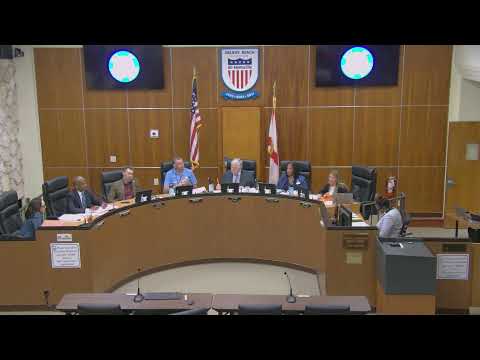
Anthea Gianniotis, development services director for the City of Delray Beach, gave a presentation to the City Commission outlining what she called the Live Local Act and how the city should expect certain large multifamily projects to proceed through administrative review.
The Live Local Act, Gianniotis said, stems from two Florida senate bills and "basically preempts local land use and zoning regulations, including the approval process for Live Local." She added the law requires municipalities to authorize multifamily and mixed-use residential development in many locations if the proposal makes at least 40% of units affordable rentals for a 30-year term.
Why it matters: commissioners and staff said the state-level change will limit Delray Beach ability to shape density, heights and the mix of uses in places where the act applies. City staff described specific thresholds in the bills that can increase allowable building bulk: projects can qualify for the city's highest allowable density without local incentives and, where floor-area-ratio (FAR) limits apply, the act allows up to 150% of the city's highest FAR. Gianniotis noted Delray Beach's downtown FAR of 3.0 could allow a Live Local project up to 4.5 under that formula.
Project in review: Gianniotis told the commission the city currently has a Live Local application for a redevelopment of a former industrial site at 2101 South Congress Avenue. The revised submittal proposes 386 total rental units, of which 154 would be required workforce/affordable rentals to meet the 40% threshold. The plan includes a token industrial component of just under 2,000 square feet to satisfy the mixed-use definition, a two-story parking deck at the rear, and multiple residential buildings ranging from five to six stories along portions of the site. A digital billboard on the site is proposed to be removed; a large existing antenna would remain.
Planning and parking: Gianniotis said the project earlier was 77 parking spaces short based on unit mix; the revised plan reduced the unit count and now meets the city's parking requirement as proposed, but she cautioned the plan may change as technical advisory comments are addressed. She also noted the Live Local Act includes a 20% parking reduction for sites within a half-mile of a major transit hub; otherwise, parking relief requires commission review.
Commission response and direction: Commissioners voiced concern about loss of local control, effects on small commercial and industrial land bases, and traffic impacts along Congress Avenue. Multiple commissioners asked staff to press the legislature for changes. The commission directed staff to work with local lobbyist Matt Forrest and the Florida League of Cities to coordinate a letter to state lawmakers and to pursue legislative refinements, including clarifying mixed-use minimums and protecting historic districts from automatic preemption. The commission did not take a formal vote on policy changes at the meeting; the action counted as direction to city staff and outside counsel/advocates.
Context and next steps: Gianniotis said Live Local projects that meet the act's standards may be approved administratively and therefore not be appealable to the commission. She advised the public that plans, renderings and application materials for the 2101 South Congress project are linked on the city's Development Services webpage under "Live Local Act" for review. The commission asked staff to continue monitoring the application as technical comments are addressed and to return with any recommended local policy responses or formal letters to the legislature.
Ending: Commissioners indicated they will pursue coordinated advocacy through the League of Cities and with Senator contacts; staff will draft the letter and report back with recommended text and timing.