Get Full Government Meeting Transcripts, Videos, & Alerts Forever!
Get email alerts on the Education Budget topic
No spam. Unsubscribe anytime.
Subcommittee reviews SB 800 budget amendments for K‑12, early childhood and higher education
Summary
Staff presented the governor's amendments to SB 800 and Senate member amendments covering K‑12 (including Opportunity Scholarships and school construction), early childhood policy changes that could create additional child-care subsidy slots, and higher-education items such as appropriations for veteran education programs and nursing supports.
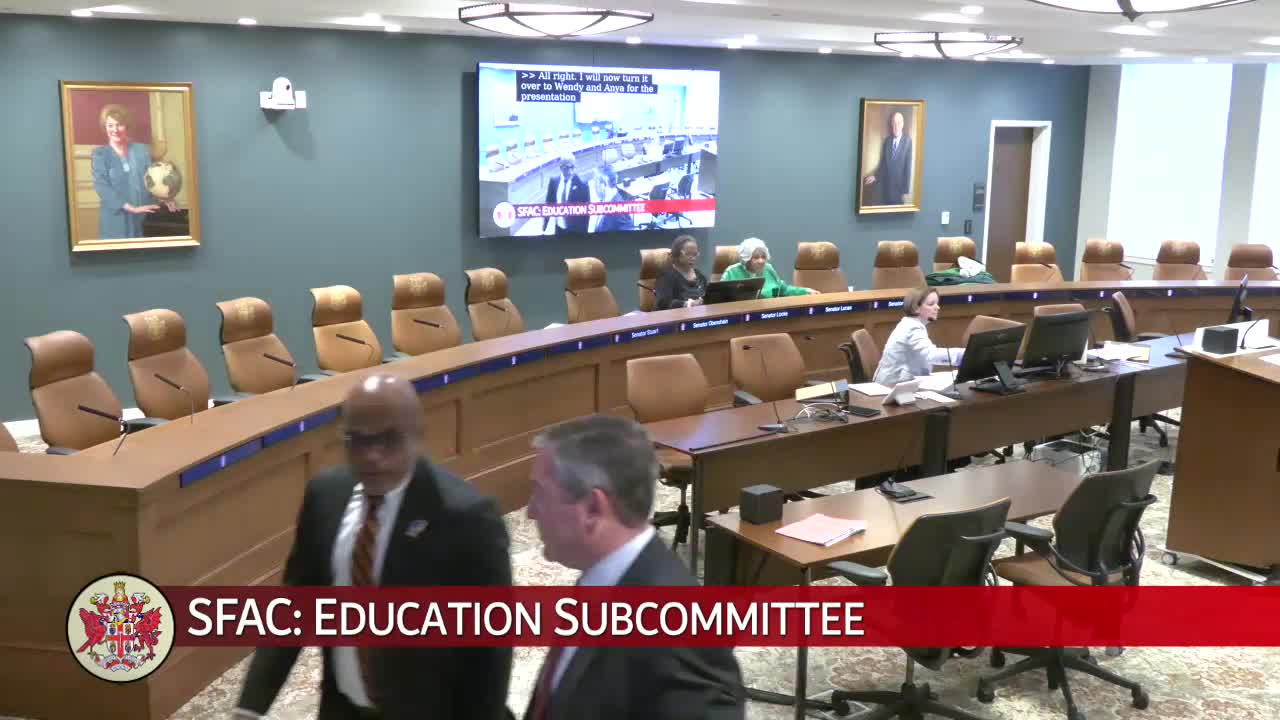
Staff members Anya and Wendy briefed the Senate Finance and Appropriations Committee Education Subcommittee on proposed amendments to SB 800 and to the introduced budget, highlighting changes for K–12, early childhood and higher education.
"Given our time constraints, we're going to move relatively quickly through this, but we did want to make sure that we provide you all with an overview of the proposed amendments to SB 800 and the introduced budget," Anya said at the start of the presentation.
The introduced budget package staff summarized includes a proposed net increase of $286.5 million in general fund spending and more than $1 billion in nongeneral funds across the biennium. Notable K–12 proposals summarized by staff include a $50 million appropriation in the second year for Virginia Opportunity Scholarships to help low‑income students attend private schools (staff described the program as paying "up to $5,000" per participating student), $25 million in the first year to establish lab school partnerships with HBCUs, and a $290 million increase for school construction across the biennium. Staff said $120 million of the construction increase in year one and $20 million in year two would come from casino tax revenue, and $150 million in year one from the Literary Fund.
Anya and Wendy also described routine data updates reflected in the introduced budget, including higher-than-expected average daily membership and an English‑learner reporting adjustment that adds roughly $110 million in cost across the biennium.
On early childhood programs, staff outlined proposed administrative changes intended to generate savings that could be redirected to the child-care subsidy program (CCSP) or mixed-delivery slots. Proposals described included raising family copayment rates to as much as 7% of annual income for some families, limiting job-search time for parents to 90 days, restricting CCSP enrollment to children birth through age 5 (with study of options for school‑age children), and removing the local composite index cap on the Virginia Preschool Initiative; staff estimated redirecting savings might create additional CCSP slots (staff used the figure "approximately 36,100" when describing the potential scale of reallocated savings and also described a separate estimate of 687 additional CCSP slots tied to one change).
In higher education, Wendy said the budget appropriates prior surplus actions and adds funding for a variety of programs. She identified roughly $90 million tied to the Virginia Military Survivors Independence Education Program appropriations and cited additional funds for college‑and‑career programs at the Virginia Community College System, grants for nursing programs, workforce credential grants, and targeted support for students at HSI‑designated institutions. The introduced budget also proposes a tuition freeze for public institutions in FY 2026 and an ongoing cap on tuition increases tied to inflation or 2.5%, whichever is lower.
Committee members asked clarifying questions about program details and duplicate amendment requests. Staff noted two sets of duplicate amendments seeking removal of caps on supplemental basic aid and on the support cap and confirmed the duplicates were not intended to double the request amount. Senator Lucas asked about the Opportunity Scholarships per‑student amount and staff said they would follow up to confirm program limits.
No formal votes or final committee actions were recorded in this transcript extract.