Get Full Government Meeting Transcripts, Videos, & Alerts Forever!
Get email alerts on the State Workforce topic
No spam. Unsubscribe anytime.
Senate committee hears state workforce update; DMV launches multi‑phase pay overhaul to tackle turnover
Summary
Department of Human Resource Management briefed a Senate committee on workforce size, vacancy and turnover trends, compensation changes including a 15% increase over three fiscal years, the DMV’s Project UpShift to address 35–46% monthly turnover, and health plan procurement and fund balances.
Director Lawson of the Virginia Department of Human Resource Management told a Senate committee in Richmond that the commonwealth’s classified workforce totaled just under 57,000 employees at the end of fiscal year 2024 and that the agency is focused on recruitment, retention and compensation adjustments.
“Just under 57,000 as of the end of fiscal year 24,” Director Lawson said, and noted the workforce count includes classified and wage employees but excludes contractors. Lawson said overall turnover and vacancy figures are within public‑sector industry standards but vary widely by agency.
The presentation quantified recent pay increases and the remaining gap with the private sector. Lawson said the commonwealth provided a cumulative 15% increase to state employees over the past three fiscal years — 5% in July 2022, 2% in December 2022, 5% in July 2023 and 3% in July 2024 — and that the average state salary now lags the private sector by about 13%, down from an earlier 25% lag.
Lawson also reviewed recruitment and vacancy metrics the agency tracks, noting a roughly 22% average vacancy rate across the workforce and a 2% increase in turnover from fiscal year 2023. Telework participation rose about 1% compared with the prior year. She cautioned that those averages mask large differences among agencies and roles; some agencies have low vacancy rates while others face high turnover.
The committee pressed for historical and agency‑level detail. Senator Serval asked for trend data and comparisons to pre‑pandemic levels; Lawson said she would follow up to determine how far back agency records and prior reporting allow the department to pull data.
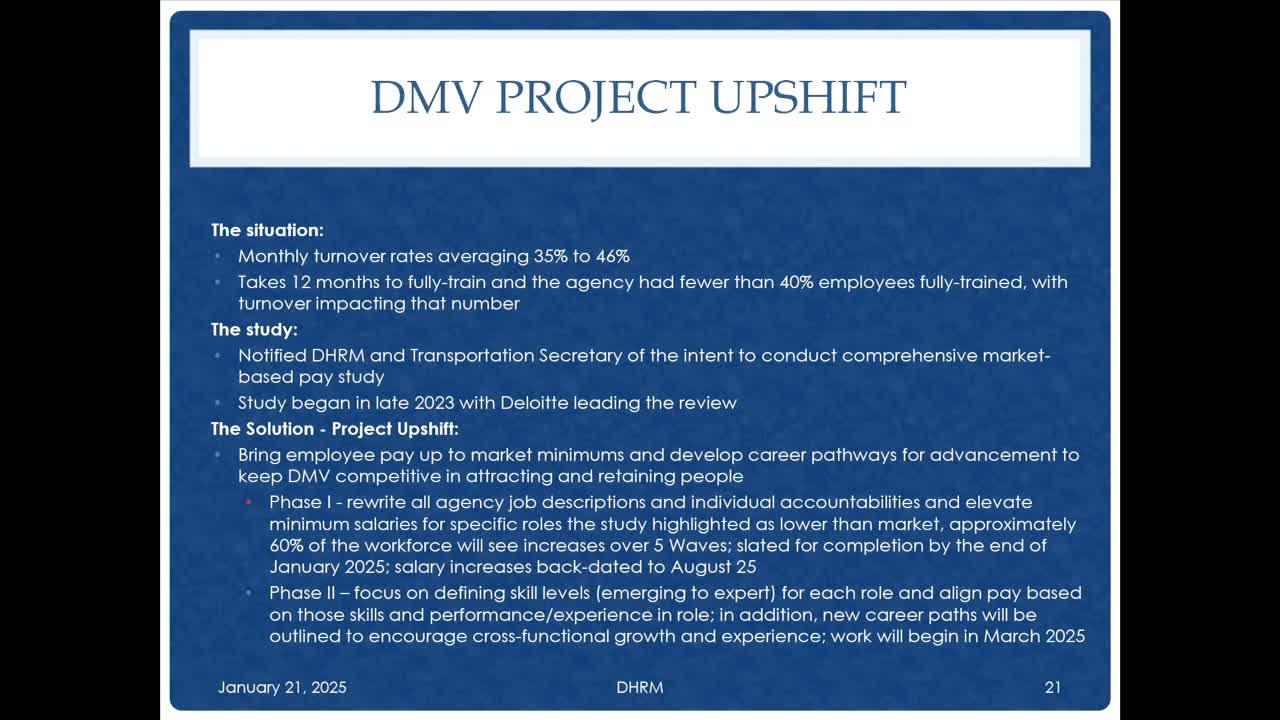
A major portion of the briefing focused on the Department of Motor Vehicles’ compensation initiative, Project UpShift. Lawson said DMV leadership engaged Deloitte on a market salary study after identifying “significantly high” turnover in customer‑facing roles. Lawson said turnover rates at DMV were “anywhere from 35 to 46% per month” and that it can take roughly 12 months to fully train employees in DMV roles.
Pam Goheen of the DMV told the committee that phase 1 of Project UpShift established market‑based minimums for many roles, rewrote job descriptions and affected roughly 60% of DMV’s workforce. Goheen said those increases are being implemented in multiple waves and will be backdated to Aug. 25. She said phase 2, planned for next spring, will evaluate experience and skill categories (emerging, seasoned, expert) to address pay compression and alignment.
“How is Project UpShift responding to pay compression and morale when newer hires could receive the same pay as tenured staff?” Senator McPike asked. Goheen replied that phase 2 is intended to identify and correct compression and alignment gaps by factoring skills and experience.
Scott Cummings, assistant commissioner for finance at DMV, told the committee the agency will absorb the Project UpShift costs within its existing special‑fund appropriation (DMV is fee‑supported, not general‑funded). Cummings said efficiency measures and revenue forecasts give DMV “sufficient resources to implement Project UpShift.”
Lawson also briefed the committee on state health benefits. The Office of Health Benefits oversees plans covering about 207,000 lives in the active and pre‑65 retiree plans, roughly 43,000 Medicare retiree members, and about 3,600 members in the Line of Duty Act program. She said the commonwealth pays about 88% of the full premium on average across coverage tiers and that total claims and administrative costs across the programs exceed $2 billion per year. Lawson said the health insurance fund peaked at about $563 million about 18 months ago, and the most recent November 2024 balance for the active/pre‑65 fund was about $485 million.
On procurement, Lawson said the administration shortened planned contract terms and added specific deliverables and expectations for the commonwealth’s self‑insured plans and pharmacy benefit manager. The solicitation closed, interviews and finalist meetings were held, and the state expected to issue an intent to award within roughly a month.
The committee also discussed recent federal and state wage rule changes. Lawson said a planned increase to the federal exemption threshold was vacated Nov. 15 and that Virginia’s minimum wage rose to $12.41 on Jan. 1; Lawson said agencies have been advised on compliance.
The committee requested more granular, historical and agency‑level reporting to help legislators spot agency‑specific problems earlier. Lawson said she would work to provide what is available from the department’s current and legacy HR systems and follow up with the committee.
The meeting concluded without any formal votes on the presentation. The human resources staff left the committee with a direction to supply additional historical and agency‑level data on vacancies, turnover and other recruitment metrics.