Get Full Government Meeting Transcripts, Videos, & Alerts Forever!
Get email alerts on the Nondiscrimination Expansion topic
No spam. Unsubscribe anytime.
Panel hears bill to add ethnicity, homelessness, immigration status and neurodivergence to school nondiscrimination protections
Summary
Senate Bill 5123 would expand Washington’s school nondiscrimination provisions to add four protected classes, separate gender identity/expression from sexual orientation, and require OSPI rulemaking; supporters cite student safety, opponents raise legal and definitional concerns.
Senate Bill 5123 was presented to the Early Learning & K‑12 Education Committee as a measure to expand protections in Washington schools by explicitly adding ethnicity, homelessness, immigration status and neurodivergence to the list of protected classes and by separating sexual orientation, gender identity and gender expression into distinct categories.
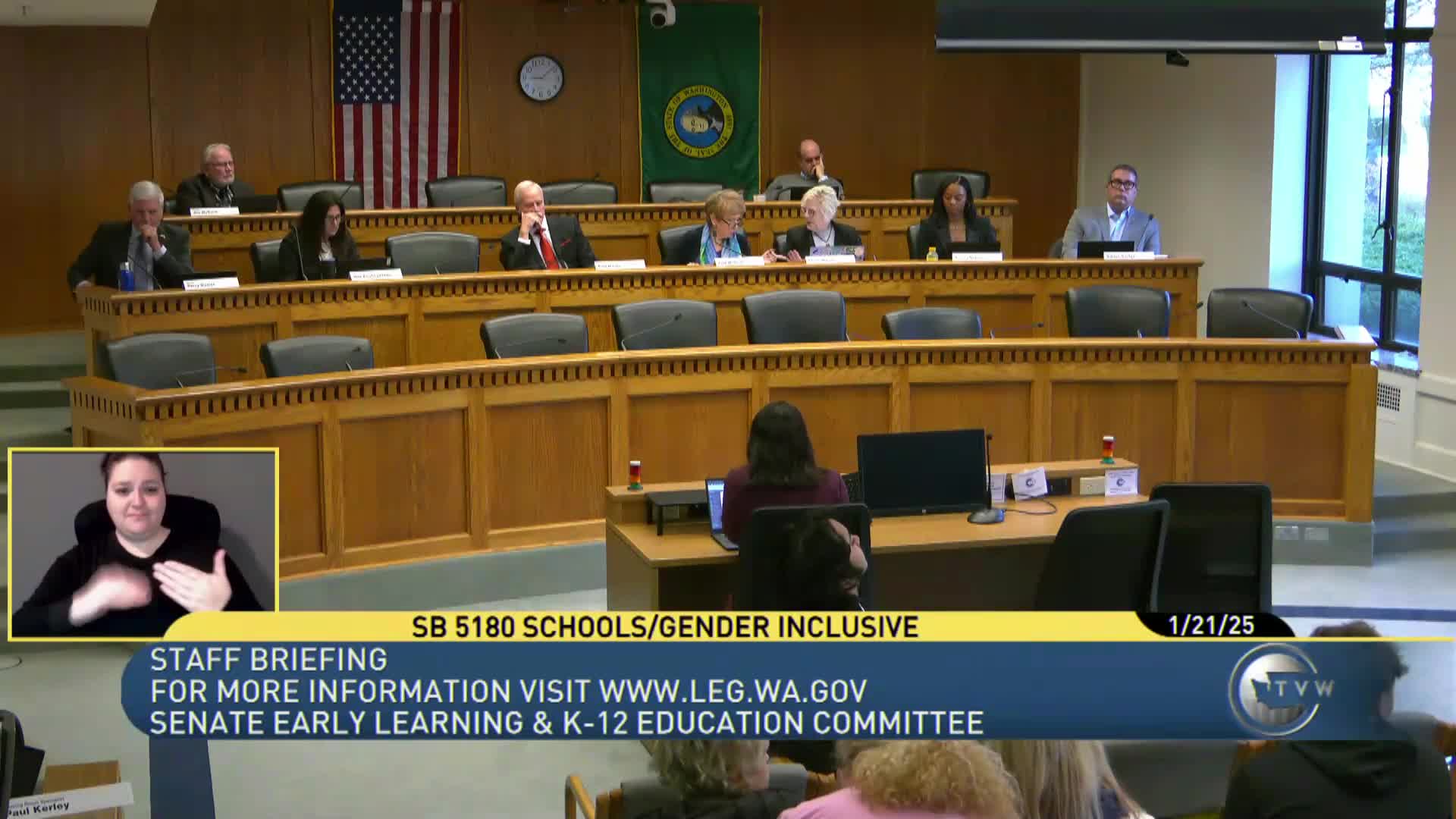
Committee staff said OSPI would develop regulations and guidelines to eliminate discrimination, monitor compliance and enforce the law; the bill would give any person aggrieved by a violation a right of action in superior court. Staff displayed comparative definition charts and noted a fiscal note had been requested but was not yet available.
Sponsor Sen. Tijuana Nobles told the committee “our laws must evolve” and described the bill as clarifying language that has not kept pace with current understandings of identity and discrimination. Youth and advocacy groups supported the bill; John V. (Legislative Youth Advisory Council) said the changes were “deeply personal” and would help students feel recognized. School psychologists and counselors, including representatives of the Washington State Association of School Psychologists and the Washington School Counselor Association, spoke in support and cited research linking discrimination to worse mental‑health and educational outcomes.
Opposition: Several witnesses, including some parents and public commenters, urged rejection. Opponents argued some definitions are inaccurate or could conflict with federal guidance; one speaker said the bill risked jeopardizing federal funding though the committee record did not show an administration finding to that effect. Testimony included legal and factual disputes over definitions of sexual orientation, gender identity and immigration status.
Next steps: Committee testimony concluded with offers from advocates and educators to work on amendment language. No committee vote or fiscal determination was recorded in the transcript.