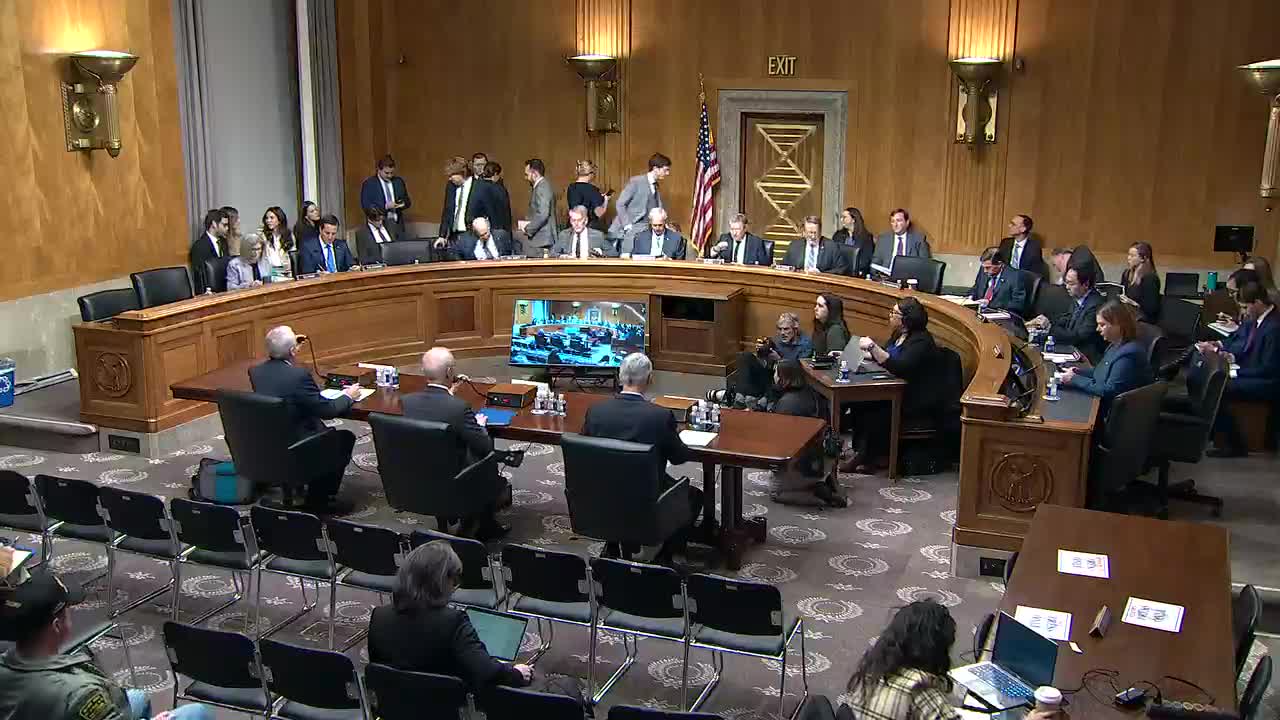
Senate Homeland Security Committee debates ‘Remain in Mexico’ policy, then approves resolution affirming presidential authority
Loading...
Summary
The Senate Committee on Homeland Security and Governmental Affairs held a hearing and markup on Jan. 23, 2025, focused on whether existing federal law gives the president and the secretary of Homeland Security authority to reenact the Migrant Protection Protocols, commonly known as Remain in Mexico, and other border measures.
The debate opened with Chairman Rand Paul saying the hearing would examine whether the president has sufficient statutory authority to act at the border and arguing the administration’s policies had allowed a “revolving door” of unauthorized entry. Former acting DHS official Ken Cuccinelli, one of three witnesses, testified the president “does have vast authority to secure America's border” and argued that MPP and a suite of existing INA authorities could be used to deter illegal entry. In contrast, Adam Isaacson of the Washington Office on Latin America and Andrew Arthur of the Center for Immigration Studies said MPP had harmful side effects: Isaacson said, “Remain in Mexico enriched the cartels,” and detailed reported extortion, kidnapping and abuse of migrants waiting in border towns. Arthur described MPP as a tool that had reduced certain encounters in 2019 and urged more capacity for expedited hearings.
Why it matters: committee members said they want tools to reduce unauthorized crossings, improve processing speed, and protect U.S. communities and border personnel. Witnesses and senators differed over whether reimplementing MPP would reduce overall harm or would instead empower cartels and cause more human-rights abuses in Mexican border cities.
During testimony, witnesses and senators cited statutes, court rulings and administrative policies repeatedly referenced in the hearing. Speakers discussed sections 208, 212 and 235 of the Immigration and Nationality Act (INA); the Flores settlement; the TVPRA statutory regime for unaccompanied children; Title 42 public-health expulsions; and the Migrant Protection Protocols (MPP). Witnesses gave specific cost and program figures: the state department funded a September 2019 project cited at $5,500,000 to provide housing in Mexican border cities and $11,900,000 in cash assistance; Isaacson estimated a conservative $71,000,000 in cartel revenue tied to MPP-era extortion in one calculation.
Committee questioning reflected sharp partisan differences. Supporters of reinstating MPP, including Senator Ron Johnson and others, emphasized deterrence and reductions in encounters under earlier implementations. Opponents, including Senator Gary Peters and several Democrats, pointed to reporting of extortion, kidnapping and other abuses of migrants while waiting in Mexico and warned that reimplementation without safeguards could worsen cartel revenue and violence.
The committee then considered an amendment (Amendment 2) introduced by Ranking Member Peters that would have required the president to certify to Congress that any reinstatement of MPP would not lead to murder, kidnapping, trafficking, increased cartel profits, separations of families, or diminished protections for children. That amendment was defeated on a roll call. The committee reported the vote as: yeas 7, nays 8; the amendment was not agreed to.
After the amendment vote the committee proceeded to the resolution that affirms the president’s legal authority to reinstate MPP and take “immediate steps” to remove illegal entrants, reinstate Remain in Mexico, and end catch-and-release. The committee voted to adopt the resolution; the reported tally was yeas 8, nays 6 and the motion was agreed to.
What was decided (votes at a glance): - Amendment (Ranking Member Peters’s certification amendment): failed, yeas 7, nays 8. (Roll-call sequence recorded in committee minutes; final tally reported by the clerk.) - Committee resolution affirming presidential authority on MPP and related measures: passed, yeas 8, nays 6.
Discussion vs. decision: the hearing portion was discussion only; witnesses provided testimony and senators asked questions but did not change law. The two formal actions were committee votes during the markup: one amendment failed and the resolution passed. No statute or rule was changed by the committee vote; the resolution is a committee statement and not binding law.
Notable direct quotes from the hearing (attributed to speakers as recorded in the transcript): - Ken Cuccinelli (witness): “The president of the United States does have vast authority to secure America's border.” - Adam Isaacson (witness, Washington Office on Latin America): “Remain in Mexico enriched the cartels.” - Andrew Arthur (witness, Center for Immigration Studies): “MPP was ... an indispensable tool in addressing the ongoing crisis at the southern border,” (quoting DHS’s 2019 assessment), and he urged expanded deportation and adjudication capacity.
Next steps and context: committee members said the record will stay open for 15 days for additional statements and questions for the record. Committee action on the resolution is a policy statement ahead of anticipated presidential actions; reimplementation of MPP would depend on executive-branch decisions, possible litigation, and cooperation from Mexico or other third countries.
Ending note: senators across the ideological spectrum said Congress also bears responsibility for clarifying statutes they cited—members repeatedly mentioned Flores, TVPRA, and other statutory matters as areas where congressional action would be needed to resolve long-running implementation challenges.