Senate Foreign Relations Committee opens confirmation hearing for Marco Rubio, who outlines ‘America first’ test for diplomacy
Get AI-powered insights, summaries, and transcripts
SubscribeSummary
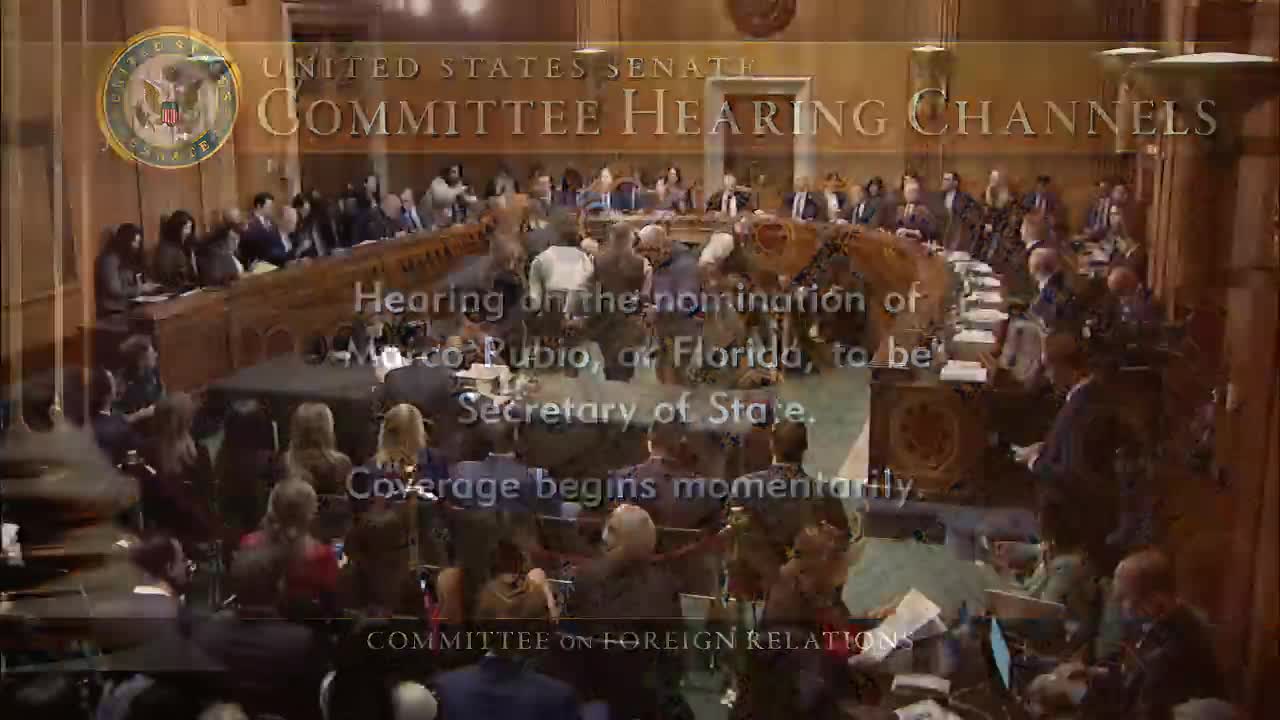
Senate Foreign Relations Committee Chairman Jim Risch convened the committee on Jan. 16 for the confirmation hearing of Sen. Marco Rubio, President‑elect Trump’s nominee for secretary of state.
Senate Foreign Relations Committee Chairman Jim Risch convened the committee on Jan. 16 for the confirmation hearing of Sen. Marco Rubio, President-elect Trump’s nominee for secretary of state. Rubio said the State Department’s work must be judged against three questions: “Does it make America safer? Does it make America stronger? Or does it make America more prosperous?”
The committee hearing opened with Chairman Risch laying ground rules for decorum and stressing time limits, saying, “This place is not a place for demonstrations or communications with members of the committee. We have work to do.” Senator Tim Scott introduced Rubio and framed him as a nominee who would carry out the incoming administration’s priorities in Latin America and beyond.
Nut graf: The hearing covered a broad set of security and diplomatic priorities — from China and the Indo-Pacific, to Ukraine and NATO, to Israel and the Gaza hostages — and regular committee business such as staffing the State Department. Committee leaders from both parties urged swift confirmation of career foreign service nominees while pressing Rubio on how he would balance alliance commitments and America’s interests.
In his opening remarks Rubio characterized the current moment as one in which the United States must prioritize its national interest in foreign policy. He criticized what he called “ill‑informed decisions” by the outgoing administration and argued for stronger stances on China, Iran and Russia. “Every dollar we spend, every program we fund, every policy we pursue must be justified by the answer to 1 of 3 questions,” he said. Rubio called China “the most significant long term risk to the United States” and urged rebuilding U.S. industrial capacity and supply chains to reduce strategic dependencies.
Members pressed Rubio across a range of theaters. Ranking Member Jeanne Shaheen emphasized bipartisan goals — quickly confirming career foreign service officers and sustaining NATO — and asked how Rubio would support Ukraine’s negotiating leverage; Rubio replied that ending the war will be difficult, will require concessions on both sides, and that sanctions and leverage should be part of any settlement. On Israel and Gaza Rubio said a ceasefire that includes release of hostages is essential and described any durable political arrangement as requiring security guarantees for Israel and a viable, nonterrorist Palestinian governance option.
Other senators pressed Rubio on regional issues: China’s influence in Central and South America and the Panama Canal; the Arctic and Greenland; countering transnational organized crime and fentanyl flows from Mexico; the situation in Cuba, Venezuela, Nicaragua, Haiti and the broader Western Hemisphere; Africa and stability programming; and the need to staff embassies. Rubio consistently said he would prioritize mission alignment and competencies in nominees, restore the department’s operational relevance, and coordinate whole-of-government approaches where necessary. He also criticized diversity, equity and inclusion structures at State as having “distracted from this mission,” saying personnel decisions should return to merit-based criteria.
Several senators highlighted human‑rights and humanitarian concerns. Senators raised Sudan, the Uyghurs, and the humanitarian situation in Gaza. Rubio said he would press partners on forced labor and human-rights abuses and noted opportunities to press for humanitarian access where recent shifts in the Middle East might make new diplomatic openings possible.
The hearing also included questions about special envoys and how they will coordinate with the State Department, the role of multilateral organizations and standard-setting (including concerns about Huawei and 5G), and the tools available to confront adversaries — from sanctions to economic and development engagement. Rubio said multilateral engagement must be justified by U.S. national interest and emphasized that the United States should contest undue influence in international institutions.
The committee recessed for a short break and continued extended rounds of questioning; the record was left open for the committee’s written questions. No formal committee vote occurred during the hearing itself.
Ending: The hearing spelled out key expectations for a prospective secretary of state: secure U.S. interests, rebuild alliances and staffing, confront rising peer competitors, and ensure U.S. foreign assistance and diplomacy demonstrably advance U.S. safety, strength and prosperity. The committee set a timetable for follow‑up written questions and additional oversight; members signaled bipartisan interest in moving nominations for career officers promptly.