Get Full Government Meeting Transcripts, Videos, & Alerts Forever!
Get email alerts on the Jail Oversight Standards topic
No spam. Unsubscribe anytime.
Senate bill would create statewide jail oversight board after task force recommended standards; counties and law enforcement raise cost and scope concerns
Summary
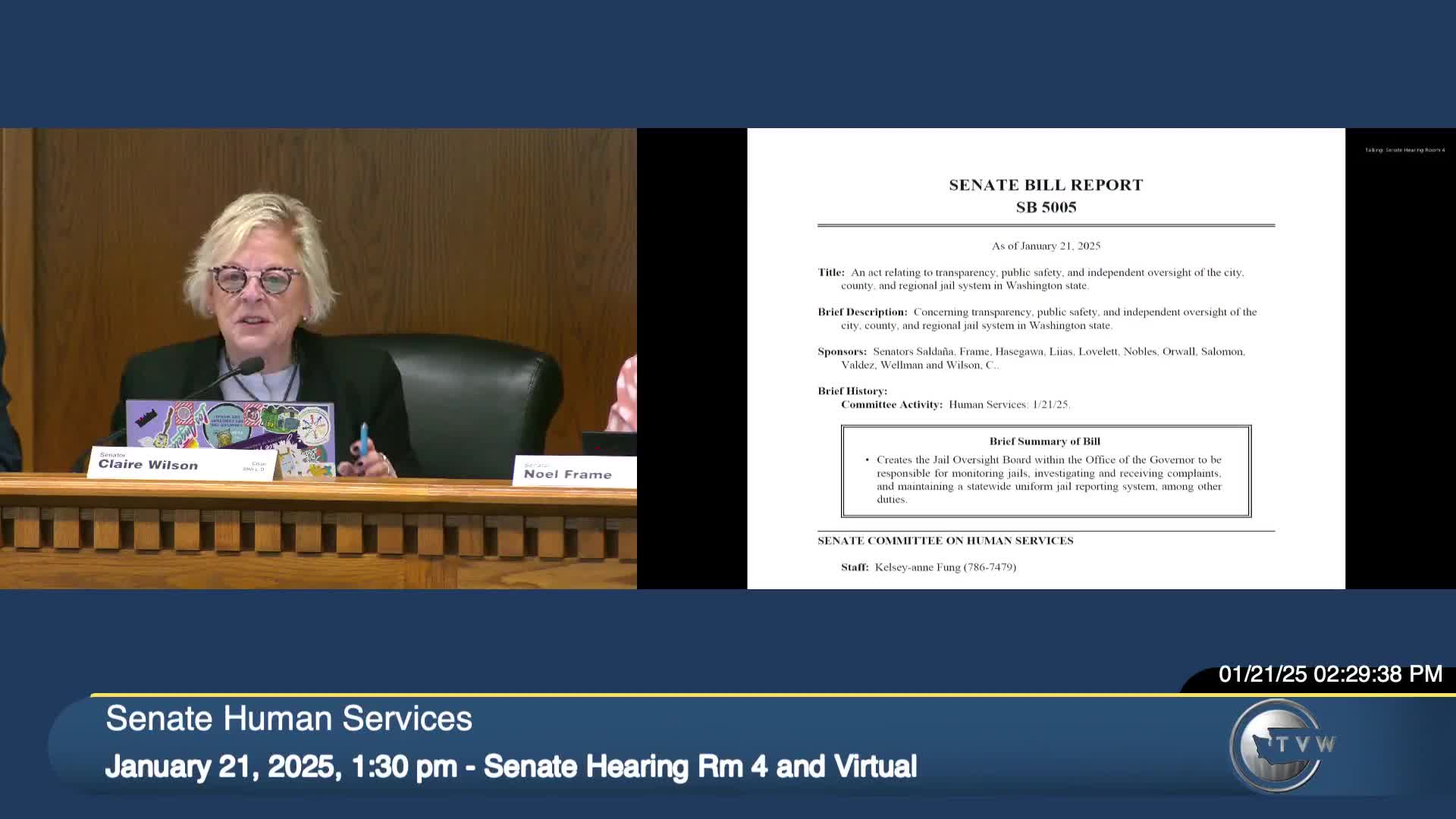
Senate Bill 5005 would create a governor’s office jail oversight board to run a statewide reporting system, perform triennial monitoring visits, investigate complaints and provide technical assistance to local jails.
Senate Bill 5005 would establish a jail oversight board in the governor’s office to administer a statewide uniform jail reporting system, conduct monitoring visits of every jail every three years, investigate complaints and provide technical assistance to local jurisdictions.
Committee staff Kelsey Ann Fung briefed the bill and summarized the Joint Legislative Task Force on Jail Standards (2022–2023), which recommended reestablishing statewide oversight functions that existed in the 1980s. The bill sets board membership and director qualifications, requires jails to provide reasonable access to the board and its staff, and includes confidentiality, civil-immunity and evidentiary-protection provisions for the board’s work. A preliminary fiscal note estimated about $9 million per biennium and 21 FTEs to staff the office.
Supporters framed the board as necessary to reduce deaths, improve conditions and provide independent review. Ethan Frenchman of Columbia Legal Services, chair of the task force, told the committee oversight is “essential to jail operations” and cited Washington’s high rate of jail deaths. Family members of people who died in jails — including David Lara and Selena Lee — described cases in which they said inadequate care and improper handling of deaths resulted in preventable tragedies and called for independent oversight and investigations.
Advocates and task force members argued oversight could be fiscally prudent by reducing costly settlements for deaths and injuries.
Cities, counties and law enforcement officials said they support the goal of better standards but raised concerns about scope, standards, cost and compatibility with federal confidentiality obligations. Candice Bach of the Association of Washington Cities asked what standards the board would apply and warned of local compliance costs. The Association of Sheriffs and Police Chiefs said it supports jail standards but opposed aspects of the bill’s approach; the Association of Counties described the proposed board as “far reaching” and potentially burdensome and asked that its recommendations be reconciled with ongoing jail modernization work.
Sponsor Sen. Manka D. Saldanha said the bill reflects the task-force recommendations and that she is willing to work with counties and other stakeholders on implementation. The committee did not take a vote; sponsors and stakeholders said they would continue negotiations on standards, scope and fiscal details.