Get Full Government Meeting Transcripts, Videos, & Alerts Forever!
Get email alerts on the Efsec Siting topic
No spam. Unsubscribe anytime.
Energy Facility Site Evaluation Council director explains siting process, SEPA review and 12‑month decision window
Summary
The director of the Energy Facility Site Evaluation Council described EFSEC’s “one‑stop” review for large energy facilities, the site certification agreement approach, tribal consultation and the council’s 12‑month recommendation requirement to the governor.
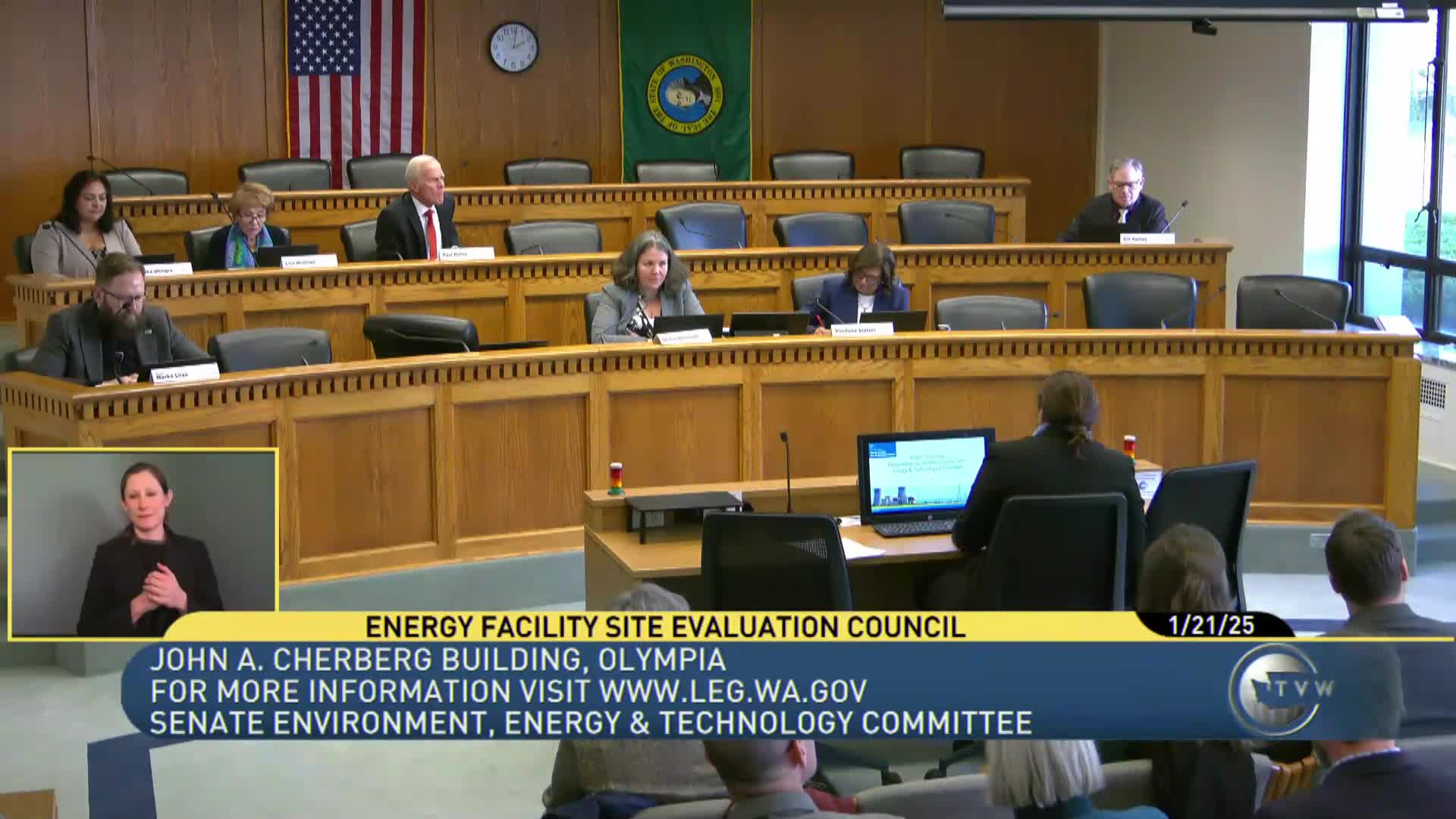
Sonya Bumpus, director of the Energy Facility Site Evaluation Council (EFSEC), told the Senate Energy, Environment and Technology Committee that EFSEC was created in 1970 as a one‑stop siting body for large energy facilities and that its mandate has expanded to allow some alternative energy projects to opt into its certification process.
Bumpus said EFSEC reviews applications under the State Environmental Policy Act (SEPA), conducts government‑to‑government tribal consultation, and, after adjudication and environmental review, forwards a recommendation to the governor. If the governor approves the council’s recommendation, EFSEC issues a site certification agreement (SCA) that operates in lieu of many other state and local permits; appeals of EFSEC decisions are routed directly to the state supreme court.
Under statute, Bumpus said, EFSEC must make a recommendation within 12 months of a complete application unless the council and the applicant mutually agree to an extension. She outlined the types of facilities that are subject to EFSEC jurisdiction: fission nuclear facilities for electricity generation, large thermal power plants over 350 megawatts, transmission lines at or above 500 kilovolts, refineries, and pipelines and storage facilities above statutory thresholds. She added that alternative energy facilities—wind, solar, storage, green hydrogen and clean energy manufacturing—may opt into EFSEC’s process.
Bumpus described EFSEC’s role as ongoing: the council remains involved with a facility throughout construction, operation and decommissioning. She said EFSEC staff recently grew to about 25 people to meet increased application workload and administrative responsibilities since becoming an independent agency. Bumpus also noted that EFSEC conducts SEPA review and may prepare an environmental impact statement (EIS) when threshold determinations of significance are appropriate.
During committee questioning, Bumpus said coordination with federal agencies is handled during pre‑application work and that EFSEC works regularly with state agencies such as Ecology, Fish and Wildlife, Department of Natural Resources and the Department of Health. On the role of the U.S. Coast Guard for projects that trigger navigational or height restrictions, Bumpus said EFSEC coordinates with federal entities when federal authorization is required.
Bumpus emphasized that EFSEC does not design or propose projects; private developers submit applications and EFSEC evaluates siting, environmental impacts and mitigation measures. She reiterated that the council’s recommendation triggers a 60‑day governor review window that results in approval, rejection or remand to the council.
Ending: Bumpus closed by offering to provide additional materials and to work with the committee on statutory clarifications if requested.