Washington officials describe expansion of 988 crisis line and steps to build statewide crisis care continuum
Loading...
Summary
Washington State health officials on Jan. 21 told the Senate Health & Long Term Care Committee that the state has expanded its 988 crisis lifeline supports and is working to build an interoperable crisis care continuum that links the 988 contact hubs with mobile response teams and facility-based stabilization.
Washington State health officials on Jan. 21 told the Senate Health & Long Term Care Committee that the state has expanded its 988 crisis lifeline supports and is working to build an interoperable crisis care continuum that links the 988 contact hubs with mobile response teams and facility-based stabilization.
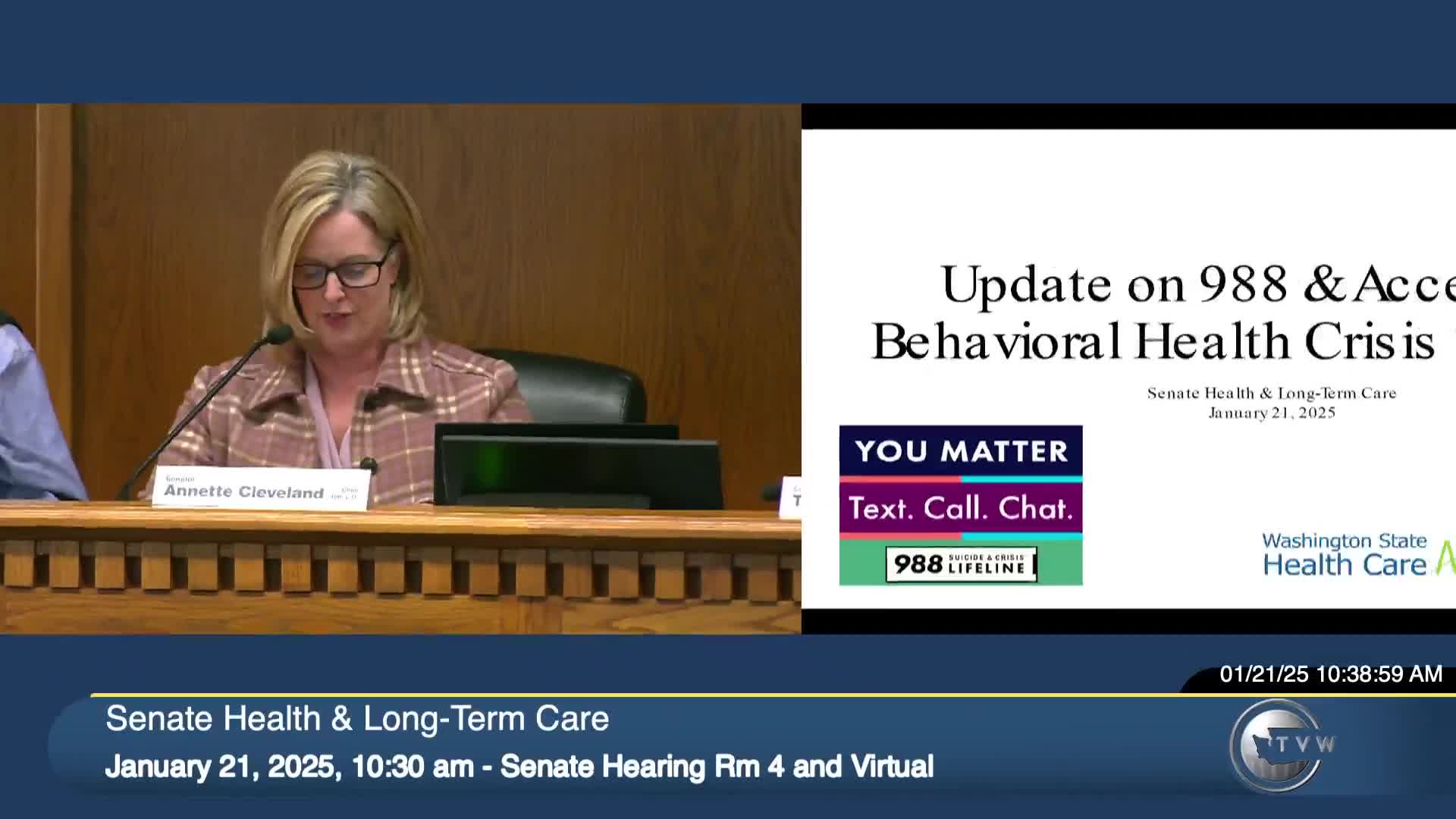
Theupdate came during a work session on access to behavioral health services. Michelle Roberts, Assistant Secretary for Prevention and Community Health at the Department of Health, and Tisha Kirschbaum, Director of the Division of Behavioral Health and Recovery at the Health Care Authority, presented the state’s progress on 988 and related crisis services.
Roberts said 988 "launched in July 2022 and it is a national 3 digit dialing code for the suicide prevention and crisis support lifeline," and noted that services are available by call, text and chat, 24/7, in English, Spanish and American Sign Language, and through interpretation in more than 240 languages. She said the Department of Health contracts with three accredited Washington crisis centers — Crisis Connections (King County), Frontier Behavioral Health (parts of Eastern Washington) and Volunteers of America (the remainder of the state) — and that centers provide mutual backup when one center needs capacity support.
Roberts described a state-funded, Washington-first "Native and Strong" lifeline routed through Volunteers of America that is staffed by Native crisis counselors who are tribal members, and said that the state has funded expansion to add text and chat for that line in the coming months. She also said the department’s funded awareness campaigns and toolkits have coincided with increased contacts to 988: "Since 2022, when 988 launched, calls, texts and chats of the 988 line have continued to increase," and she cited percentage increases in calls, texts and chats reported by the crisis centers.
Both agencies highlighted a Mental Health Crisis Call Diversion pilot that partners three 911 public safety answering points with Washington crisis centers. "In 2024, over 5,000 calls have been diverted from 911 to 988 just in those three pilot partnerships," Roberts said, describing the pilot as a "no wrong door approach" that transfers behavioral-health-related 911 calls to trained crisis counselors.
Kirschbaum described the rest of the crisis continuum beyond the contact hubs, where mobile rapid response crisis teams and community-based crisis teams provide in-person, voluntary de-escalation and follow-up, and facility-based crisis stabilization (including 23-hour centers and longer-stay crisis stabilization units) offers on-site stabilization and referral. She said endorsed teams must meet state standards for staffing, training and transportation, and that endorsed teams and community-based crisis teams deliver de-escalation, stabilization and follow-up supports.
Both agencies said they are completing a feasibility study and planning for a shared technology platform to allow information sharing across components of the continuum — from 988 contacts to mobile teams and facility providers — so help seekers need not repeat their story and providers can share relevant, consented information. Kirschbaum said the technology feasibility report would be final "in the coming weeks."
Committee members praised progress and asked about endorsement interest, ramp-up to crisis centers and the demographics of text/chat users. Roberts said she did not have exact counts available in the hearing but offered to follow up with the committee; she also said the state had taken a cautious approach to promotion early on to ensure services and staffing were in place before broad outreach.
The presentation also described rulemaking the Department of Health completed to define criteria and an application process for designating crisis hubs. Roberts said the crisis center hub rules had completed the equitable rulemaking process and would go into effect later in the month, with hub selection to occur later this year.
The agencies concluded by asking for continued collaboration with community and tribal partners as the state expands mobile response, endorsed teams and facility-based crisis resources.
Looking ahead, the Department of Health and Health Care Authority said they will continue to develop hub applications, finalize the technology feasibility study, implement text and chat for the Native and Strong line and coordinate outreach and endorsement processes for mobile crisis teams.