Get email alerts on the Partial Confinement Reentry Alignment topic
No spam. Unsubscribe anytime.
Senate bill would align partial confinement programs, expand CPA and modify substance-use assessment rules
Summary
Senate Bill 5219 would align DOC partial confinement programs so eligible people may serve up to the last 18 months of their term in community-based programs and would expand CPA eligibility and revise SUD assessment requirements for graduated reentry.
Senate Bill 5219 would align several Department of Corrections (DOC) partial confinement programs so qualifying people could serve up to the last 18 months of their confinement in community-based programs, expand Community Parenting Alternative (CPA) eligibility and change procedures for substance use disorder (SUD) assessments for transfer to graduated reentry.
Committee staff Kelsey Ann Fung said the bill extends the maximum community participation period to 18 months across multiple partial confinement tracks (work release/reentry centers, CPA, graduated reentry), adjusts minimum in-facility time required for eligibility on some GRE tracks, and allows DOC to rely on a clinically appropriate SUD evaluation rather than a comprehensive assessment as a prerequisite for transfer.
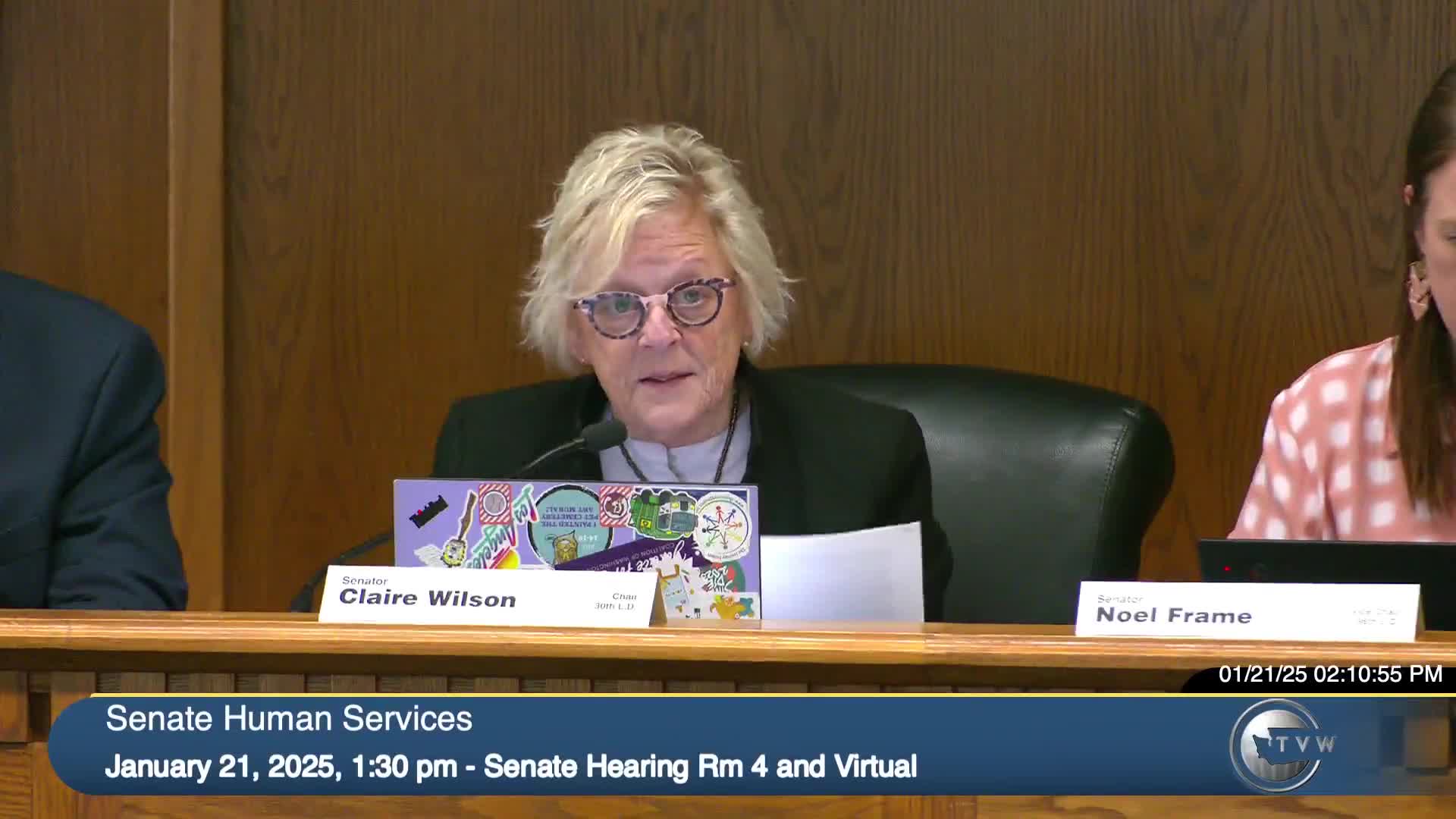
Sen. Claire Wilson, sponsor, said misaligned program start dates can push people to choose the program that becomes available earlier rather than the option that best fits their needs; aligning programs to 18 months would “allow an individual to pick the best path for them, not the one that has the longest path.”
DOC Assistant Secretary Danielle Armbruster testified in support, saying alignment and an updated definition of parent for CPA would let DOC provide resources to more children and families. She said changing SUD language would allow DOC to align processes with clinical best practices and better use limited resources.
Opponents or concerned stakeholders included Russell Brown of the Washington Association of Prosecuting Attorneys, who said expanding CPA to people without prior child relationships raises concerns in the context of a sentencing alternative, and county sheriffs expressed worry that reducing in-facility time for serious offenses would be viewed as reducing accountability and could contribute to a “revolving door” perception.
Testimony described implementation challenges, including staffing and the ability to conduct timely assessments; staff said part of the reason for changing the SUD prerequisite was difficulty completing assessments inside facilities due to limited provider access.
No committee vote was taken; supporters and opponents asked for further drafting to address concerns about eligibility and assessment language.
AI generated
The text on this page is AI generated. Summaries, highlights, analysis, and video transcripts are all produced from the original source material.
AI can make mistakes, so if you spot one, and we will fix it for everyone.
Note: the source content is unaltered by us. Any content source we link to, be it a video, an audio recording, or a document, is presented exactly as its publisher released it. That publisher is usually a government body, sometimes an individual official or another organisation.