Get Full Government Meeting Transcripts, Videos, & Alerts Forever!
Get email alerts on the State Government & Elections topic
No spam. Unsubscribe anytime.
Hearing on candidate filing changes spotlights signature thresholds and verification workload
Summary
Senate Bill 5225 would require candidates in many races to collect a minimum number of petition signatures within filing week and split filing fees between initial filing and the end of filing week.
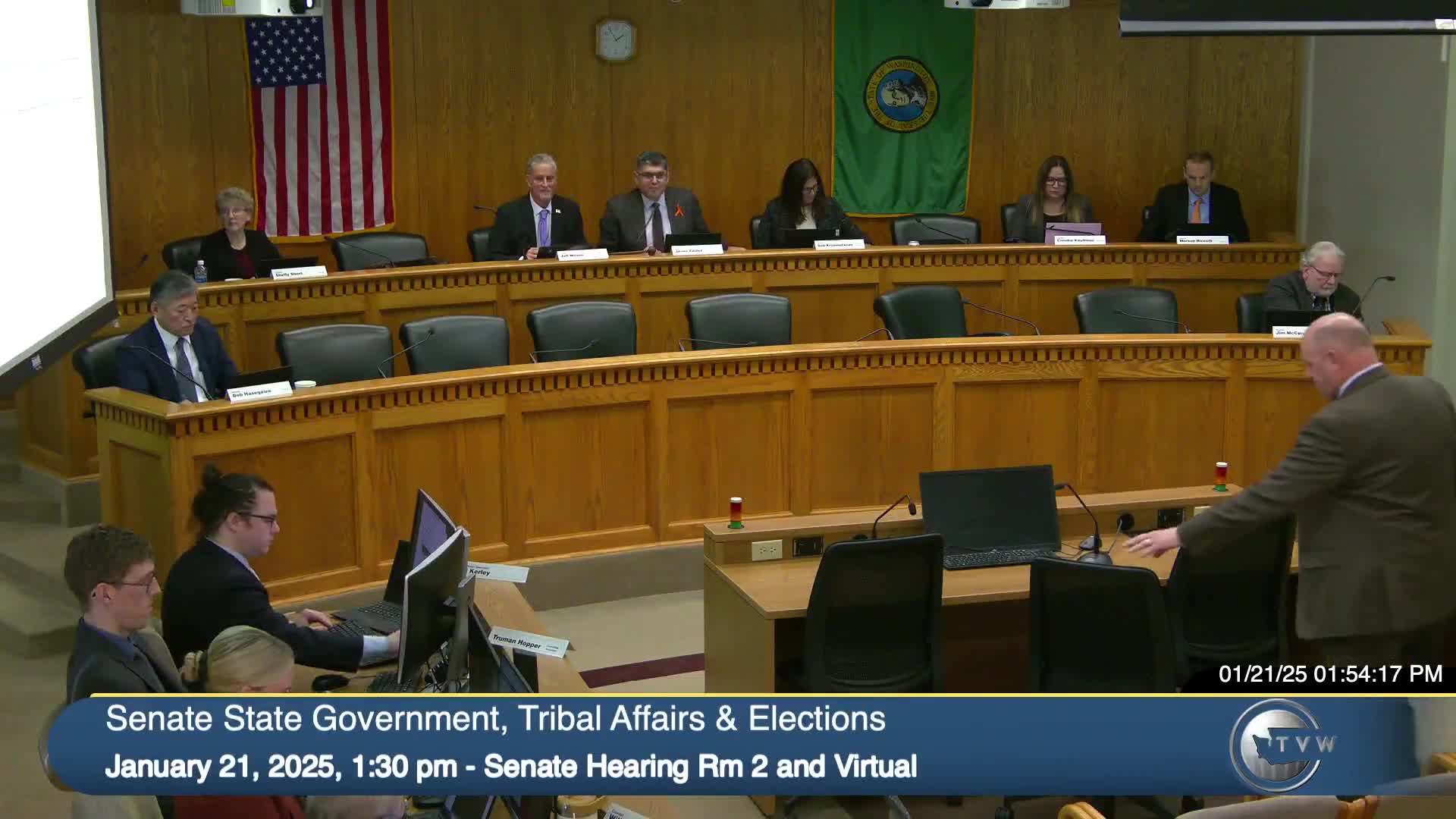
Senate Bill 5225, discussed Jan. 21 before the Senate Government, Tribal Affairs and Elections Committee, would change candidate filing rules by splitting filing fees and adding a petition-signature requirement for many offices. The bill also clarifies and expands criminal liability for using confusing or deceptive names on ballots.
William Bridges, committee staff, briefed the committee that under the bill candidates would pay half of the filing fee at the time they file a declaration of candidacy and the other half at the close of the filing week, when they must also deliver petition signatures. The proposal sets signature thresholds by office: not less than 500 signatures for state legislative offices; not less than 750 for U.S. House candidates; not less than 1,000 for statewide offices and U.S. Senate.
Senator Drew MacEwen (spelled in the transcript as McEwen) explained the bill’s intent to ensure candidates show a baseline level of support and to discourage late-week “vanity” filings and strategic withdrawals that can limit competition. MacEwen said the thresholds are modest compared with several other states and that the measure is designed to be permissive of incumbents and to lessen financial risk for candidates who pay only a portion of the fee up front.
Sean Merchant, policy director at the Office of the Secretary of State, testified that the signature-verification requirement would create a significant operational burden. Merchant said the office would be required to verify that each signer is a registered voter in the candidate’s jurisdiction and eligible to sign petitions; in a heavy year with many filings, he estimated the additional verification workload could be very large (he described numbers in the hundreds of thousands of signatures in aggregate) and could make meeting statutory deadlines for certifying candidate lists and servicing overseas ballots infeasible without extra staff or weekend work.
Committee members asked procedural questions: whether signatures must be from registered voters in the candidate’s jurisdiction (staff said yes), whether candidates could pay the entire filing fee at initial filing (staff said paying up front would not excuse the petition requirement), and whether the requirement would apply every filing cycle (staff confirmed signatures would be required each time a candidate files anew). The committee asked staff and sponsors to clarify administrative rules for late verification and to consider whether incumbency or a one-time rule change might reduce burdens.
The hearing closed with no committee vote; proponents and the Secretary of State’s office signaled a need to resolve operational details if the bill advances.