Get Full Government Meeting Transcripts, Videos, & Alerts Forever!
Get email alerts on the Firearms Tax Prevention topic
No spam. Unsubscribe anytime.
Panel split as committee hears proposal for an 11% firearms and ammunition excise tax
Summary
House Bill 1386 would impose an 11% excise tax on retail sales of firearms, firearm parts and ammunition, with sponsor intent that revenues be used for gun violence prevention, suicide prevention and victim services. The hearing drew extensive pro and con testimony.
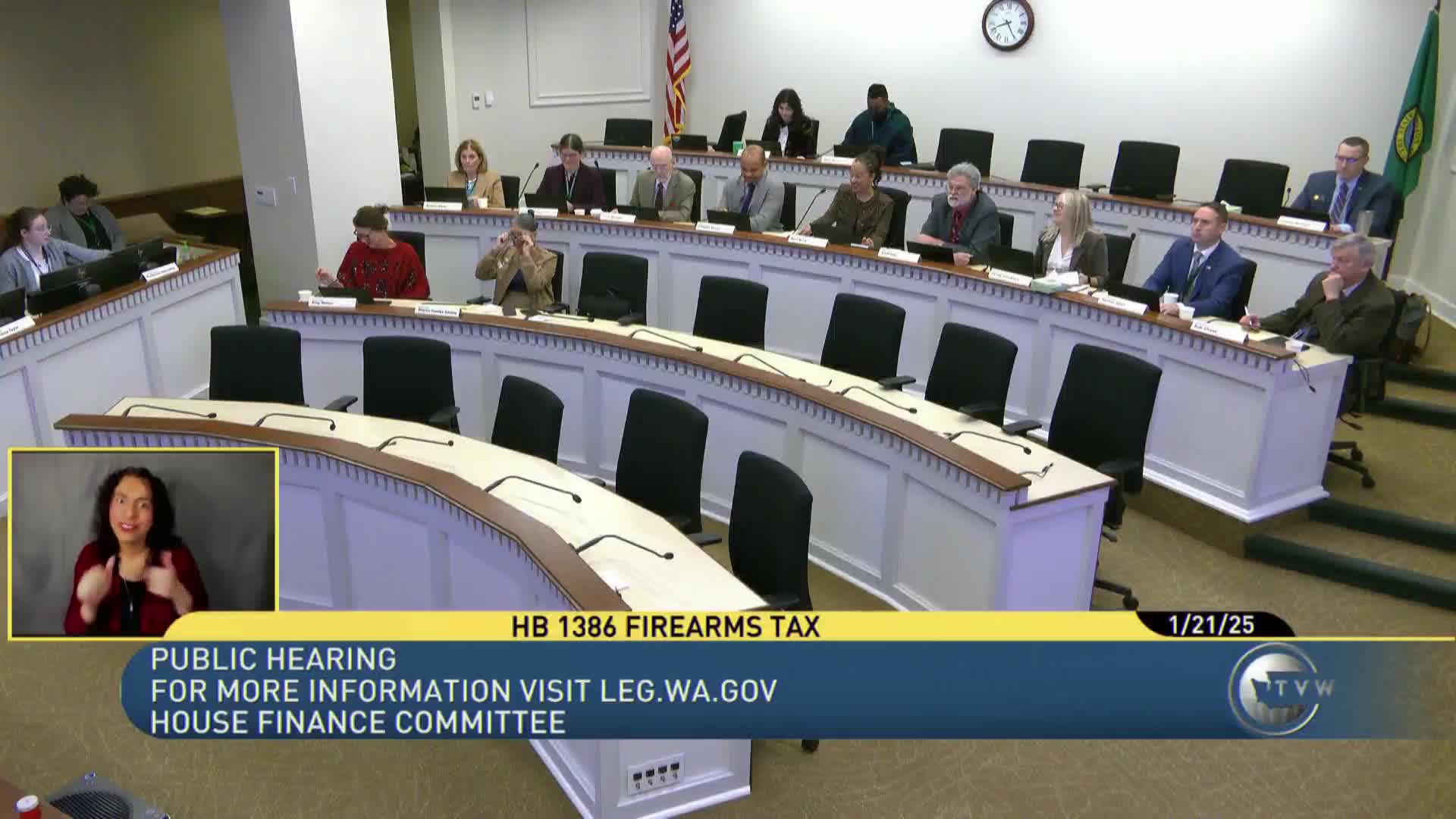
House Finance Committee members heard hours of pro and con testimony Jan. 21 on House Bill 1386, which would levy an 11% excise tax on retail sales of firearms, firearm parts and ammunition and direct the legislature’s intent that revenue be used for programs focused on gun violence prevention, suicide prevention and victim services.
"Under House Bill 1386, an excise tax is levied and collected on the retail sale of a firearm, firearm parts or ammunition. This rate is 11% of the sales price and is in addition to any other taxes levied on the sale of the item," Tracy Taylor, committee staff, said during the bill briefing. The staff briefing also noted the bill would take effect Jan. 1, 2026, and that sales to law enforcement would be exempted.
Sponsor Representative Milin Tai framed the bill as a public-health and prevention measure and likened taxing harmful consumer products to past public-policy actions on tobacco and alcohol. "The bill in front of you...I can speak for hours about the harms to mental health...the alarming rate of suicide by firearms," Representative Tai said, urging the committee to consider directing new revenue to prevention and support services.
Public-health organizations, victim-service advocates and youth testified in favor, describing firearm suicide and domestic violence trends and asking for new funding for prevention and victim services. Karen Brownson of Public Health — Seattle & King County said firearm suicides and injuries produce substantial direct and indirect costs; Melanie Smith of the Washington State Coalition Against Domestic Violence said federal victim funding has declined and state investments are needed.
Medical and youth voices also supported the bill. Dr. Crystal Shen, a pediatrician with the Washington Chapter of the American Academy of Pediatrics, described treating teens injured by firearms and urged support for prevention programs. A student speaker with the Washington Youth Alliance recounted the pervasive fear among peers and urged the committee to act to save lives.
Opponents included gun-rights groups, firearms trainers, veterans and many individual gun owners who said an excise tax would be regressive, would penalize lawful owners and would not deter criminals or reduce violence. Aileen Klein of the NRA described the tax as a "predatory assault on a constitutionally protected right," and several speakers warned the tax would raise training and ammunition costs and prompt cross-border purchases and black-market activity.
Testimony also questioned the bill’s mechanisms for ensuring revenue flows to the programs named in the bill’s intent. Staff confirmed the bill does not create a dedicated account; revenues would be deposited to the general fund unless the legislature later appropriates them for the stated purposes. "There's nothing that directs the money into a particular account. It would be deposited in the general fund like other excise taxes," Tracy Taylor said in response to a committee question.
Staff presented an estimated fiscal impact from the Department of Revenue: roughly 3,100 potential taxpayers affected; an estimated $6.6 million in additional state revenue for five months of collections in fiscal year 2026 and about $16.3 million in fiscal year 2027 (the first full year), and DOR implementation costs estimated at $347,000 in year one and $85,000 in year two. The bill exempts purchases by law-enforcement agencies; staff said the bill does not explicitly exempt federal purchases or military purchases beyond existing law.
Committee members heard a large volume of testimony both pro and con, asked clarifying questions about tax mechanics and exemptions, and closed the public hearing. No committee vote occurred during the Jan. 21 session.