Get Full Government Meeting Transcripts, Videos, & Alerts Forever!
Get email alerts on the Urban Agriculture topic
No spam. Unsubscribe anytime.
State study finds land access, water and technical assistance limit urban agriculture; recommends funding and zoning guidance
Summary
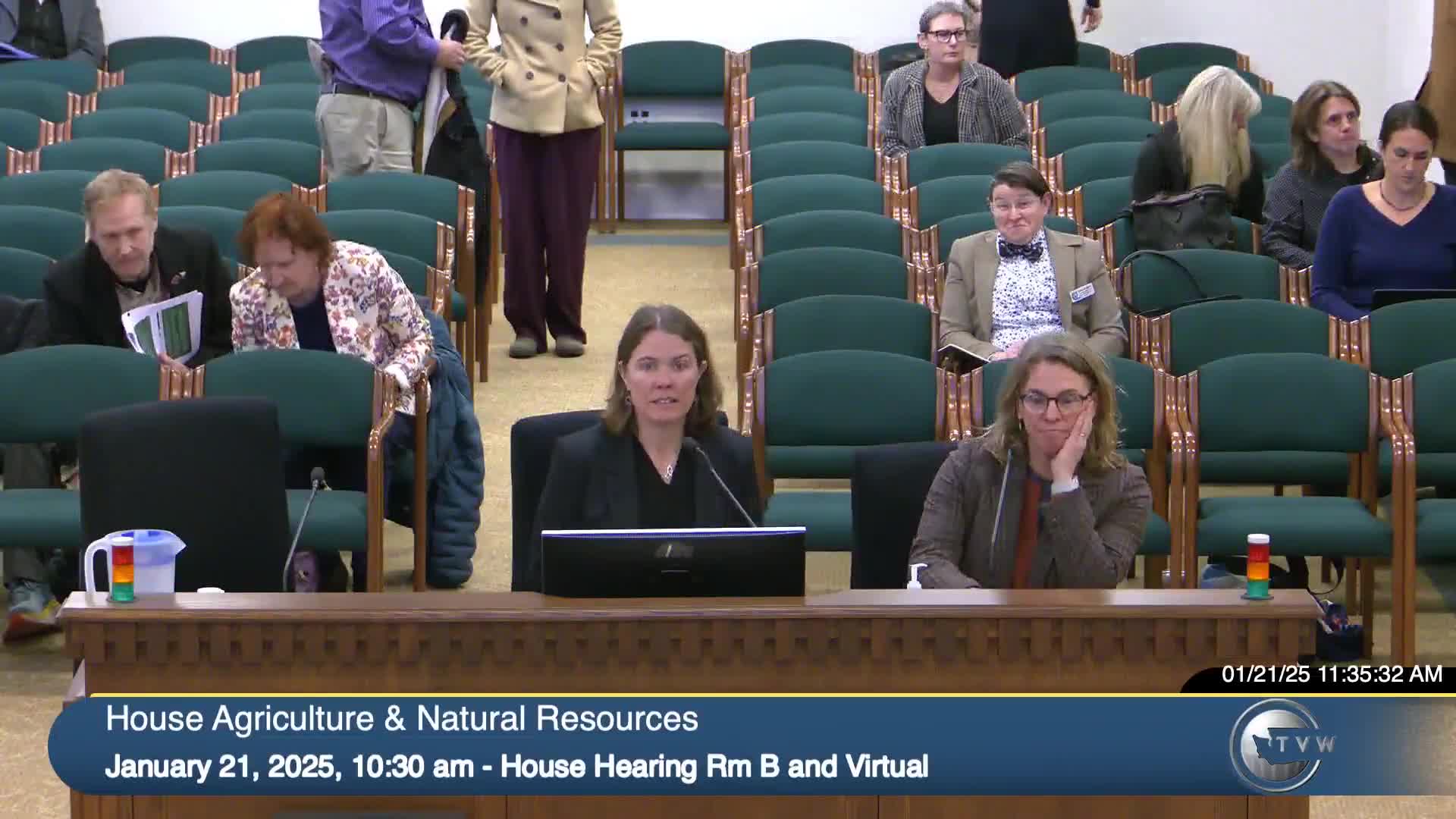
Danny Madrone, legislative director at the State Conservation Commission, presented the commission’s HB1552 (2023) study on urban and peri‑urban agriculture to the Agriculture and Natural Resources Committee on Jan. 21, identifying land access, water and technical assistance as the primary barriers to scaling production.
Danny Madrone, legislative director at the State Conservation Commission, presented the commission’s urban‑agriculture study to the Agriculture and Natural Resources Committee on Jan. 21, saying the work grew from House Bill 1552 (2023) and a set of land‑use recommendations from the Washington Food Policy Forum.
The study, prepared by Ross Strategic for the commission, focused on outdoor urban and peri‑urban farms, for‑profit and nonprofit operations, and community gardens. It combined a literature review, interviews, a focus group, a survey with 45 respondents and three case studies. The presentation emphasized the potential benefits — increased food access, economic opportunities, education and community connection — and the principal barriers: unstable land access and tenure, insufficient technical assistance and training, zoning and regulatory barriers, water cost and access, and limited market and network support.
Survey respondents (45 total) reported diverse backgrounds but uneven geographic and demographic representation: most responses were from King and Whatcom counties, and respondents identified as roughly 66% white, with smaller shares identifying as Hispanic/Latino, Asian, American Indian/Alaska Native, Black/African American and other. Madrone said timing and response rates limited sample size but the findings align with broader national and state experience on urban agriculture.
Recommendations included establishing an urban and peri‑urban agriculture advisory committee or ombudsperson (hosted at WSDA or the State Conservation Commission), issuing guidance for local governments on zoning and comprehensive‑plan language to allow agritourism, onsite sales and small‑scale animal husbandry, and increasing funding for land protection and access programs. The study suggests boosting funding for the commission’s Farmland Protection and Land Access program, creating funding sources for community land trusts and nonprofit land ownership, and expanding irrigation‑efficiency grants and match funds to help urban producers access USDA programs such as EQIP for water‑conservation investments.
Other recommendations were to provide permanent funding for consumer‑focused local‑food education programs, invest in existing networks (for example, WSU’s peri‑urban ag network and Washington Young Farmers Coalition), fund conservation‑district urban agriculture programs, and hire agricultural planners to help cities and counties provide technical assistance.
Kristin MacIver, program director for Harvest Pierce County at the Pierce Conservation District, described local implementation in Pierce County. She said the district supports 93 community gardens across the county (up from six in 2006), operates a gleaning program that has harvested 487,735 pounds of food since 2014 for redistribution, and runs an incubator/new‑farmer program that has graduated about 60 participants; 14 graduates have started farms and the district currently hosts around 11 farm businesses on an incubator property. MacIver said the district prioritizes outreach to immigrant and BIPOC communities, and many incubator participants are immigrant‑ or BIPOC‑led farms.
Committee members asked whether the study addressed indoor or vertical farming in vacant commercial space. Madrone said the report focused on outdoor production but acknowledged that indoor production and year‑round systems are an important part of the broader urban‑agriculture landscape and could be considered in future work. Vice Chair Morgan asked about low representation of Black farmers in survey results; Madrone offered to follow up with members with more targeted recommendations on improving equity and recruitment.
The study lists short‑ and medium‑term actions state agencies and local governments can take, and the commission recommended continued investment to expand land access, water support and technical assistance so urban and peri‑urban food systems can scale.