Get Full Government Meeting Transcripts, Videos, & Alerts Forever!
Get email alerts on the Tax Administration Dor topic
No spam. Unsubscribe anytime.
Committee reviews bill standardizing local tax notices to Department of Revenue
Summary
House Bill 1126 would require written standardized notifications — including signed ordinances or resolutions — to the Department of Revenue when local governments change sales and use tax rates or annex territory affecting tax boundaries.
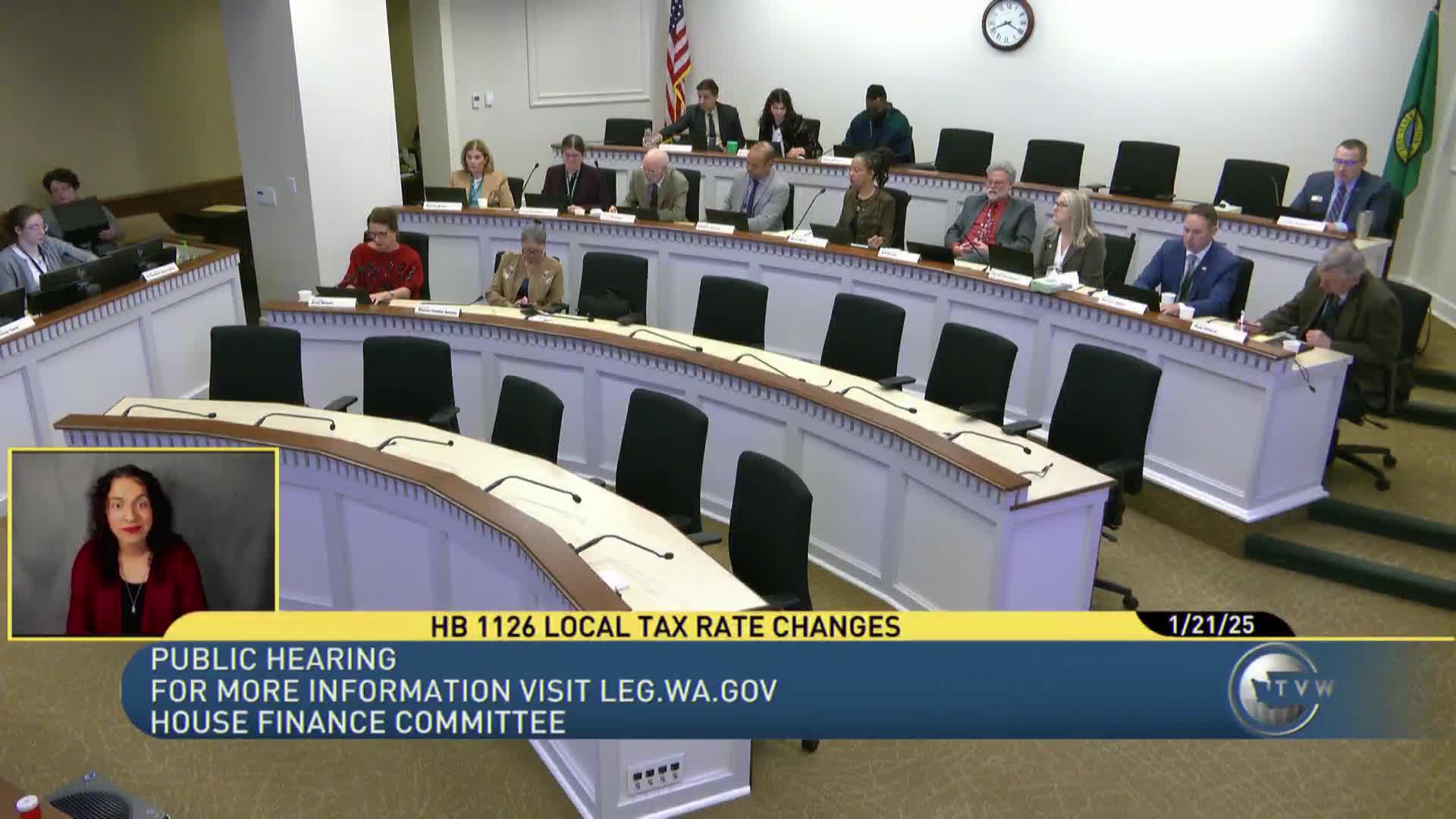
House Finance Committee staff and the bill sponsor briefed members Jan. 21 on House Bill 1126, a Department of Revenue (DOR) request bill that standardizes what local governments must send the department when they change local sales and use tax rates.
"House Bill 1126 updates notification requirements to the Department of Revenue for local government that makes changes to local sales and use tax rates," Tracy Taylor, committee staff, said in the staff briefing.
Under current practice, the state sales tax rate is 6.5 percent and local sales and use tax rates vary by jurisdiction; local governments generally must notify the DOR at least 75 days before a rate change (30 days where the local tax is credited against the state portion). HB 1126 would require written notification to include a copy of the signed ordinance or resolution enacting the change. For annexations that change tax boundaries, the written notice would also need a legal description, boundary map and list of parcel numbers. The bill also requires public facilities districts that impose a local tax credited against the state tax to notify the DOR of the actual bond retirement date at least 70 days before retirement.
Representative Wallen, the prime sponsor, described HB 1126 as a practical, government-admin request bill to create a standardized form for the many counties, cities and taxing districts that interact with the DOR. "With 39 counties and 281 cities and a couple of thousand taxing districts, I think a standardized form makes sense," Wallen said.
Staff said the bill’s effective date would be 90 days after adjournment and that an initial fiscal note showed no revenue impact and no implementation cost to the DOR.
Committee members asked clarifying questions about the numbers cited and about whether the bill would address specific notice nuances (for example, for tax changes credited against the state portion). The committee closed the hearing after receiving testimony from Department of Revenue staff and the sponsor.