Get Full Government Meeting Transcripts, Videos, & Alerts Forever!
Get email alerts on the Freight Mobility topic
No spam. Unsubscribe anytime.
Freight Mobility board pitches 6‑year investment plan and a multi‑pronged truck parking strategy
Summary
The Freight Mobility Strategic Investment Board briefed the committee on Jan. 21 on a new six‑year investment program and a multi‑part truck‑parking strategy that includes data tools and proposed state matching funds.
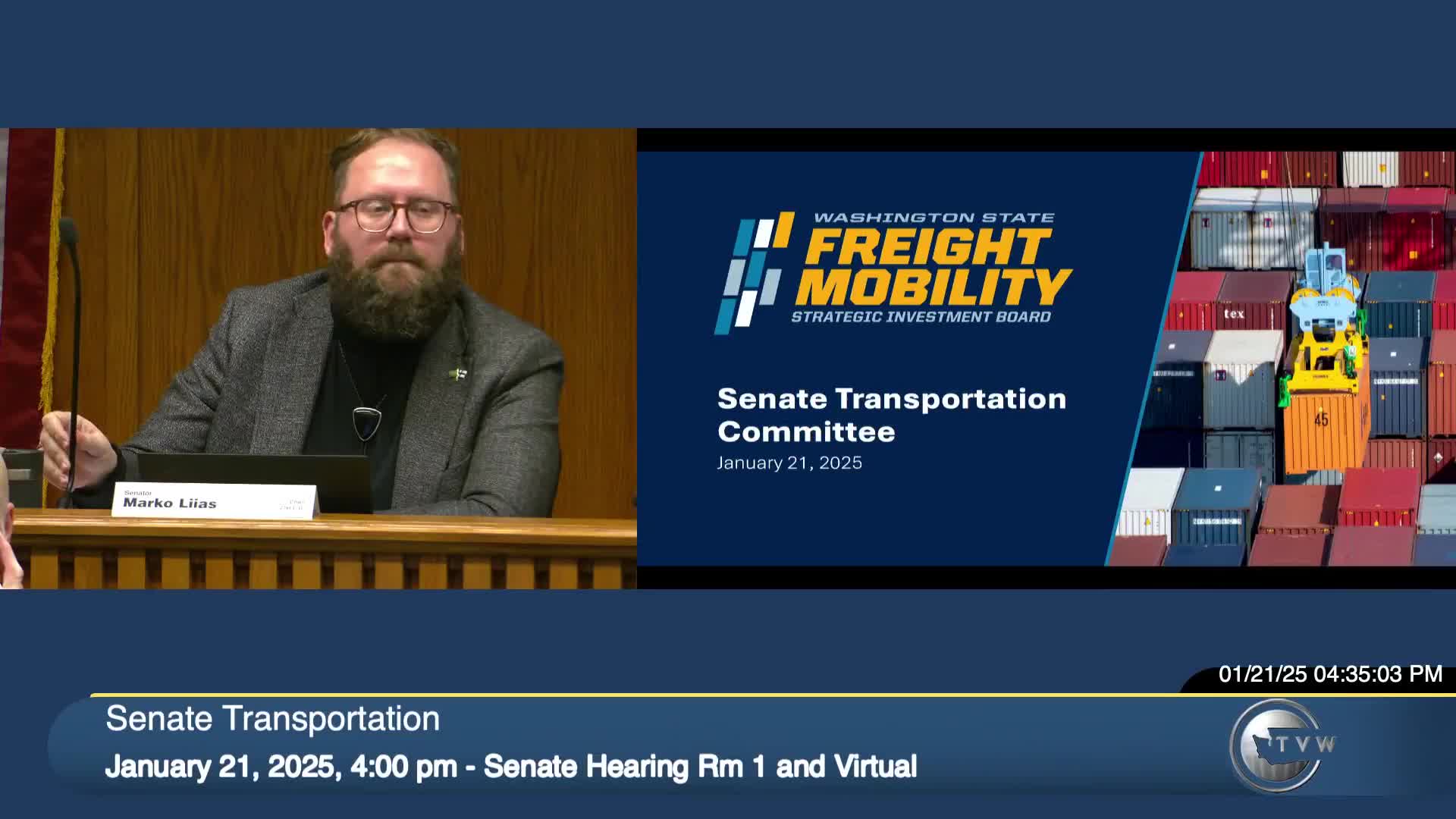
The Freight Mobility Strategic Investment Board (FMSIB) briefed the Senate Transportation Committee on Jan. 21 on a new six‑year investment program, updated community‑integration tools and an actionable suite of recommendations to address long‑running truck‑parking shortages.
Board priorities and six‑year plan
Brandi DeLange, FMSIB executive director, said the board developed a six‑year investment program that vetted approximately 66 candidate projects and produced a list of 34 projects for consideration; 11 projects received specific funding recommendations for the 2025–27 biennium while others are identified in out‑years without committed dollar amounts. DeLange said the program is new to the agency, will be refined with stakeholder engagement, and relies on integration with a mapping tool that highlights overburdened communities and nearby freight infrastructure.
Community integration and mitigation tools
Under direction from House Bill 1084, FMSIB worked with BERC and Cascadia Consulting to develop mapping and application worksheets to help applicants identify community impacts and mitigation strategies. DeLange said FMSIB will input the six‑year project list into the mapping tool so sponsors and community stakeholders can see existing freight infrastructure and whether proposed projects overlap with neighborhoods designated as overburdened.
Truck parking recommendations
DeLange presented a six‑part truck‑parking strategy that includes: (1) creating a truck parking information management system (TPIMS) to help drivers locate available spaces; (2) pursuing a $30 million state match to leverage a RAISE grant for expanding the I‑5 Fort Lewis weigh station; (3) providing safety rest‑area infrastructure (water/sewer); (4) identifying a lead entity to coordinate government and private investment; (5) piloting public‑private partnership (P3) approaches to expand parking; and (6) ensuring long‑term maintenance and operations for new truck‑parking sites.
Funding, staffing and outreach needs
DeLange said FMSIB is a small agency (staff of three) that depends on partnerships and back‑office support; the board has a decision package before the Legislature to request additional staff and resources for program delivery and outreach. DeLange also said FMSIB intends to continue outreach to broaden applicant participation and ensure geographic diversity across the state.
Ending
DeLange framed the six‑year program and truck‑parking package as practical, implementable steps that will require legislative support for matching funds and administrative capacity. She described the mapping tool and applicant worksheet as part of the board’s effort to make freight investments more responsive to community concerns.