Get Full Government Meeting Transcripts, Videos, & Alerts Forever!
Get email alerts on the Local Roads Funding topic
No spam. Unsubscribe anytime.
County Road Administration Board urges new competitive grant to tackle 'local roads' crisis
Summary
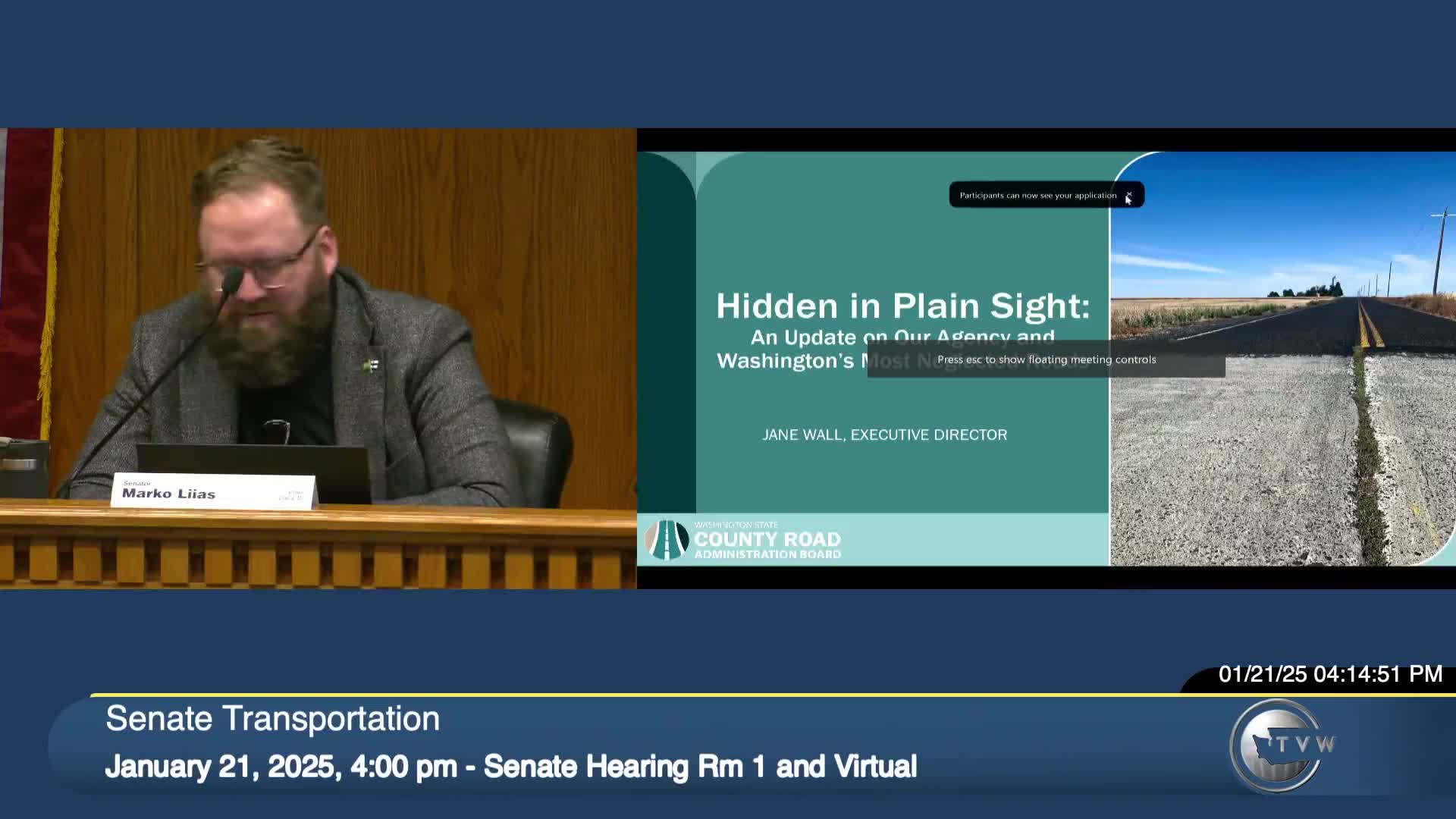
Jane Wall, executive director of the County Road Administration Board, told the committee that local roads—62% of county lane miles—lack a dedicated funding program and CRAB will propose a phased competitive grant program and a decision package this session.
The County Road Administration Board told the Senate Transportation Committee on Jan. 21 that Washington’s local roads lack a statewide funding program and that counties need new grant authority to address reconstruction, bridges, fish‑passage and pedestrian facilities.
CRAB Executive Director Jane Wall said the board will propose a competitive grant program to serve the state’s 39 counties and is seeking legislative support for a decision package and forthcoming bill.
Why local roads matter
"Local roads are expansive. They're ubiquitous and deeply intertwined with everyone in this room's goals for Washington," Jane Wall, CRAB executive director, told the committee. She said local roads are a federal functional class (class 9) and make up 62% of the county road system, representing roughly one third of all roads in the state and far more lane miles than the state highway system.
Wall described local roads as a varied set of facilities—from heavily used urban arterials with transit stops to rural routes serving schools, timber and farm‑to‑market traffic—and said many were transferred to counties without funding for long‑term maintenance.
Scale and safety concerns
CRAB provided several measures to show the scope of the issue: the county road network covers about 78,000 lane miles; local roads include roughly 1,500 miles that CRAB rates for pavement preservation work; and local roads carry notable safety burdens. Wall said there were 518 fatal or serious‑injury collisions on county local roads from 2019 to 2023 (111 fatalities and 480 serious injuries referenced in her presentation) and that many local roads also serve as critical emergency routes, provide access to federal and state lands, and connect schools and health centers.
CRAB’s proposal and rationale
Wall urged the Legislature to fund a phased competitive grant program administered by CRAB, targeted to high‑need projects (2R/3R reconstruction, bridge replacement, fish passage removal, pedestrian facilities), with a phased rollout to reflect administrative realities. She said CRAB’s administrative costs are low (the agency estimates 2.5–4% overhead) and that a state grant program for local roads would free county capital funds for preservation and match on larger state and federal grants.
The board has also submitted a decision package to help counties and cities with bridge load‑rating work required by federal changes and warned that non‑compliance could put the state’s federal funding at risk. Wall said CRAB will bring a bill in the coming days or weeks and asked the committee to consider the unique state–county partnership in addressing the funding gap.
Ending
Wall closed by stressing local roads’ links to fish‑passage removal, freight, safety, equity and economic development and asking legislators to "work with us, the County Road Administration Board, to solve this problem."