Get Full Government Meeting Transcripts, Videos, & Alerts Forever!
Get email alerts on the Restoration Of Rights topic
No spam. Unsubscribe anytime.
Panel Debates Venue and Eligibility Changes in HB 1118 on Restoration of Firearm Rights
Summary
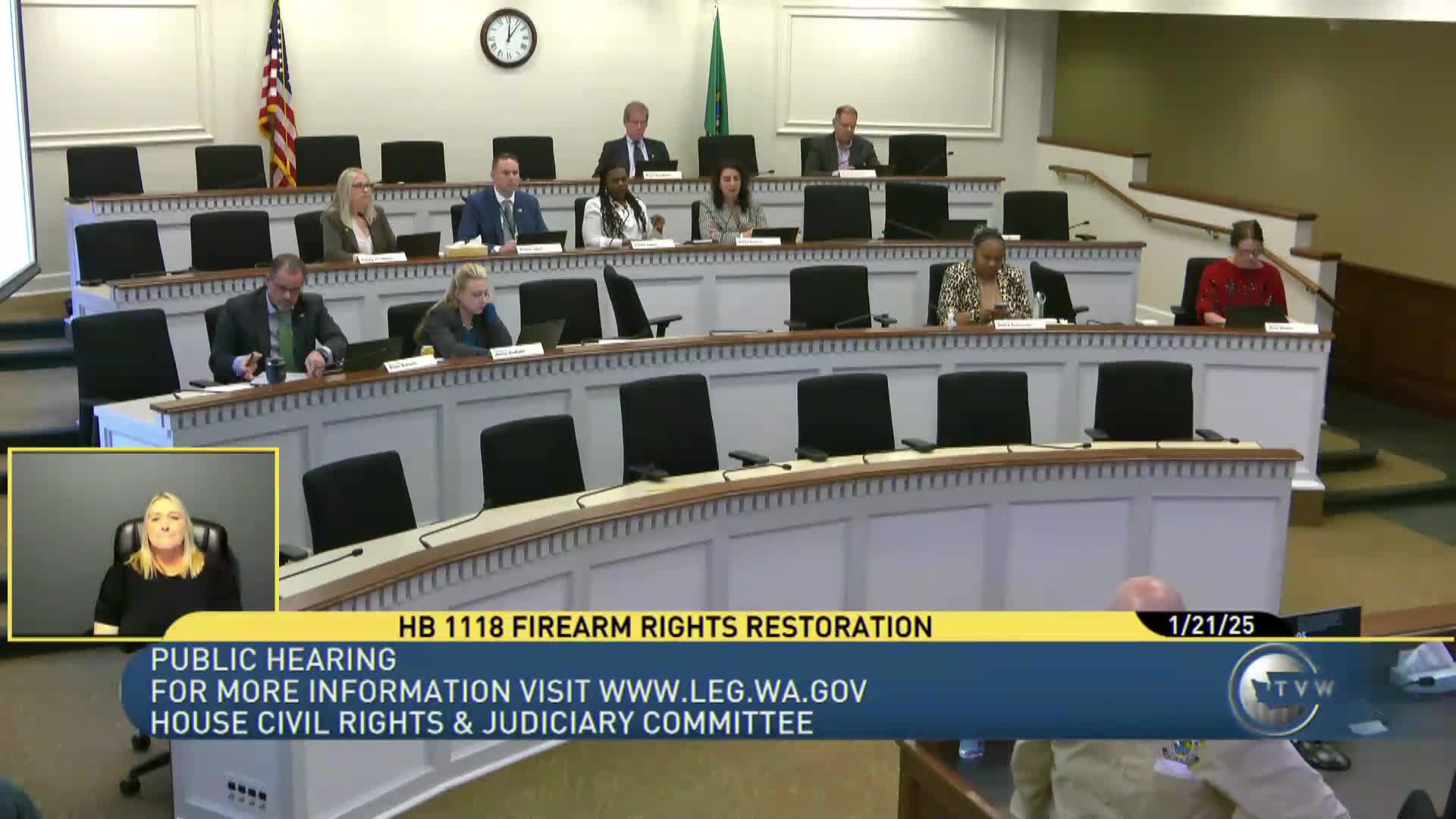
House Bill 1118 would broaden where petitioners may file a superior-court petition to restore firearm rights — allowing filing in the county that entered the prohibition, in a petitioner’s Washington county of residence when the underlying conviction was outside the state, or in Thurston County for nonresidents — and would remove certain class B nonviolent drug offenses from the list of disqualifying convictions.
House Bill 1118 would change where a person may petition a superior court for restoration of firearm rights and would narrow some offenses that permanently bar a petition. Currently, a person seeking restoration must file in the county that entered the prohibition; HB 1118 would allow filing in any county that entered the prohibition, in the petitioner’s county of residence if the prohibiting conviction did not occur in Washington, or in Thurston County if the petitioner is not a Washington resident. The bill would also exclude certain class B nonviolent drug offenses from the list of offenses that prohibit a petition for restoration.
Sponsor Representative Tara Simmons described the bill as bipartisan and said it was intended to address technical and equity issues in the restoration process — particularly for people whose underlying convictions occurred out of state and who therefore lack a practical venue to petition in Washington. Several witnesses, including individuals who said they had regained rights or sought restoration, testified in support and urged easier access to restoration for rehabilitated individuals.
Opponents, including organizations that represent survivors of intimate-partner violence and narcotics investigators, urged caution. The Violence Law Center and others asked the committee to allow the Washington Supreme Court to issue its pending decision in State v. Aarons (oral argument scheduled) before the Legislature changes venue rules. Those witnesses emphasized that filing in the county that entered the prohibition gives local prosecutors and law enforcement jurisdictional context and contact information for survivors and urged the committee not to make changes that could reduce survivor protections.
Other witnesses supported the bill on fairness grounds, arguing that people who have paid their debt to society and been rehabilitated should be able to pursue restoration; prosecutors and defense stakeholders also urged clarifying full faith-and-credit recognition for out-of-state restorations. The committee heard testimony from prosecutors who said the bill could be improved by adding full-faith-and-credit language so an out-of-state restoration would be recognized in Washington without repeating court processes.
The hearing closed without a committee vote. Committee staff and several witnesses said they would follow up with technical suggestions and pointed to a pending Washington Supreme Court case that could affect venue law.