Get Full Government Meeting Transcripts, Videos, & Alerts Forever!
Get email alerts on the Wdfw Governance Review topic
No spam. Unsubscribe anytime.
Ruckelshaus Center urges governance, funding and tribal‑coordination reforms for WDFW
Summary
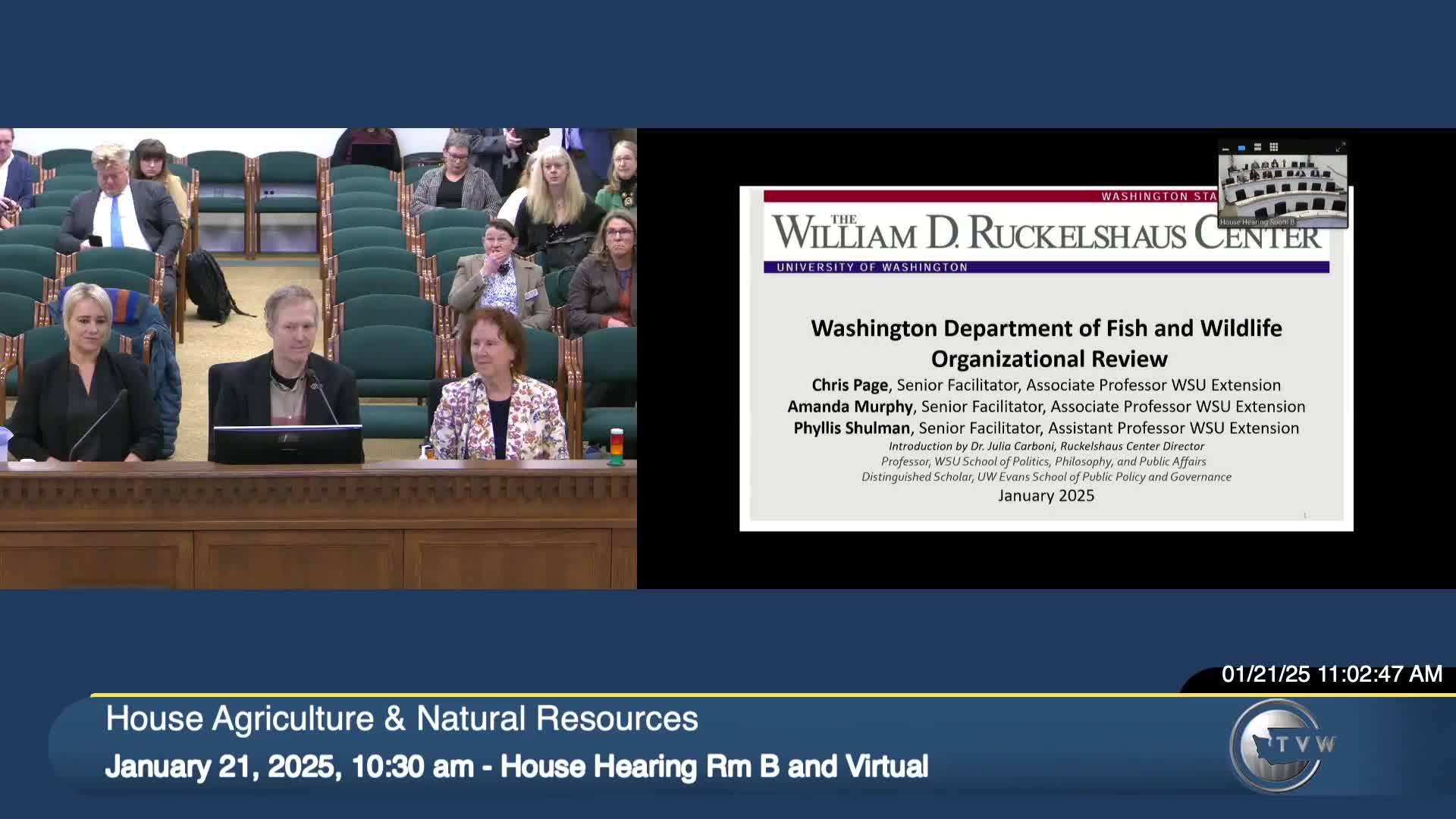
The William D. Ruckelshaus Center told the Agriculture and Natural Resources Committee on Jan. 21 that its organizational review of the Washington Department of Fish and Wildlife, based on roughly 100 interviews, finds structural governance problems, funding confusion and gaps in tribal coordination that require major reforms or a change in agency structure.
The William D. Ruckelshaus Center told the Agriculture and Natural Resources Committee on Jan. 21 that its comprehensive review of the Washington Department of Fish and Wildlife (WDFW), based on more than 100 interviews, identifies structural governance problems, confusion about funding and a need for clearer tribal coordination and scientific transparency.
The center presented three governance options: maintain the status quo; convert WDFW into a cabinet agency; or keep a commission structure but implement multiple significant, simultaneous reforms to address appointment processes, commissioner roles and resourcing. The center cautioned that maintaining the commission without comprehensive reforms is unlikely to be viable if there is insufficient political will in the Legislature and governor’s office to pursue major change.
Dr. Julia Carbone, director of the Ruckelshaus Center, said the review was designed as an organizational assessment with a future focus, asking stakeholders to describe a successful vision for WDFW and then identifying what must be sustained or changed to achieve it. Chris Page, Amanda Murphy and Phyllis Shulman of the center summarized findings drawn from about 103 interviews with tribal, local, state, conservation, industry and other stakeholders.
Key findings included widespread confusion about the commission’s role and appointment process; concerns about the commission’s staffing and support; differing interpretations of WDFW’s dual mandate to conserve fish and wildlife while maximizing hunting and fishing opportunities; and inconsistent funding information. The report said many stakeholders appreciate recent legislative investments for biodiversity work, but that more predictable long‑term funding is needed. The center recommended updating WDFW’s long‑term funding plan and improving public communication about how the agency is funded.
On tribal relations, the center said the statutory and co‑management context is complex and varies tribe‑by‑tribe. The report recommends clarifying the commission’s role in relation to U.S. v. Washington and U.S. v. Oregon co‑management frameworks, increasing tribal liaisons and providing training for staff and commissioners on tribal sovereignty, treaty rights and co‑management.
The center recommended that the department continue implementing and investing in its science and decision‑making policies, expand transparency of data and models used for decisions, and sustain recent improvements in public engagement and advisory committees. It also urged building collaborative capacity, particularly to engage communities that have not traditionally participated in WDFW processes.
During questions, Representative Springer asked which actors must have political will to change the governance structure; Chris Page replied that converting the commission or implementing major reforms would require political will from the state Legislature and governor. Committee members also pressed on the government‑to‑government relationship with tribes; presenters said stakeholders described the relationship as improved at the department level but that clarity about the commission’s role is still needed.
The Ruckelshaus Center provided a menu of reform options and recommended a deliberate transition strategy and communication plan if major governance changes were adopted. The center also recommended delaying any public process to revise the agency’s statutory mandate until structural conflicts are reduced and collaborative capacity is strengthened, while noting the need to consult tribes about any mandate changes that would affect co‑management.
The report and its recommendations now sit with the committee; presenters said the review may lead to follow‑up legislation and the center offered to assist in process design to implement reforms.