Get Full Government Meeting Transcripts, Videos, & Alerts Forever!
Get email alerts on the Transportation Funding topic
No spam. Unsubscribe anytime.
Transportation Improvement Board warns declining gas-tax revenue will squeeze grants for city and small-town projects
Summary
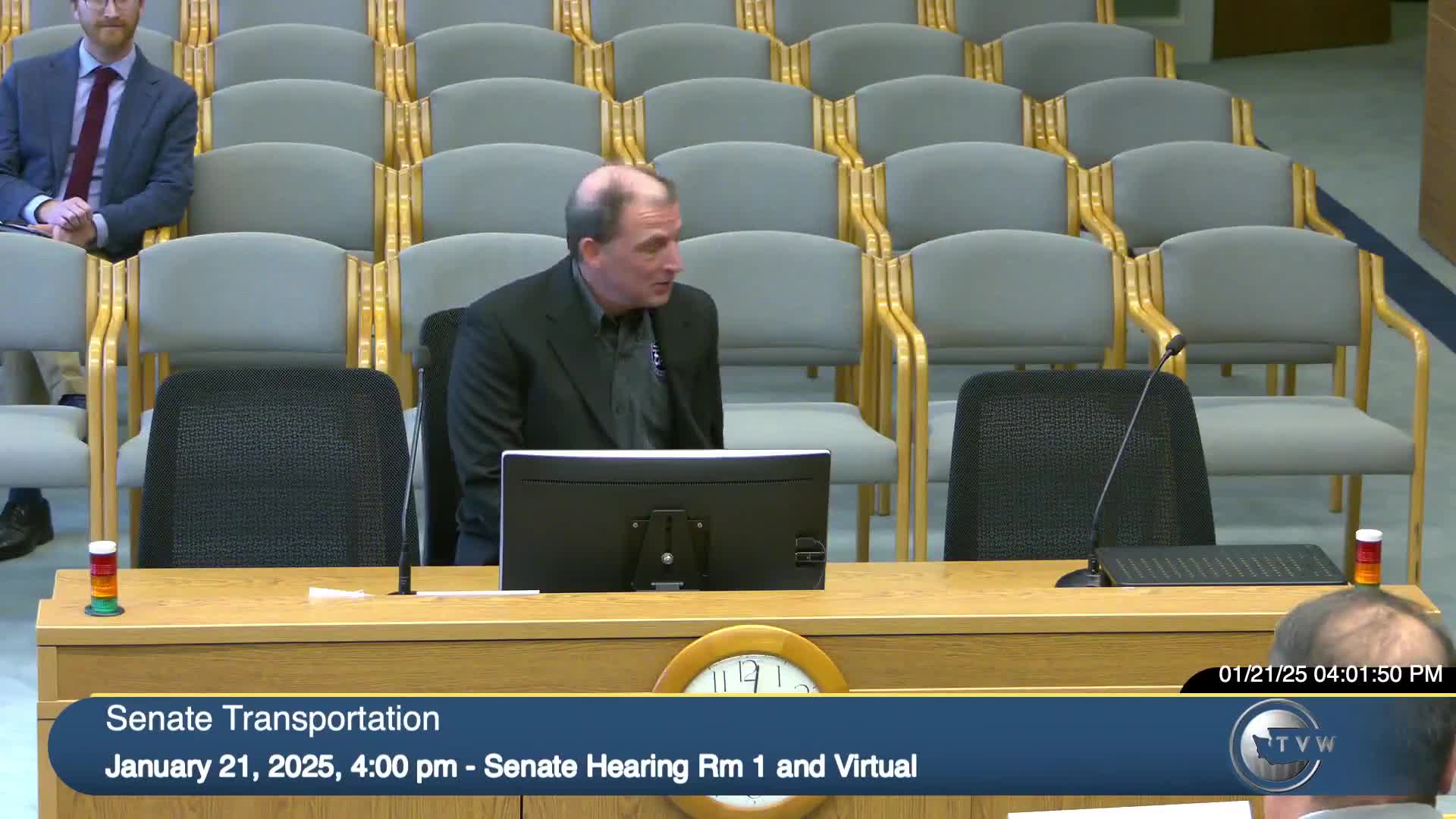
Ashley Probert, executive director of the Transportation Improvement Board, told the Senate Transportation Committee that TIB is highly dependent on the gas tax, is awarding record grants, and is watching revenue forecasts as gas-tax receipts and project readiness change.
Transportation Improvement Board receives 3 cents of the state gas tax and uses it to fund city and small‑town projects, Executive Director Ashley Probert told the Senate Transportation Committee on Jan. 21.
Probert told the committee the Board receives roughly $100 million a year from that 3‑cent share and has distributed TIB funds to about 5,400 projects over 25 years, with total TIB funding of about $3.6 billion (matching pushes that to roughly $5 billion).
TIB’s role and why it matters
TIB funds range from small‑city preservation to urban arterial construction. "When you fill up at the gas tank or gas pump and you pay your $0.49 gas tax, $0.03 of that gas tax comes to the Transportation Improvement Board and it's roughly about $100,000,000 a year," Probert said. She described TIB as the primary paving program for towns under 5,000 people and as a partner on larger urban projects where funding often follows an approximate "one‑third, one‑third, one‑third" pattern: one third TIB, one third local, one third federal pass‑through.
Probert highlighted program scale and recent awards: the board has awarded a record $145 million in a single selection cycle and funded 179 projects this most recent round from 343 requests, with applicants asking for about $287 million. She said historically demand is commonly three to four dollars chasing every TIB dollar, though recent supply and labor shifts have reduced applications.
Revenue and program delivery risks
Probert warned that TIB is about 95% dependent on the motor‑fuel excise tax and called attention to a weakening revenue forecast. For the 2025–27 biennium she cited an updated forecast of $192 million for TIB with a $7 million drop already reflected. She said TIB receives a small and growing electric‑vehicle fee but that it does not replace motor‑fuel receipts.
Probert also described non‑statutory distributions TIB receives (for preservation and Complete Streets) that function like an additional fraction of a cent of gas‑tax equivalent. She said Move Ahead Washington added $10 million per biennium for city preservation and that Complete Streets funding has doubled in recent years, which generated a surge of ready projects; TIB implemented early calls in March and May 2024 and required many of those projects to be closed by April 30, 2025.
Performance measures and small‑city focus
Probert said TIB’s dashboard and annual assessment track project delivery and pavement condition. She described a long‑term small‑city preservation effort that moved the number of very poor pavement‑condition towns down to five "red towns" in the latest data and expects that number to fall further when the agency refreshes its dataset.
Questions from committee members were limited; Probert closed by noting the agency will monitor legislative proposals this session, including any road‑usage charge (for which revenue neutrality matters to TIB) and a retail delivery fee. She also said the board will pursue minor statutory cleanups to remove obsolete references in TIB law.
Ending
Probert invited committee members to TIB’s public performance dashboard and said the agency will work to deliver its historic portfolio of projects despite revenue uncertainty. "We have 5[0] active projects and the largest grant awards in our agency history," she said, noting the board would focus on delivery and low‑cost maintenance for small cities.