Get Full Government Meeting Transcripts, Videos, & Alerts Forever!
Get email alerts on the Ecosystem Services And Carbon topic
No spam. Unsubscribe anytime.
DNR outlines study of ecosystem‑service markets and plan to set aside carbon‑dense trust lands
Summary
At a Jan. 21 hearing, Duane Emmons of the Washington Department of Natural Resources summarized three proviso‑funded studies on monetizing ecosystem services, modeling forest management for carbon and economic outcomes, and a $70 million land‑acquisition program to set aside carbon‑dense trust lands.
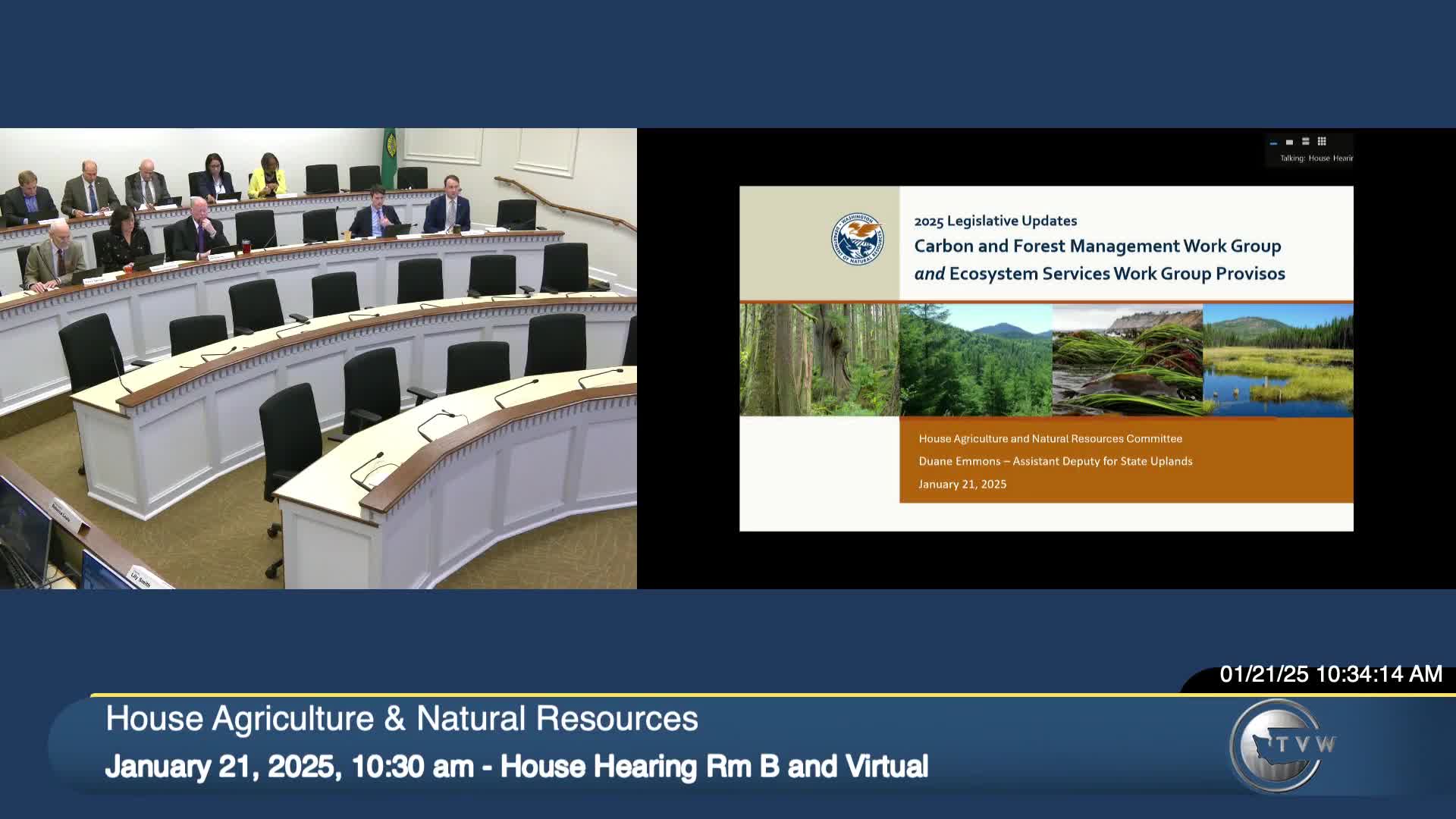
Duane Emmons, Assistant Deputy for State Uplands at the Washington Department of Natural Resources, told the Agriculture and Natural Resources Committee on Jan. 21 that the department is completing three proviso‑funded studies examining how state lands might participate in ecosystem‑service markets, how forest management scenarios affect carbon and local economies, and how to use legislative funds to set aside carbon‑dense forest parcels.
The work matters because the department manages lands that generate revenue for trust beneficiaries, and any entry into voluntary or regulatory markets for carbon, water quality, wetlands mitigation or other ecosystem services could affect conservation outcomes, timber supply and county economies.
Emmons said the department contracted with private consultants and convened multi‑stakeholder work groups to inventory ecosystem‑service assets, analyze market definitions and constraints, develop a marginal‑cost abatement model, and prepare implementation recommendations. Contractors named in the presentation include Green Economics (ecosystem services inventory) and ESSA and Evergreen Economics (forest/carbon and economic modeling). The studies examine both regulatory and voluntary carbon markets, blue carbon on aquatic lands, wetland mitigation, emerging water‑quality and water‑quantity markets, and avoided wildfire‑emissions credits.
Emmons described the forest‑management modeling as scenario‑driven: a work group set eight management pathways (for example, lengthening harvest rotations, shortening rotations, increasing thinning, increasing young‑stand silviculture, or increasing deferrals). Contractors are modeling those eight pathways under two climate scenarios, producing roughly 16 model runs to estimate carbon sequestration, carbon in harvested wood products, and regional wood supply impacts. Emmons said initial model outputs showed implausible results in some scenarios — for example, a modeled thinning rate that would thin nearly 100% of stands — and the work group is refining scenario parameters to reflect realistic management.
"Natural systems are much more complex than rocket science," Emmons said, urging caution in interpreting preliminary results. He told the committee the department will deliver a final asset inventory and implementation recommendations in spring and a legislative report by mid‑to‑late June per the proviso schedule. Emmons also said the department conducted broad outreach for work‑group membership — sending invitations to more than 200 individuals and entities — but received limited applications from tribal and environmental‑justice organizations for some groups: for one work group he said only two tribes and one environmental‑justice applicant responded.
On the land‑acquisition proviso, Emmons said the budget provided $70,000,000 to set aside up to 2,000 acres of carbon‑dense, structurally complex forest and purchase replacement trust lands, with any remaining funds to be applied to land purchases for encumbered‑lands counties identified in the proviso. He said the department identified the 2,000 acres called for in the proviso and reported acquiring more than 8,000 acres in a partnership transaction described as the Deep River Woods transaction, brokered jointly with a conservation partner that is holding additional parcels under option for future purchase as funding becomes available. Emmons said the department subsequently received additional legislature funding to continue acquisitions.
Committee members asked for clarification on several technical points. Representative Dent asked Emmons to define "avoided wildfire emissions" credits; Emmons said the work is ongoing and he was not yet certain how that market would operate, but offered to follow up with more detail. Representative Orcutt asked what "manage" means for carbon‑dense, structurally complex stands; Emmons said the proviso language envisions treatments such as habitat‑restoration thinning, variable‑density thinning or selective removals (including pollarding or selective removal of high‑value poles) to open canopy gaps and stimulate growth in remaining trees. When Orcutt asked whether the scenarios include changes to tree species planted under reforestation, Emmons said modeling included increased silviculture and some attention to species shifts under climate scenarios but that the contractors confront uncertainty when projecting future species distributions.
Emmons closed by telling the committee the work is complex and will continue through the proviso timeline; Chair Reeves said the committee will invite him back and hold a public hearing on pending legislation that would authorize DNR to pursue carbon‑sequestration activity on state lands.
The presentation identified next steps and delivery dates: asset inventory and implementation plan due in late April/early May, final work‑group meetings in late May, and a final legislative report with recommendations by mid‑to‑late June. Emmons told the committee he would provide more detail to members who requested clarifications on avoided‑emissions markets and species‑mix questions.