Get Full Government Meeting Transcripts, Videos, & Alerts Forever!
Get email alerts on the Firearm Storage topic
No spam. Unsubscribe anytime.
Committee Hears Bill Requiring Locked, Concealed Storage for Guns in Homes and Vehicles
Summary
House Bill 1152 would require firearms left in vehicles to be stored unloaded in an opaque, locked container affixed within the vehicle, concealed from outside view, and for the vehicle to be locked; it also sets secure-storage standards for firearms in residences and establishes civil and criminal penalties for violations.
House Bill 1152 would require firearms left in vehicles to be stored unloaded in an opaque, locked container affixed within the vehicle, concealed from outside view, and for the vehicle to be locked; pistols must be in hard-sided containers while rifles and shotguns may be in hard- or soft-sided containers. The bill would also require firearms in residences to be securely stored whenever not being carried or readily controlled by the owner or other lawfully authorized user, and it prescribes civil and criminal penalties for violations.
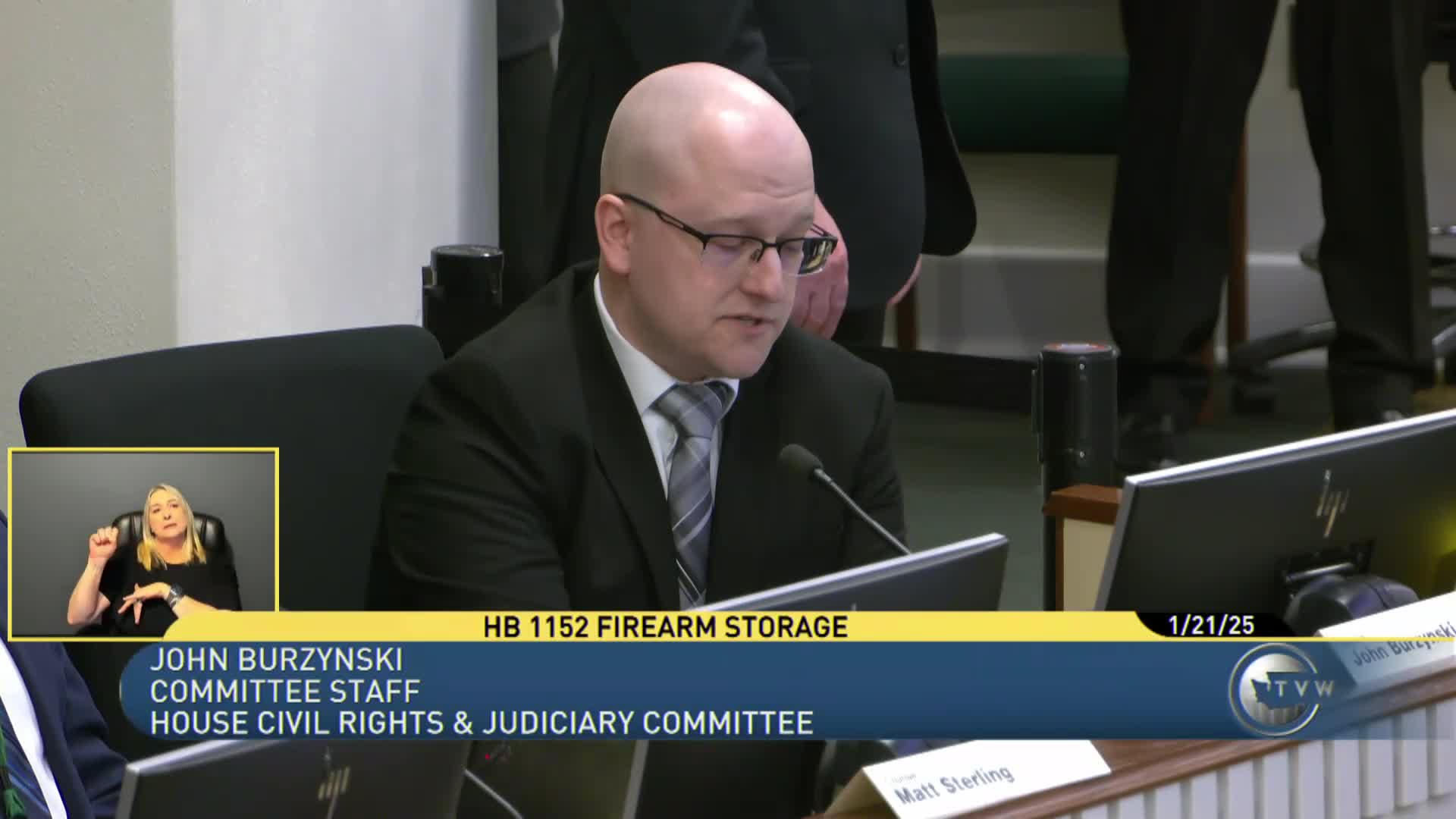
The proposal, presented to the Civil Rights & Judiciary Committee on Jan. 21, 2025, would make unsecured storage a civil infraction subject to a $1,000 penalty and escalate criminal penalties when a prohibited person obtains the firearm: misdemeanor, gross misdemeanor, or class C felony depending on resulting harm. The measure would also expand duties of the Washington Office of Firearm Safety and Violence Prevention to include public education on secure storage.
Supporters described the bill as a public-safety measure that builds on existing law. Representative Beth D'A'Leo, the bill's prime sponsor, told the committee the measure ‘‘builds on that shared value to address a pressing public safety issue, unsecured firearms,’’ and cited statewide data on stolen firearms. Testimony from survivors and prevention groups emphasized child safety and suicide prevention: Sandra Ramirez described the 2024 death of her 13-year-old son after a youth found a loaded gun in an unlocked safe, and public-health and pediatric clinicians cited statistics linking unsecured firearms to unintentional shootings and youth suicide.
Opponents warned the committee the bill could burden lawful self-defense, be difficult or costly to comply with, and improperly shift blame to victims of theft. Speakers including competitive shooters, the National Rifle Association and multiple individual witnesses argued that the storage requirements — especially as applied to vehicles, renters and people who live in vehicles — could leave some people vulnerable or impose inequitable costs. Several witnesses also questioned how the bill would affect incidents such as vehicle thefts or police pursuits.
Committee members asked for clarifications about several technical points in the bill. Representative Graham asked whether a firearm that is locked in a stolen vehicle still implicates the statute’s penalties; the prime sponsor deferred to staff and said she would follow up. Representatives also pressed the sponsor on the statutory exceptions listed in the bill (antique firearms, farm vehicles used on private farmland, persons living in vehicles, peace officers and other categories) and whether the bill should expand exemptions for guard or reserve military members.
The public hearing included a broad range of comment: survivors and safety advocates urged passage as a means to prevent theft, unintentional shootings and youth suicide; multiple witnesses representing gun-owner and shooting-sports organizations urged rejection, citing constitutional concerns, enforcement practicalities and possible impacts on self-defense and training. Staff and the sponsor said they would provide follow-up information to the committee on statutory interactions and clarify some exception language.
The hearing concluded without a committee vote; no formal action on the bill was recorded at the hearing. Committee staff referred members to the bill text and analysis for details and offered to supply clarifications requested by members.
House Bill 1152 now proceeds in the committee process for further consideration.