Get Full Government Meeting Transcripts, Videos, & Alerts Forever!
Get email alerts on the Higher Education Financial Aid topic
No spam. Unsubscribe anytime.
Committee hears testimony on restoring inflation adjustment for Washington College Grant
Summary
At a public hearing for House Bill 1143, sponsors and witnesses argued the bill would restore an annual tuition growth factor for Washington College Grant awards to private independent institutions that meet nondiscrimination requirements; public and private institutions differed on equity and comparative funding impacts.
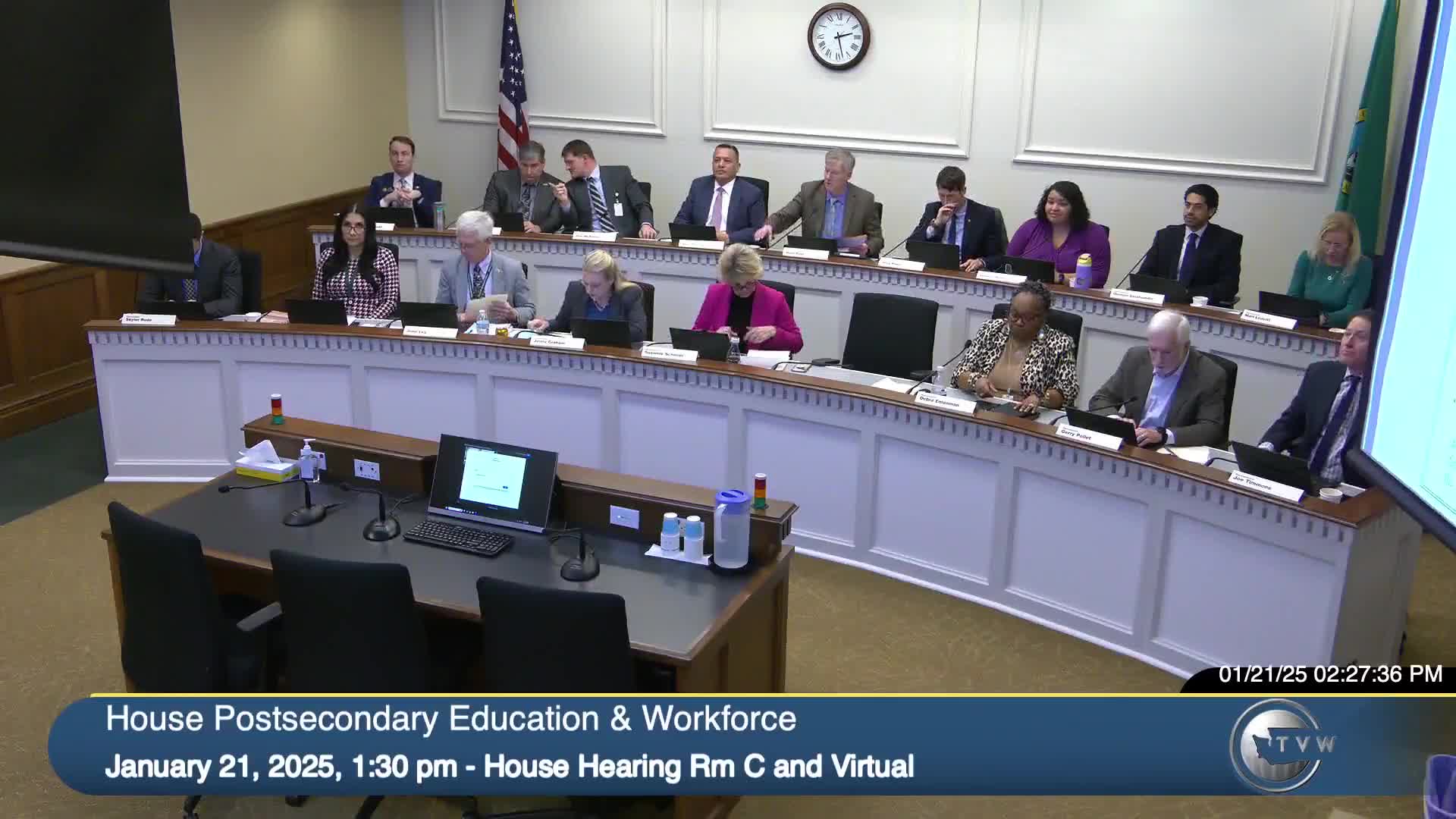
The House Postsecondary Education & Workforce Committee held a public hearing on Jan. 21 for House Bill 1143, which would restore the tuition growth factor (an annual inflation adjustment) to Washington College Grant awards for students at private, nonprofit institutions that sign a nondiscrimination affidavit and are not subject to certain settlements or court orders.
Committee counsel Saranda Ross explained the bill’s mechanics: for public institutions that sign the affidavit and are not subject to a pre-finding settlement or final court order for discriminatory employment practices, the maximum Washington College Grant would equal tuition and fees for 15 quarter credit hours and may increase annually by the tuition growth factor. For private institutions and Western Governors University that sign the affidavit and are not subject to those settlements or orders, the bill would permit annual increases of the statutory award by the tuition growth factor; institutions that do not sign or are subject to an unresolved settlement or order would have their maximum awards fixed at the 2024-25 statutory amounts.
Sponsor Rep. Charlotte Mena (29th District) framed the bill as an equity and access measure for students who choose independent colleges close to home. “This bill is about restoring a little bit that can make a big difference for students like me,” Mena said, describing her experience as a first-generation college graduate and the role of the Washington College Grant in her community.
Testimony in support came from representatives of independent colleges and students. Terri Standish Kewan of Independent Colleges of Washington urged the committee to advance the bill, saying many member-campus students are Pell- and Washington College Grant–eligible and that award levels for some campuses have not changed since 2018. Diego Gonzalez, a Seattle University student, testified he relied on the Washington College Grant and has not seen his award increase while peers at public schools did.
Opponents or those urging caution included faculty and representatives of public universities, who highlighted funding disparities between public and private institutions. Sam Ligon, faculty legislative representative for Eastern Washington University, said the proposal risks widening disparities because public students at many institutions receive grants that are tied to tuition and can cover full tuition and fees, while the fixed award for private institutions covers a smaller share of private tuition. Sandy Kaiser, speaking for Evergreen State College and registering on behalf of Central, Western and Western Washington University, urged the committee to consider ways to provide equivalent support to public students.
Pacific Lutheran University President Alan Belton testified in strong support, saying PLU’s students include a high percentage of Pell-eligible and first-generation students and that the 2019 delinking of private institutions from the tuition growth factor disproportionately affected PLU’s students.
Committee members asked staff for additional information (including a chart comparing award amounts under the bill for private versus public institutions and a review of whether institutions already must certify nondiscrimination to receive federal or state aid). Counsel said she would follow up with requested data. The hearing record showed 12 registered proponents and 7 opponents; five individuals testified in person and one online. No committee vote was taken on HB 1143 during the hearing.