Get Full Government Meeting Transcripts, Videos, & Alerts Forever!
Get email alerts on the Biomarker Testing Coverage topic
No spam. Unsubscribe anytime.
Lawmakers weigh mandatory coverage for biomarker testing; agencies urge caution
Summary
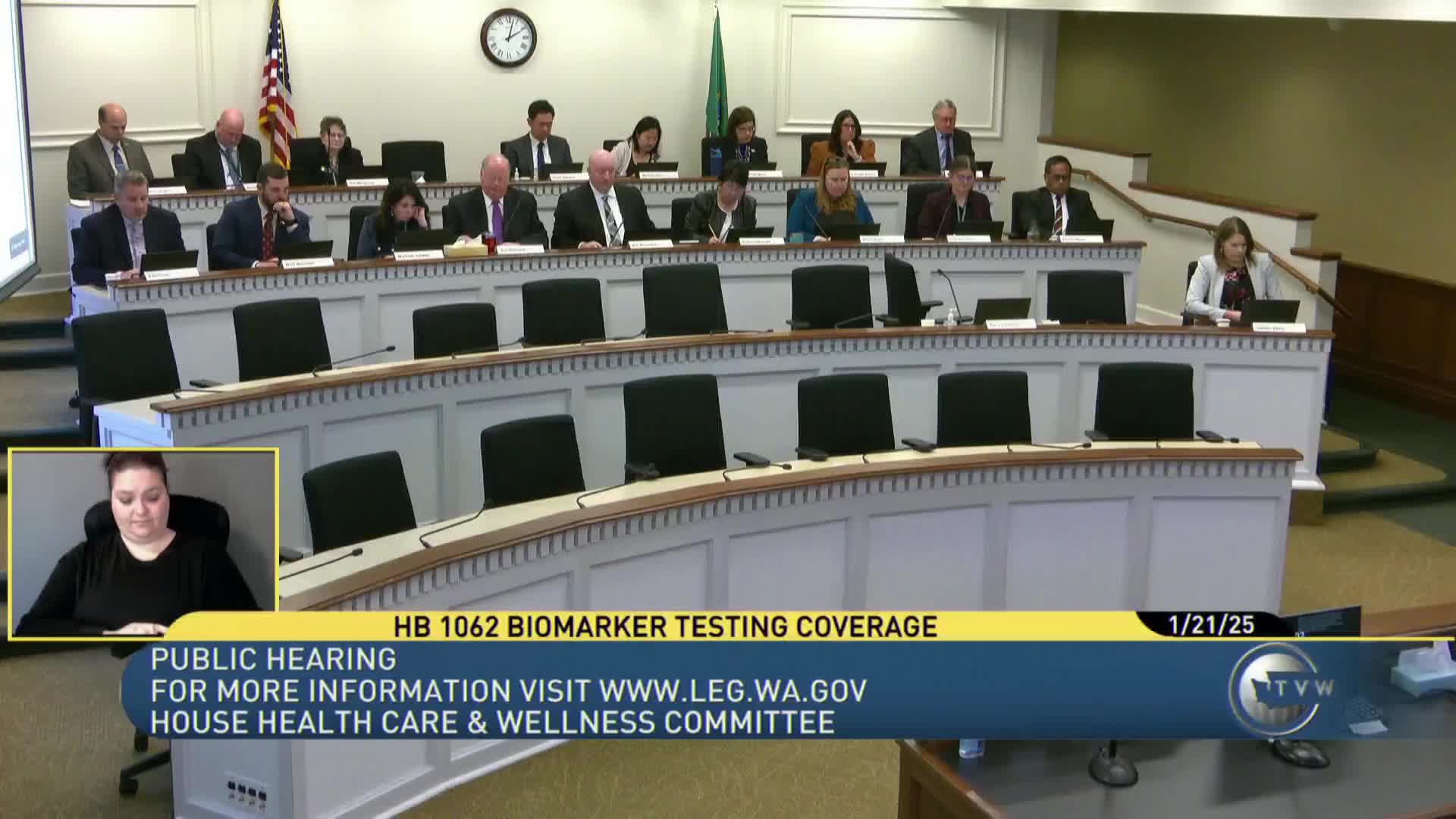
The House Health Care & Wellness Committee held a public hearing Jan. 21 on House Bill 1062, which would require coverage of biomarker testing by state‑regulated health plans, public employee plans and Medicaid when the tests meet medical and scientific criteria.
The House Health Care & Wellness Committee held a public hearing Jan. 21 on House Bill 1062, which would require coverage of biomarker testing by state‑regulated health plans, public employee plans and Medicaid when the tests meet medical and scientific criteria.
Committee staff explained the bill’s scope and a recent mandated benefit review (MBR). "A biomarker is a measurable substance that may indicate a disease, infection, or environmental exposure," said Jim Morishima, staff to the committee, and he noted the Department of Health’s 2024 MBR concluded it could not recommend adopting a broad mandated benefit because of definitional and evidentiary challenges.
Patient advocates, clinicians and industry groups urged the committee to require coverage for tests that guide care. Katie Cole of the Washington State Medical Oncology Society called biomarker testing "standard of care" for many cancers and told the committee coverage delays harm patients: "Delays in access and coverage exacerbate the physical, emotional, and economic burdens of the disease." Brad Forbes of the Alzheimer's Association said biomarker testing can speed dementia diagnosis and treatment access. Life Science Washington and clinical oncologists likewise urged passage to expand precision‑medicine access.
State agencies and insurers urged restraint and edits. Anna Kelsey, a policy analyst with the Department of Health, said the 2024 MBR had concluded biomarker testing is already covered when scientific and medical criteria are met, and that the bill’s current definitions expand coverage to investigational tests: "Investigational tests can lead to medical management decisions based on inaccurate information with the potential for harmful consequences, including misdiagnosis and inappropriate medical treatment." Charissa Fotinos of the Health Care Authority reiterated concerns about laboratory‑developed tests that lack FDA review and post‑market reporting.
Jennifer Ziegler of the Association of Washington Health Care Plans said insurers already cover many biomarker tests when they meet medical necessity criteria, but that the bill’s scope could mandate investigational testing and raise costs. The Office of the Insurance Commissioner also testified that the bill, as currently drafted, could unintentionally encourage use of expensive brand‑name tests when equally effective generics or validated alternatives exist, with possible premium impacts.
Supporters said the bill would reduce delays and disparities in access to tests that enable targeted treatments. The American Cancer Society’s Audrey Miller Garcia and other patient advocates testified biomarker coverage can improve outcomes and reduce long‑term costs by avoiding ineffective treatments.
Committee members and agencies flagged several drafting points: clarifying evidentiary standards for covered tests, preserving appropriate utilization management, and ensuring investigational tests are not unintendedly mandated. Representatives of state agencies and insurers said they are willing to work with the sponsor on narrower language.
No vote was taken; the committee closed public testimony and left the measure for further drafting.