Get Full Government Meeting Transcripts, Videos, & Alerts Forever!
Get email alerts on the Mental Health Literacy And Mtss topic
No spam. Unsubscribe anytime.
State embeds mental‑health literacy in health standards and increases funding for counselors, nurses and MTSS supports
Summary
OSPI told the House Education Committee it has embedded mental‑health literacy in the health learning standards, developed lesson plans and invested in MTSS and prototypical staffing (nurses, counselors, social workers). Lawmakers pressed for measurable outcomes and raised concerns about fitting new requirements into limited school schedules.
OSPI officials told the House Education Committee the state has moved to embed mental‑health literacy into K–12 health learning standards, build lesson plans and expand staffing to support social and emotional learning.
"We purposely did that, was to embed that," Dixie Groenenfelder said of OSPI’s decision to place mental‑health literacy within the health standards, adding that lesson plans were designed to be adaptable so schools could offer materials in health or science classes.
OSPI described several implementation efforts:
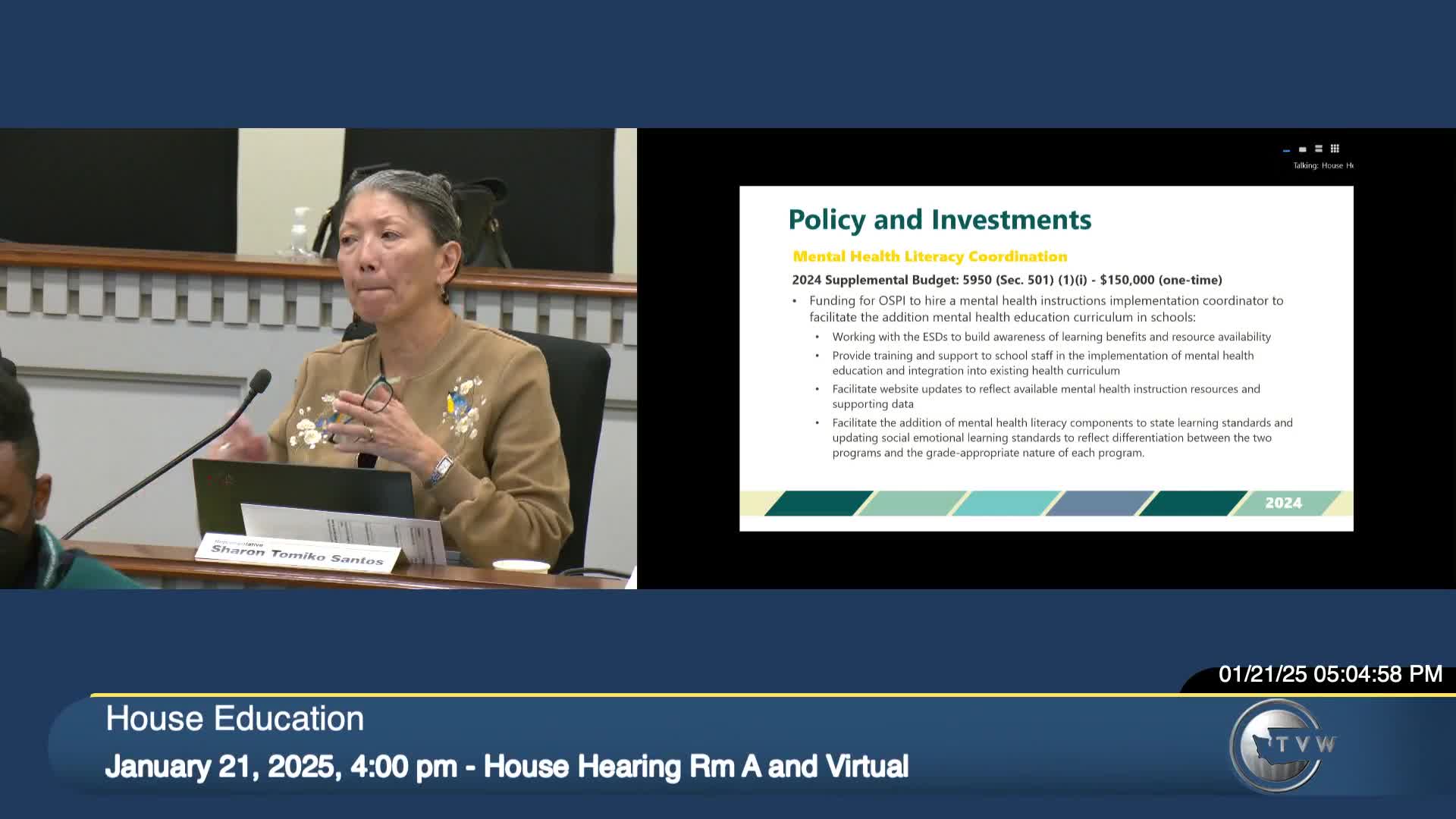
- Mental‑health literacy: OSPI has hired an implementation coordinator on a one‑time basis to facilitate mental‑health education and to build lesson plans aligned to the health standards. Officials said the curriculum is intended to teach students about their mental health, help‑seeking behaviors and basic coping skills.
- Multi‑Tiered Systems of Support (MTSS): The 2021 biennium funded OSPI to support MTSS implementation statewide, including staff professional development, data‑driven leadership supports, teaming processes and use of evidence‑based practices to create a continuum of prevention, intervention and intensive supports.
- Prototypical funding and staffing: House Bill 1664 and related budget decisions increased prototypical school funding to raise minimum allocations for school nurses, social workers, school psychologists and counselors, and additional investments addressed paraeducators and noninstructional staff.
Lawmakers expressed concern about measurable results and the amount of instructional time available to add new content. Representative Keaton and others asked whether social‑emotional investments have demonstrable impacts on academics; OSPI pointed to some Healthy Youth Survey findings and CASEL research as evidence that positive school climate and SEL can affect performance, but officials acknowledged the committee did not receive a full data packet during the session.
Committee members also raised scheduling concerns: OSPI noted that health is typically a one‑semester credit and that embedding mental‑health literacy across standards was intended to let districts integrate content into existing courses rather than add a separate required course.
OSPI recommended developing vertical alignment and teacher supports so SEL and mental‑health instruction continue across grade bands and do not depend solely on isolated classroom lessons.