Get Full Government Meeting Transcripts, Videos, & Alerts Forever!
Get email alerts on the Water Quality Trading topic
No spam. Unsubscribe anytime.
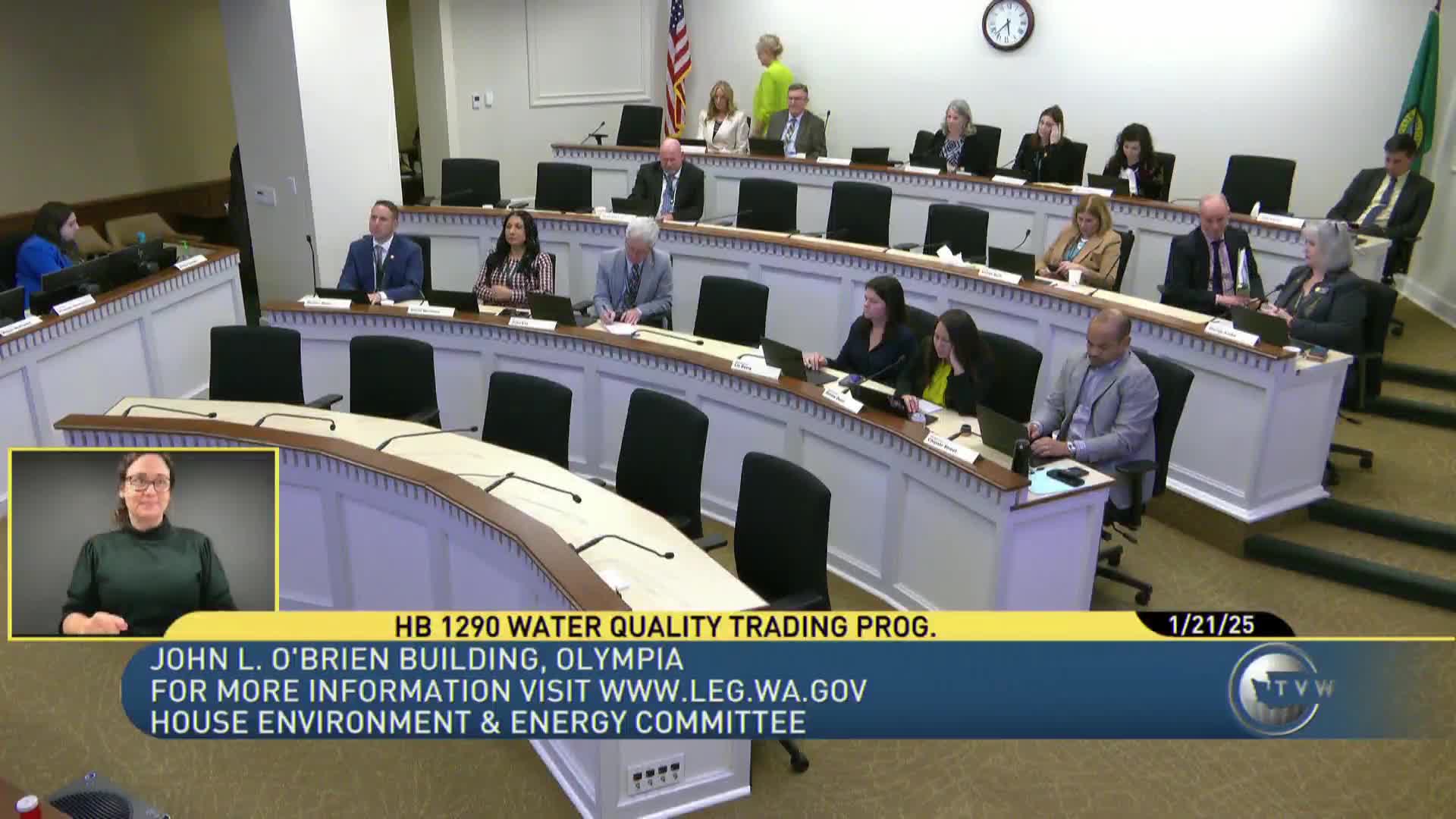
Bill would require Ecology to offer temperature trading option for NPDES permittees; Ecology and Puget Sound Partnership warn of limited market demand
Summary
HB 1290 would require Ecology to offer a water‑quality trading program as a compliance option for NPDES permittees discharging to water bodies with temperature TMDLs.
House Bill 1290 would require the Department of Ecology to offer a water‑quality trading program to NPDES (National Pollutant Discharge Elimination System) permittees that discharge to water bodies subject to a temperature Total Maximum Daily Load (TMDL). The program in the bill would allow permittees not in compliance with temperature limits to use community‑ or market‑based trading to help meet permit requirements.
Matt Sterling, committee staff, reviewed the federal Clean Water Act framework, NPDES permitting and TMDL basics and described the bill’s requirement that Ecology offer a trading option for permittees with temperature TMDLs. Representative Denny Dye (sponsor) said the approach is modeled on projects such as the Tualatin River program in Oregon and described trading as a way to direct funds toward upstream restoration — tree planting, floodplain reconnection and stream shading — that can cool water and improve habitat.
Ecology program manager Vincent McGowan told the committee that a successful trading market depends on sufficient demand from permittees with temperature limits; Ecology staff said relatively few facilities in Washington currently have temperature limits or the kind of permit noncompliance that would create a trading market. McGowan recommended a market‑feasibility analysis before creating a new trading program and noted the agency lacks funding in the governor’s budget to develop and maintain a trading program.
Rob Kribel of the Puget Sound Partnership said the Puget Sound basin contains many warm streams that threaten salmon but that there are few general‑permit point sources in the region with temperature permit limits and no known regional violations that would drive trading demand. Both agency witnesses urged careful, watershed‑specific work before establishing a statewide trading program. No committee vote occurred at the hearing.