Get Full Government Meeting Transcripts, Videos, & Alerts Forever!
Get email alerts on the Esd Behavioral Health Expansion topic
No spam. Unsubscribe anytime.
Regional ESDs expand behavioral‑health services; telehealth and Student Assistance Program pilots show early promise
Summary
OSPI told the House Education Committee funding to ESDs has increased in recent biennia and described pilots — including telehealth in five ESDs and an expanded Student Assistance Program evaluated by the UW SMART Center — that officials said are producing positive results but remain limited in scale.
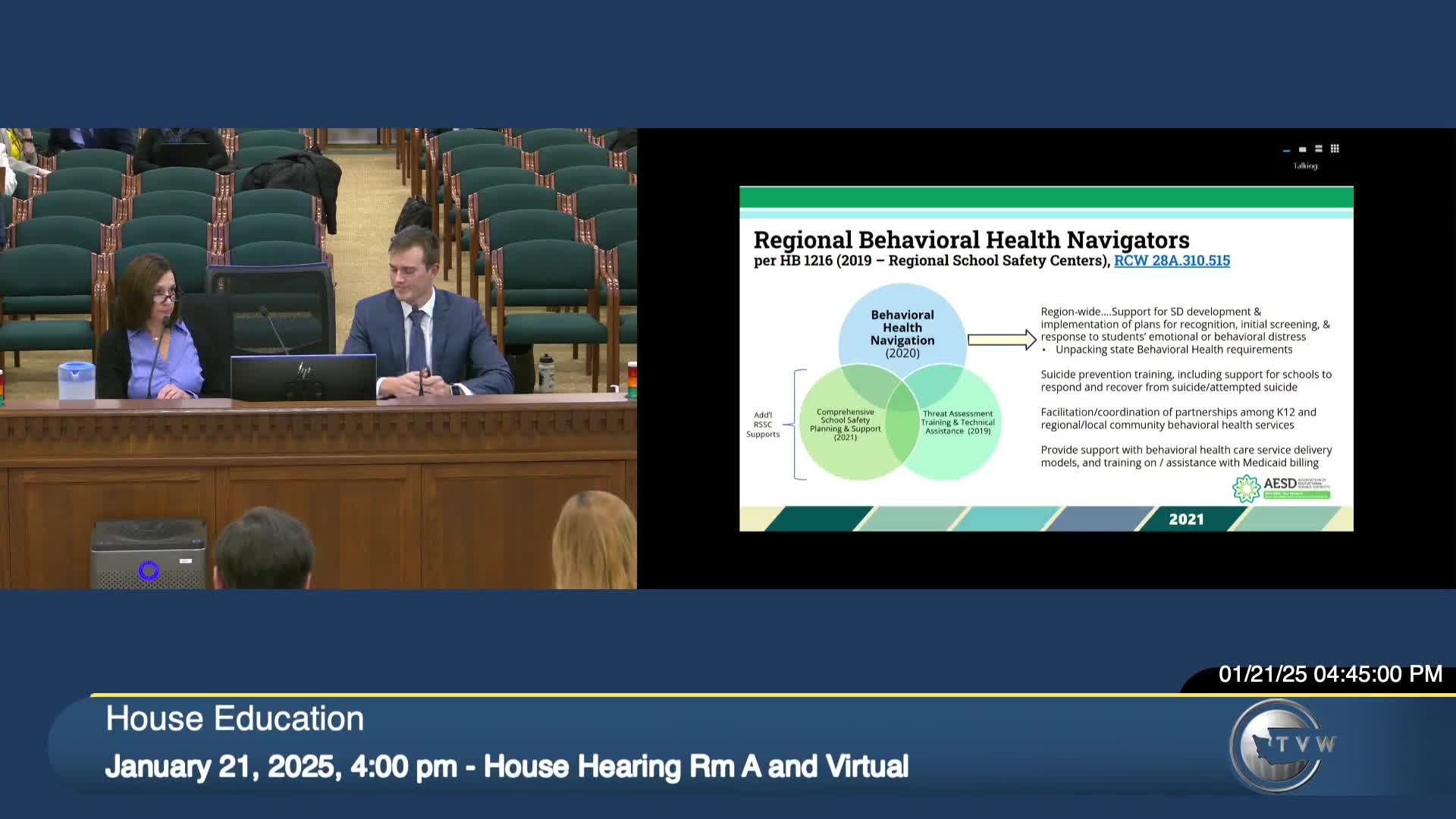
OSPI officials told the House Education Committee that Educational Service Districts (ESDs) have taken on a growing role in delivering or coordinating school‑based behavioral‑health services and that state funding for those regional services has grown substantially.
"We rely on [ESDs] quite heavily," Dixie Groenenfelder, executive director of student engagement and support at OSPI, said. OSPI said funding for ESD behavioral‑health work in recent years rose ‘‘from $17,000,000 to $40,000,000 per biennium’’ in the most recent budget cycles.
Committee members heard specifics about several pilots and programs:
- Telehealth pilot: OSPI said five ESDs are participating in a telehealth pilot that requires a licensed mental‑health provider who can bill Medicaid. Participation and scale vary by region; one ESD is using telehealth in only a few schools while another is offering it broadly. OSPI described telehealth as a component of a broader continuum that can increase access where local providers are scarce.
- Social‑worker associates and in‑school placements: The 2023‑session budget included provisos to fund in‑school placements of social‑worker associates and masters‑level social‑work candidates, plus supervision funding geared toward workforce development.
- Student Assistance Program (SAP): OSPI said state funding expanded SAP — historically focused on substance‑use prevention — to include mental‑health services. OSPI cited an evaluation by the University of Washington SMART Center that officials described as showing “phenomenal outcomes” from initial ESSER and subsequent state funding, though the transcript did not present detailed metrics.
- Community partnerships: OSPI noted contracts and pilots with community organizations, including a provision that funded mental‑health counselors at Boys & Girls Club sites (OSPI referenced nine or eleven club sites during the session) and mentoring supports funded to community‑based organizations.
OSPI officials and lawmakers repeatedly emphasized that telehealth and SAP are most effective when they are part of a coordinated, multi‑tiered system rather than stand‑alone services. The agency said pilots are prioritized for districts lacking local services, especially in rural areas.
OSPI asked the committee to consider sustaining funding for successful pilots and expanding supports that enable ESDs to coordinate regionally rather than rely solely on district‑level capacity.