Get Full Government Meeting Transcripts, Videos, & Alerts Forever!
Get email alerts on the Student Mental Health Policy Review topic
No spam. Unsubscribe anytime.
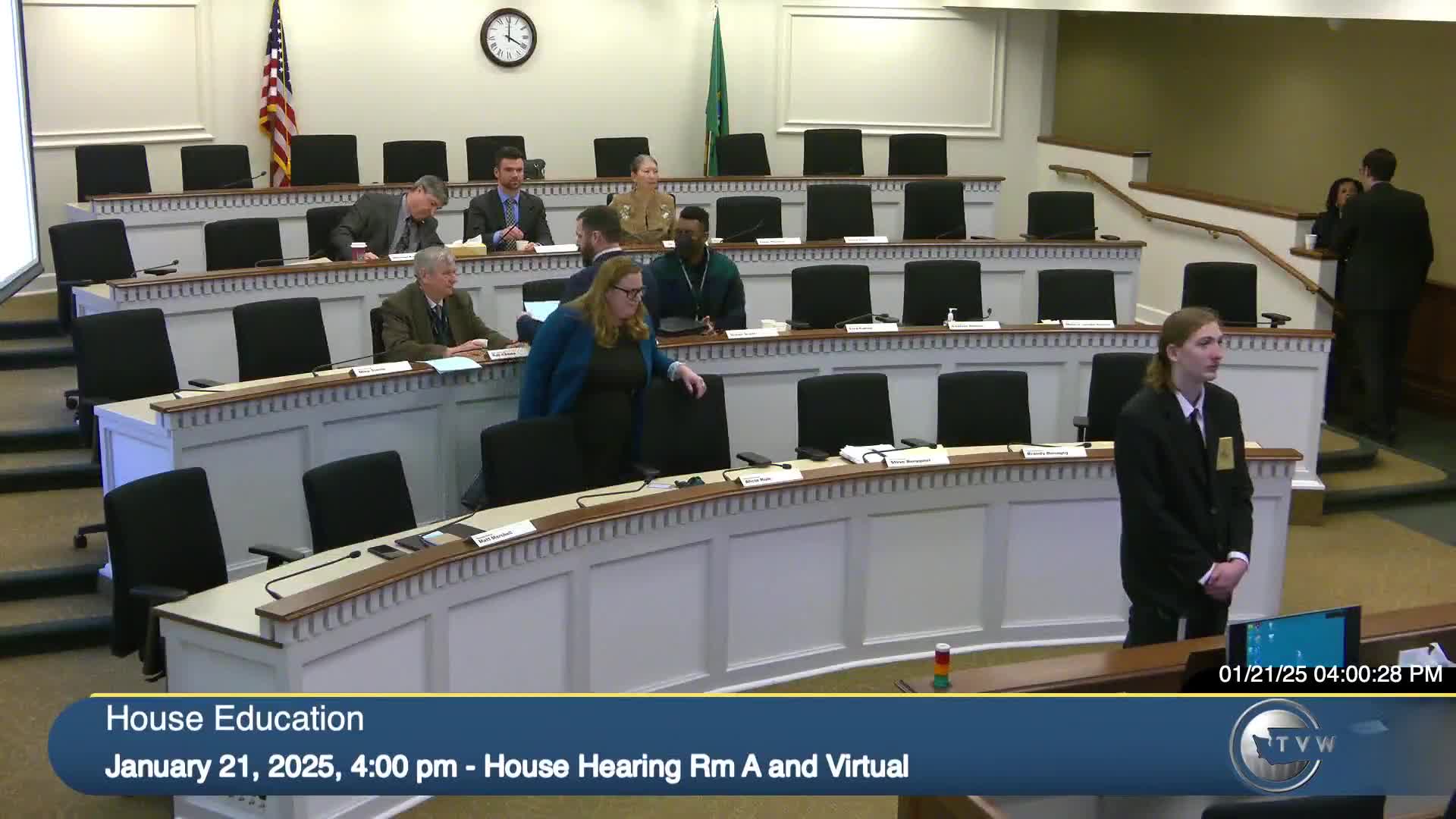
House Education Committee hears 15-year review of student mental‑health policy; auditors find state approach fragmented
Summary
OSPI presented a timeline of laws, funding and programs addressing student mental and behavioral health since 2003 and told the House Education Committee that investments have grown but remain fragmented. A 2021 state auditor performance audit found the system lacked sufficient resources and coordination to meet needs.
The House Education Committee convened a work session where officials from the Office of the Superintendent of Public Instruction (OSPI) outlined about 15 years of legislative action and investments aimed at student mental and behavioral health in Washington state. OSPI senior policy analyst Misha Chernysky and Dixie Groenenfelder, OSPI’s executive director for student engagement and support, delivered the timeline and answered lawmakers’ questions.
OSPI framed the session as a high‑level review of statutes, budget provisos and programs the legislature and state agencies have enacted to address student behavioral and mental health. “The purpose of this is to really provide a high level overview of legislation, investments, and policy actions over the past 10 to 15 years,” Misha Chernysky said for the record.
The presentation traced actions dating back to district bullying‑policy requirements in the early 2000s and highlighted later milestones: House Bill 1336 (2013) on district capacity to recognize and respond to troubled youth; the Washington Integrated Student Supports protocol in Substitute House Bill 1541 (2016); statewide social‑emotional‑learning work beginning about 2015 and codified funding for the SEL committee in 2019; the creation of the Department of Children, Youth, and Families and the Children and Youth Behavioral Health Workgroup; and multiple budget provisos that expanded regional supports through Educational Service Districts (ESDs).
OSPI officials emphasized the Healthy Youth Survey as a long‑running data source for adolescent behavior and mental health; OSPI said the survey became a funded, required statewide effort after Initiative 502 and state RCW changes in 2015. The Joint Legislative Audit and Review Committee (JLARC) and later the state auditor’s 2021 performance audit were also cited: JLARC reported districts faced barriers to accessing mental‑health services (transportation, provider shortages and insurance costs), and the state auditor concluded Washington’s approach to students’ behavioral health was “fragmented and lacked sufficient resources” to meet demand.
Dixie Groenenfelder described schools’ role in prevention: “When I think of school being a primary prevention provider, I think about the social, emotional learning role that they play in helping young people understand who they are,” she said, noting schools offer caring adults and foundational supports that can prevent later crises.
Lawmakers asked whether the many laws and pilot programs have produced measurable results. Representative McIntyre asked for more than “a glimmer” of evidence that investments were improving outcomes. OSPI pointed to some positive Healthy Youth Survey indicators but acknowledged the evidence base is mixed and that programs are often piloted in limited regions or funded for short periods before scaling decisions are made.
OSPI concluded by previewing an immediate implementation item: the Integrated Student Supports protocol will be required for districts’ Learning Assistance Program plans beginning September 2025. The agency said it would provide follow‑up materials, links to surveys and additional data requested by committee members.
With repeated questions from committee members about agency roles and accountability, several lawmakers emphasized that while schools host many services, the primary responsibility for public health lies with health agencies. OSPI and lawmakers agreed coordination among OSPI, the Department of Health, the Healthcare Authority and the Department of Children, Youth, and Families remains a central implementation challenge.
Looking ahead, OSPI urged the committee to consider both sustaining successful pilots and improving cross‑agency coordination to convert one‑time investments into systemic capacity.