Get Full Government Meeting Transcripts, Videos, & Alerts Forever!
Get email alerts on the Budget 25 26 topic
No spam. Unsubscribe anytime.
Avon Grove presents preliminary 2025–26 budget: $121.5M plan, 3% tax increase proposed; fund balance projected to fall
Summary
District finance staff presented a preliminary $121,493,482 budget with a proposed 3% tax increase, an $8 million planned use of fund balance, and projected decline in reserves as large capital projects loom.
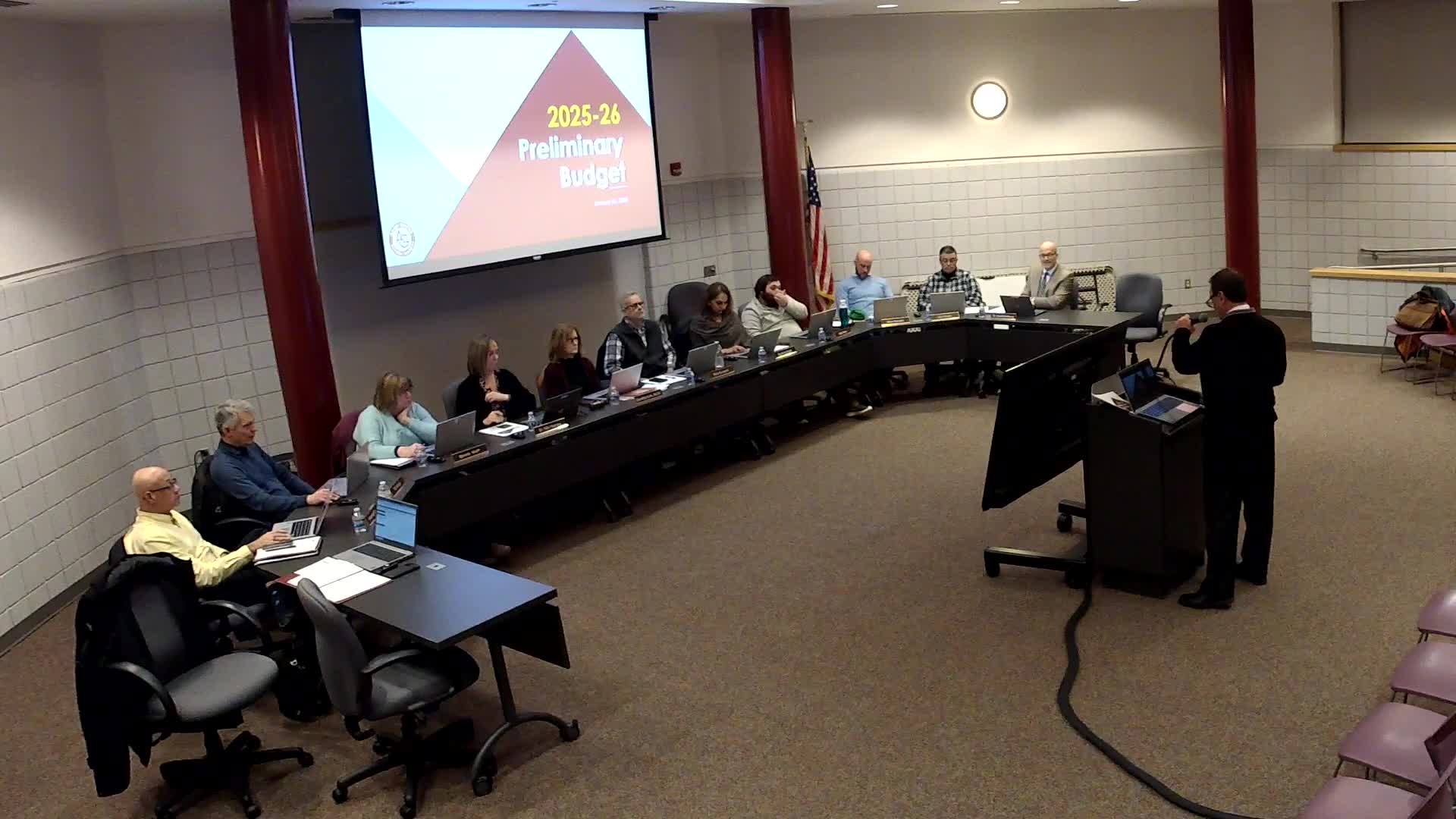
Avon Grove School District presented a first look at its 2025–26 preliminary budget on Jan. 14, showing a proposed total budget of $121,493,482, projected revenues of roughly $113 million, a planned use of about $8 million of fund balance, and a recommended preliminary tax increase of 3 percent.
Dan (finance staff) reviewed fiscal years and variances from 2023–24 and explained drivers for the district’s current projection. He said 2023–24 revenues came in higher than budget due in part to recognition of previously deferred property tax revenue tied to a court decision affecting a hospital tax protest; a repricing of interest earnings; and stronger state education funding. “We recognize we are able to recognize in the past financial, in 23, 24, $1,600,000 of revenue that had been deferred,” Dan said, describing a Supreme Court of Pennsylvania decision that allowed the district to recognize disputed revenue from Generalsville Hospital.
Why it matters: The preliminary budget projects a decline in the district’s general‑fund balance from recent highs as the district uses reserves to cover operating needs and planned capital transfers. Board members and staff emphasized the importance of setting a target fund balance and highlighted several major cost drivers — personnel costs, health‑care premium increases, transportation costs and upcoming capital projects (roofs, HVAC, safety/security upgrades).
Key figures presented in the meeting included: - Proposed total budget: $121,493,482 - Estimated total revenues: approximately $113,000,000 - Planned use of fund balance: $8,000,000 (including transfers to capital and use of unassigned balance) - Preliminary proposed tax increase: 3% (millage estimated to reach 36.1 mills under that proposal) - Projected general‑fund balance after budget: roughly $21,000,000 (staff recommended maintaining $21M–$25M, with $25M preferable)
Dan and Eric (finance staff) detailed revenue and expenditure drivers: a positive variance in 2023–24 real‑estate tax revenue tied to a court resolution of a hospital protest; higher than budgeted interest earnings in 2023–24; a projected $3.1 million increase in state revenue for 2024–25 driven by basic education and special education increases and Ready to Learn/Adequacy supplement funds; higher special‑education outsourcing costs and substitute costs; custodial and facility supply increases tied to additional square footage; and charter tuition trending slightly lower than budget due to enrollment changes.
Board members asked clarifying questions. Rick asked whether the Ready to Learn Block Grant is hold‑harmless; staff said the funding is currently written into law as part of adequacy and equity and should remain. Scott and Nikki emphasized the fund‑balance trend and recommended the board set a formal target range; Scott suggested a $25M–$30M target range.
Dan said inflationary and contractual pressures will be significant in 2025–26: personnel and benefits accounted for the largest single increase (approximately $3.8 million of the identified $6.0–$6.3 million major cost drivers), projected health‑care premium increases (consultant projection ~13.1%), property‑casualty and workers‑comp pressures, utility increases and continuing charter‑tuition pressures. Dan noted that some major impacts and requests from principals and directors had not yet been incorporated into the preliminary numbers and will be considered in coming budget updates.
The finance team walked the board through alternative millage scenarios: at 0% tax increase the district would use more fund balance (projected use $10M); at the proposed 3% the fund‑balance use falls to about $8M; at the full adjusted index (about 5.3%) fund‑balance use would be smaller (projected $6.5M). Dan recommended the board avoid depleting unassigned fund balance below a conservative threshold and cautioned against using unassigned reserves beyond recommended levels because of past late state budgets and borrowing risks.
No formal budget vote was taken; this was an informational presentation. Staff said the budget calendar will continue with a revenue review in February, program/expenditure reviews with principals and directors in March and April, capital‑budget reviews in April, and final board approval scheduled for June.
Ending: Board members thanked finance staff for the overview and urged continued work to refine personnel assumptions, health‑care driver scenarios, and capital‑project cost estimates ahead of next budget presentations.