Get Full Government Meeting Transcripts, Videos, & Alerts Forever!
Get email alerts on the Board Governance topic
No spam. Unsubscribe anytime.
Pittsburgh school board policy committee reviews broad governance changes including 10-day document rule and consent agenda
Summary
At a Jan. 6, 2025 policy workshop, the Pittsburgh Public Schools Policy Committee reviewed proposed revisions to its 0-series governance policies that would set a four-year review cadence, require earlier distribution of meeting materials, allow consent agendas, and replace standing administrative committees with time-bound ad hoc committees.
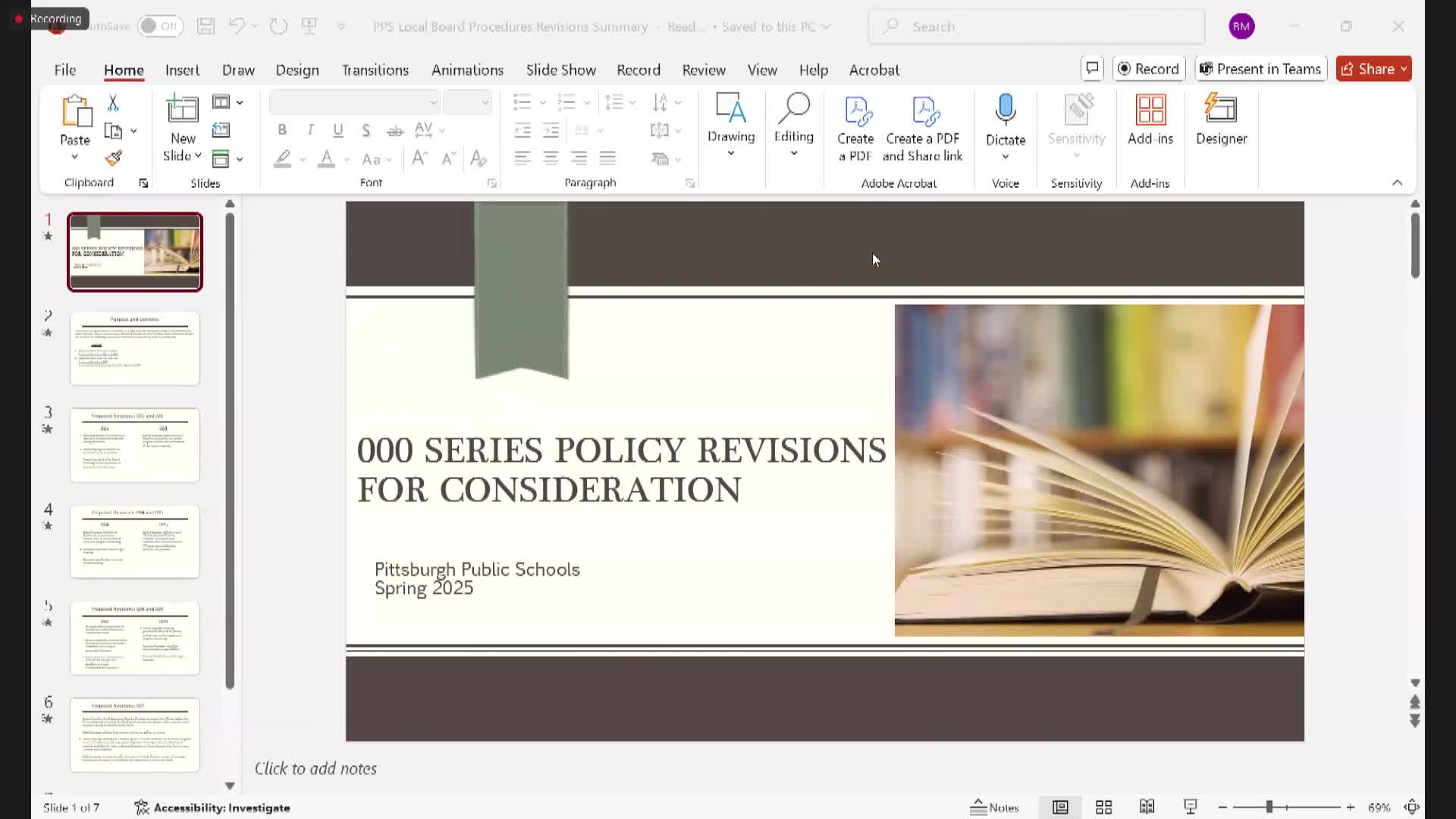
Jamie Petrovsky, chair of the Pittsburgh Public Schools Policy Committee, opened the policy workshop on Jan. 6, 2025, and introduced a presentation by Ben Mackey of the Council of Great City Schools on proposed revisions to the district’s 0-series board governance policies.
The draft package would: establish a minimum four-year cycle for reviewing district policies; require documents related to agenda items to be shared with board members 10 days before an initial meeting; create a 4-day window for directors to submit written questions to administration; publish administration responses before the public meeting; permit a consent agenda at legislative meetings; strengthen conflict-of-interest language to address campaign contributions and other receipts; and remove a standing-committee requirement for administrative work in favor of ad hoc committees with specific charges and deadlines.
"It's not enough to just have priorities. We must publicly monitor them so that our community also sees our progress towards them and what we're doing about it," Ben Mackey said, describing new language that would require regular progress monitoring of board priorities.
Board members asked for clarification on several points. Director Silk asked Mackey to distinguish "administrative work" from "board work." Mackey explained that administrative work — such as day-to-day operations, staffing, and tactical implementation — is the responsibility of the superintendent and district administration, while the board's role is setting strategic direction, values and monitoring progress. He said the proposed change would remove a policy requirement that the district maintain standing subcommittees strictly for administrative review, while still allowing the board to create ad hoc committees when needed.
Several directors said they supported the proposed timeline changes to give directors and administration more time to prepare and respond. Under the proposal, documents would be finalized and distributed 10 days prior to the first meeting in a monthly cycle; directors would submit questions up to 4 days before the agenda-review meeting; and administration would publish answers to those questions as attachments to the agenda before the legislative meeting. The scheme is presented as a sample monthly cadence that the board could adopt or modify.
The proposed consent-agenda approach would allow multiple routine items to be adopted as a single action at the legislative meeting while preserving each director's ability to pull an item for separate discussion or vote. Mackey said the intent is to focus discussion time on items that at least three directors flag for deeper conversation.
Directors also discussed strengthening conflict-of-interest rules. The draft would require recusal when directors receive campaign contributions, gifts or other receipts from people or entities with business before the board.
Petrovsky and other committee members said the draft reflects input from board directors and district staff and that the policy committee will continue revising the language. Petrovsky noted the redline and clean policy documents would be posted to the board website and expected to be available no later than the end of the week following the workshop.
No formal motions or votes took place during the workshop. Committee members agreed to continue refining the language in pre-committee meetings and bring revised drafts to the full board for consideration.
The committee asked staff to improve public access to draft policy documents on the board website, and members said they will circulate comments to the policy subcommittee during the drafting period. Chair Petrovsky said a full public comment period would follow any formally published draft and that the board could schedule adoption after the required comment window.