Get Full Government Meeting Transcripts, Videos, & Alerts Forever!
Get email alerts on the Judiciary Budget topic
No spam. Unsubscribe anytime.
Minnesota judicial branch seeks funding to address staff pay, digital access and rising mandated costs
Summary
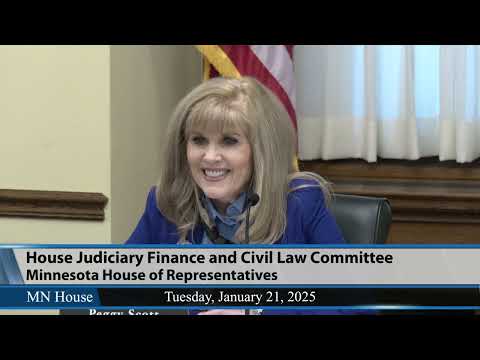
State court administrator Jeff Schorba told the House Judiciary Finance and Civil Law Committee the judicial branch’s 2026–27 budget request seeks targeted increases for pay, digital accessibility work, justice‑partner data access and costs driven by rising demand for interpreters and forensic exams.
Jeff Schorba, Minnesota’s state court administrator, told the House Judiciary Finance and Civil Law Committee on the morning of the hearing that the judicial branch is seeking increased legislative funding to meet rising costs and maintain timely access to justice.
The branch’s biennial request for fiscal 2026–27 includes proposals for compensation increases, a digital accessibility remediation project to comply with new federal rules, a modernized justice‑partner access system, higher pay for contract forensic examiners, and an increase in juror per diem.
Schorba said the judiciary’s mission is “to provide justice through a system that assures equal access for the fair and timely resolution of cases and controversies,” and he cited the constitutional guarantee that “every person is entitled to access justice freely, promptly, and without delay.” He told the committee the branch is funded almost entirely by legislative appropriation and reminded members that court fines and fees are deposited into the state general fund rather than retained by the courts.
Key figures Schorba cited from the presentation: - Current fiscal year 2025 budget: approximately $479,000,000 (about 1% of the state budget). - Judges and staff: “322 judges” and roughly the staff figure reported in the presentation (transcript phrasing: “roughly 28,100 court staff”). - Salary and personnel requests: $77,300,000 for FY 2026–27 and $104,000,000 for FY 2028–29 to support judicial salary increases and related costs (Schorba said the requested pay increase is roughly 6%, based on a market study). - Digital accessibility: $5,100,000 in FY 2026–27 and $1,760,000 in FY 2028–29 (one‑time and ongoing portions) to remediate web and case documents and meet new Department of Justice digital accessibility requirements that Schorba said must be met by April 24, 2026. - Justice partner access: $4,000,000 in FY 2026–27 and $800,000 in FY 2028–29 to implement a modernized access system for justice partners. - Forensic examiners: $7,200,000 in FY 2026–27 to raise contract examiner pay from $136 per hour to $175 per hour, Schorba said, to address a shortage and delays in evaluations. - Juror compensation: $18,000,000 in FY 2026–27 to increase juror per diem from $20 to $100 per day and to align mileage with federal rates, Schorba said.
Schorba highlighted operational accomplishments tied to prior appropriations, including reductions of the pandemic backlog for felony and gross‑misdemeanor cases to pre‑pandemic levels, technology upgrades such as a digital exhibit system and remote hearing tools, and statewide policy work culminating in a new district court hearing framework set to take effect Feb. 3 (Schorba said the framework reflects three years of work and will be evaluated through the year). He said last session’s appropriations included roughly $86,000,000 in ongoing funding and about $52,000,000 in one‑time funding that helped raise interpreter and examiner pay and support cybersecurity and other programs.
Committee members asked questions about funding for treatment courts, bargaining and negotiations with unions, availability of mental‑health evaluators and treatment beds, qualifications for forensic examiners, and cybersecurity risks. Schorba told members the judicial branch conducts its own labor negotiations, that examiners must generally be licensed psychiatrists or psychologists “set by statute,” and that the branch has launched a mental‑health advisory group to explore broader system responses. On cybersecurity, Schorba said the branch has strengthened defenses after earlier incidents and offered to brief members and staff in a nonpublic setting on technical details.
Members asked for trend data on mandated services and interpreter events; Schorba said the branch collects extensive data and offered to present trend analyses and invite members to the mental‑health advisory group meetings, which he said are public.
The presentation left committee members with follow‑up requests for written breakdowns: specific per‑court or per‑treatment‑court funding, historic trends on mandated services, and more detail about failure‑to‑appear and remote‑hearing metrics.
The branch emphasized that many of the rising costs are statutorily required under Minnesota law and flagged continuing implementation costs for cybersecurity and digital accessibility as one‑time funding ends.